
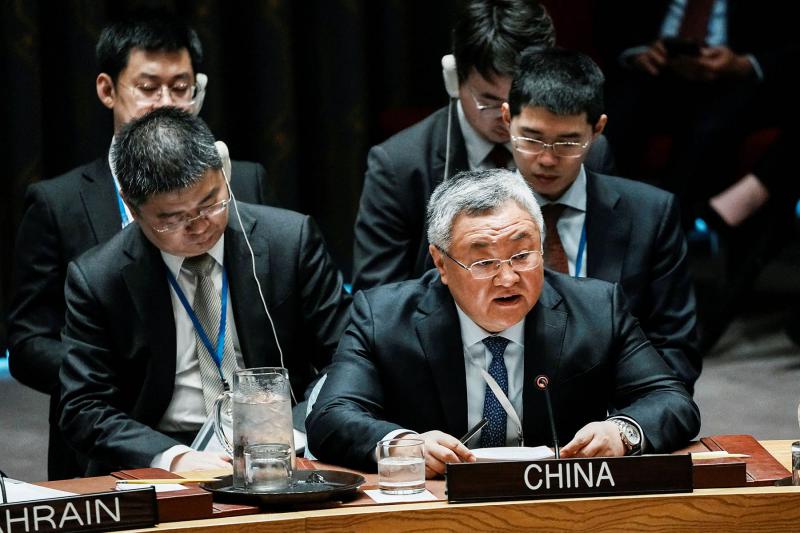
The UN Security Council was set to vote Tuesday on a resolution to protect commercial shipping in the Strait of Hormuz, but in a form so diluted from its original draft that it no longer authorises force — a retreat forced by Chinese opposition that illustrates how completely the geopolitics of the Iran war have paralysed the body theoretically responsible for managing exactly this kind of crisis.
Bahrain, the current Security Council chair, has been driving the resolution through multiple drafts over the past week, each successive version stripped of provisions that China, Russia or both found objectionable. The original draft circulated last Thursday would have authorised “all defensive means necessary” to protect commercial shipping. Votes scheduled for Friday and Saturday were postponed. The latest iteration, seen by Reuters, abandons any explicit authorisation of force entirely.
What remains is language that “strongly encourages” states to coordinate “defensive” efforts “commensurate to the circumstances” to ensure navigation safety through the strait. The text says such contributions could include the escort of merchant and commercial vessels, and endorses efforts to deter attempts to close, obstruct or interfere with international navigation. The difference between authorising force and encouraging coordination is not semantic — it is the difference between a resolution with legal teeth and a statement of collective aspiration.
Read also: Trump Threatens ‘Hell’ If Iran Blocks Strait, Eyes Deal
China’s position has been consistent throughout the drafting process. Last Thursday, Beijing opposed any force authorisation, saying it would amount to “legitimising the unlawful and indiscriminate use of force” and would inevitably escalate the situation. Chinese Foreign Minister Wang Yi reinforced Beijing’s broader posture Sunday, saying after speaking with his Russian counterpart that the fundamental solution to the Hormuz problem was an immediate ceasefire — and that China was willing to cooperate with Russia at the Security Council to calm the Middle East situation. The formulation places China and Russia on the same side of a diplomatic ledger that separates them from Bahrain, the Gulf Arab states and Washington.
The economics of China’s position are not incidental. China is the world’s largest buyer of oil that moves through the Strait of Hormuz. Every week the waterway remains effectively closed is a week Beijing absorbs the cost of disrupted energy supply and elevated prices. That China has nonetheless resisted any resolution that could provide legal cover for Western military operations in the strait reflects a calculation that the precedent of authorised force is more costly to Chinese interests than the disruption itself.
Read more: Planet Labs Announces Blackout On Iran War Satellite Footage
Diplomats said the watered-down version had a better chance of passing than its predecessors, though its fate remained uncertain. A resolution requires at least nine affirmative votes and no vetoes from the five permanent members — the United States, Britain, France, China and Russia. Whether China would abstain or veto the revised text, and whether enough of the council’s ten elected members would vote yes, was not resolved as of Monday evening.
The diplomatic maneuvering at the Security Council unfolded against a backdrop of sharp statements from both Iran and the United States. Iran said Monday it wanted a lasting end to the war but pushed back against pressure to reopen the strait unconditionally, maintaining its position that reparations and a new legal regime governing passage are prerequisites for any normalisation. Trump, meanwhile, warned Iran could be “taken out” if it failed to meet his Tuesday night deadline to reach a deal — his latest in a series of deadlines that have passed with extensions rather than strikes, though the administration has maintained that Tuesday’s was firm.
Five weeks into a war that has cut global oil flows by roughly a fifth, pushed crude prices up 50 percent, triggered the largest emergency release of strategic reserves in international energy history, and sent diplomatic missions scrambling from Islamabad to Paris to New York, the Security Council is preparing to pass a resolution encouraging countries to escort tankers. The gap between the crisis and the institutional response to it tells its own story about how far the multilateral architecture built after the Second World War has drifted from the conflicts it was designed to manage.