
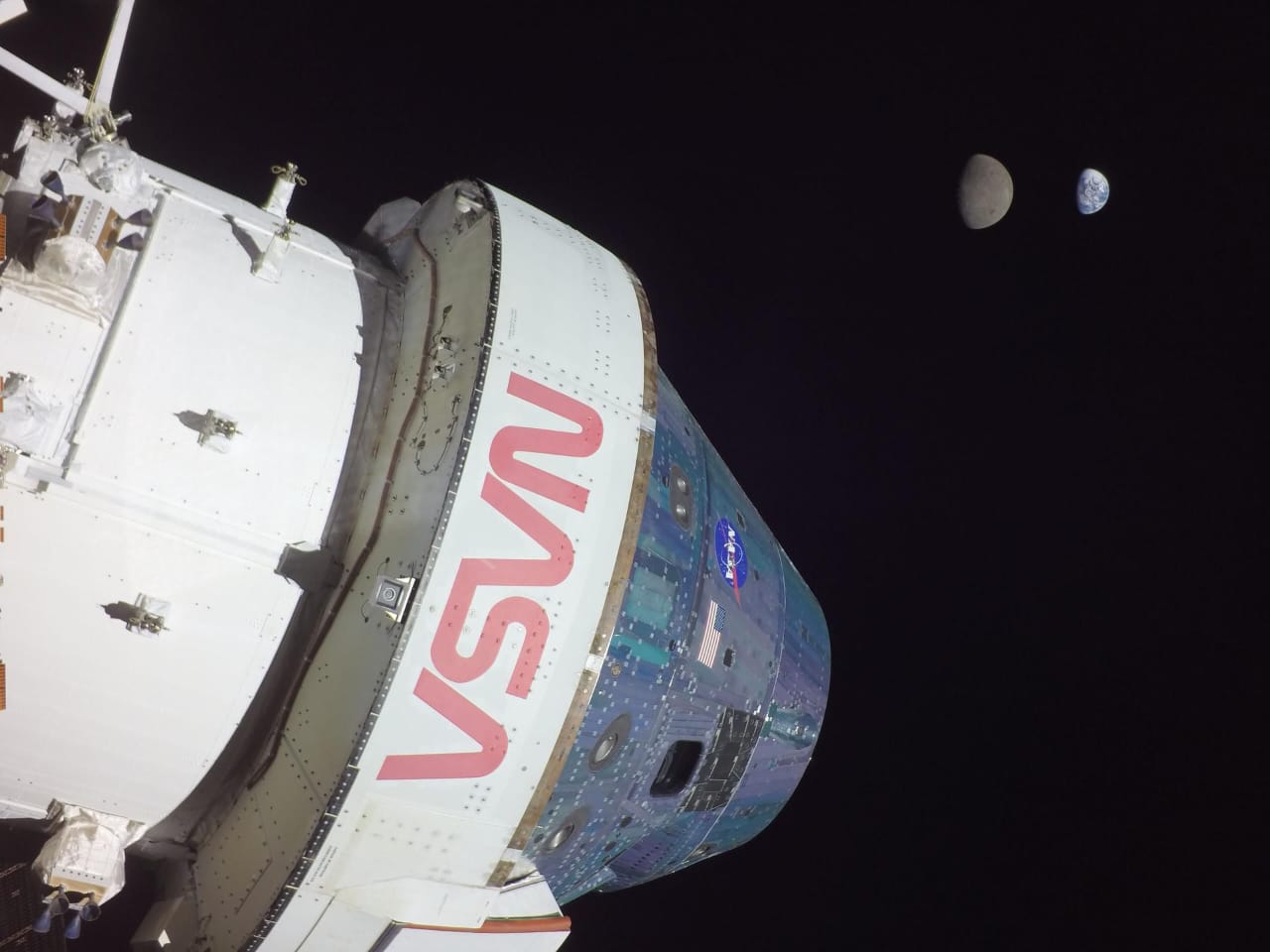
Four astronauts are riding back toward Earth aboard NASA’s Orion capsule after travelling further from their planet than any human beings in history, preparing to plunge through the atmosphere at nearly 40,000 kilometres per hour in what mission pilot Victor Glover described simply as “a fireball” — an ending, he said, that is “deeply special.”
The Artemis II crew — Glover, mission commander Reid Wiseman, NASA astronaut Christina Koch, and Canadian Space Agency astronaut Jeremy Hansen — held their first press conference from space Wednesday as they made their way home from the far side of the Moon. They are scheduled to splash down in the Pacific Ocean off the coast of San Diego on Friday night, around 1 a.m. Central European Time, completing a mission of nearly ten days that rewrote the record books before it was finished.
On Monday, the crew reached a distance of approximately 405,000 kilometres from Earth — surpassing by roughly 6,500 kilometres the previous record held by the Apollo 13 crew, a mark that had stood for 56 years. The trajectory carried them past the far side of the Moon, a region that no human eyes had observed directly from such proximity, and turned their six-hour lunar flyby into a continuous stream of real-time scientific observation transmitted to dozens of researchers housed in rooms adjacent to NASA’s mission control in Houston.
Re-entry remains the mission’s final high-stakes test. The Orion capsule will hit Earth’s atmosphere at speeds of up to 38,365 kilometres per hour, generating heat and friction intense enough to put its heat shield under stresses that ground tests can simulate but space alone can prove. Glover said he had been thinking about the return journey since the mission was first assigned to him on April 3, 2023. “There are so many more photos, so many stories, and I haven’t even begun to process everything we’ve been through,” he said. “We still have two days to go.”
Read also: Artemis II Moon Rocket Soars After Flawless NASA Launch
Koch framed the mission in terms of what comes after it rather than what it contains. She told reporters the crew had purchased physical batons to symbolise the handoff to future Artemis crews. “We plan to hand them over to the next crew, and everything we do we do with them in mind,” she said. Artemis III will test docking procedures between the Orion capsule and the lunar landing vehicles NASA intends to use for surface missions. Artemis IV, currently planned for 2028, would be the first human landing on the Moon since Apollo 17 in December 1972.
Read more: Artemis II Crew Sets New Record For Deepest Space Journey
Wiseman also described what it meant to hear crewmates speaking with their families from deep space — each crew member had two brief conversations with loved ones during the mission. “Hearing your crew members giggling and crying, sighing, listening and loving their families from afar,” he said. “Family is very important to all four of us and that was incredible.”
The Artemis programme sits at the intersection of science, geopolitics and the long human ambition to return to the Moon. NASA has framed it explicitly as a race against China, with the goal of landing American astronauts on the lunar surface before Beijing achieves the same milestone, and establishing a sustained presence that could eventually support missions to Mars. Artemis II is the programme’s first crewed flight — the proof that humans can safely travel to the Moon and back aboard the systems NASA has spent years and billions of dollars building.
The science returns are already accumulating. The Moon, Koch said before launch, is a “record book” of the solar system’s formation — a body whose surface preserves evidence of conditions that Earth’s own geology has long since erased. Six hours of direct human observation during the flyby produced a volume and quality of real-time data that lunar orbiting satellites and Earth-based observation cannot replicate.
Friday night’s splashdown will end the mission. The batons, metaphorical and physical, pass to the next crew. The fireball comes first.