
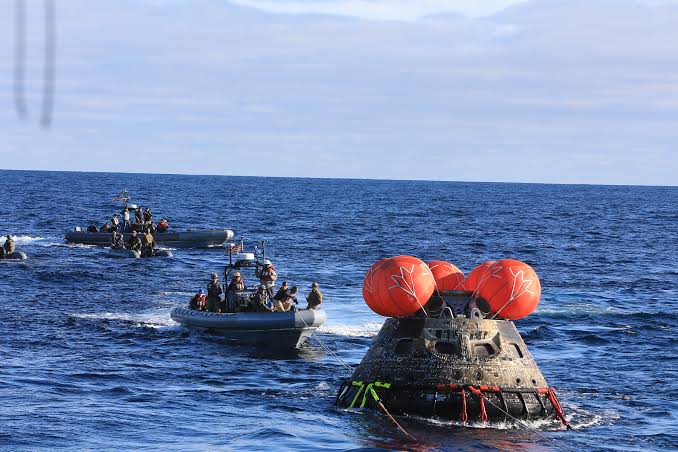
Four astronauts splashed down safely in the Pacific Ocean on Friday, completing the first crewed mission to travel around the Moon in more than half a century and returning to Earth with data that will determine whether humanity’s return to the lunar surface remains on schedule.
The Orion spacecraft hit the water off the coast of California at 5:07 p.m. local time, ending a ten-day journey that took NASA astronauts Reid Wiseman, Victor Glover and Christina Koch, along with Canadian astronaut Jeremy Hansen, further from Earth than any human beings since the Apollo era. Recovery teams were already positioned when the capsule arrived, moving quickly to secure it and bring the crew aboard a US Navy recovery ship.
The return was not without drama. Re-entry lasted 13 minutes and subjected the Orion capsule to temperatures of approximately 2,760 degrees Celsius on its exterior — hot enough to generate a plasma layer around the spacecraft that briefly severed all communication with the crew. Contact was restored as parachutes deployed, slowing the descent before splashdown. The astronauts reported minor communication issues but were otherwise in good condition when the hatch was opened.
Minutes before re-entry, Wiseman radioed mission control with characteristic understatement: “We got a great view of the Moon out window 2 — looks a little smaller than yesterday.” Houston’s reply was equally dry: “Guess we’ll have to go back.”
The capsule’s performance through re-entry was among the mission’s most critical tests. Engineers will now analyse the heat shield’s behaviour under actual lunar return conditions — data that no amount of ground simulation can fully replicate — alongside navigation systems and life-support technology that future crews will depend on for missions that go deeper and stay longer.
Read also: Astronauts Ready For Fiery Earth Return From Artemis II Mission
NASA chief Jared Isaacman, speaking from the recovery ship, framed the significance plainly. “We are back in the business of sending astronauts to the Moon, bringing them back safely, and set up for a series more,” he said.
The mission carried several historic firsts alongside its primary engineering objectives. Glover became the first person of colour to travel around the Moon. Koch became the first woman to do so. Hansen became the first non-American. All four travelled farther from Earth than any humans since the Apollo 13 crew set a distance record in 1970 — a mark the Artemis II crew surpassed by approximately 6,500 kilometres when they reached their maximum distance of around 405,000 kilometres on Monday.
During the journey the crew reported observations of lunar surface features in real-time, witnessed a solar eclipse and watched meteorite impacts — direct human observations of phenomena that orbital satellites and Earth-based instruments can only partially capture. Dozens of scientists were housed in rooms adjacent to NASA’s mission control in Houston throughout the mission, recording the crew’s continuous stream of observations from deep space.
Read more: Artemis II Crew Sets New Record For Deepest Space Journey
The mission also carried a private moment that became public in the most affecting way. During the crew’s closest approach to the lunar surface, Canadian astronaut Hansen broke down in tears as he proposed to mission control that a newly identified crater be named Carroll, after mission commander Wiseman’s late wife, who died of cancer in 2020. The suggestion had originated with the crew during pre-launch quarantine. Many NASA employees in Houston wept as Hansen delivered it.
Wiseman reflected on what the mission meant beyond its technical achievements. “What we really hoped in our soul is that we could, for just a moment, have the world pause — and remember that this is a beautiful planet in a very special place in our universe,” he said. “We should all cherish what we have been gifted.”
On Friday morning, the crew awoke to two songs beamed up from mission control — Live’s Run to the Water and Zac Brown Band’s Free. Hours later they were in the ocean.
Artemis II serves as the foundation for Artemis IV, currently planned for 2028, which aims to land astronauts on the lunar surface for the first time since Apollo 17 in December 1972. The next mission, Artemis III, will test docking procedures between the Orion capsule and the lunar landing vehicles that will carry crews to the surface in later missions. Koch described the relay race quality of what the programme is building, noting that the crew had purchased physical batons to hand to the next crew as a symbol of continuity.
The baton has been passed. The Moon, for the first time in 53 years, has had human eyes looking back at it from close range. The engineers now have what they needed. The next crew is watching.