
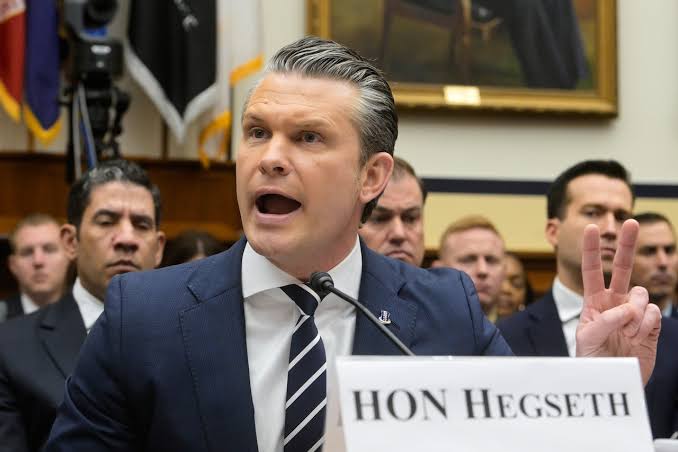
Pete Hegseth sat before the House Armed Services Committee on Wednesday and spent several hours insisting the Iran war is not a quagmire while simultaneously invoking Vietnam, Iraq and Afghanistan as models of American endurance — apparently without registering the contradiction.
The defence secretary’s appearance before the committee, alongside Joint Chiefs chairman General Dan Caine, was the first time senior Pentagon officials had faced sustained congressional questioning about a conflict now two months old, $25 billion deep and nowhere near the four-to-six-week timeline Trump publicly projected when it began. Jules Hurst III, the Pentagon’s chief financial officer, confirmed the $25 billion figure to lawmakers — mostly munitions costs, plus operations, maintenance and equipment replacement — and described it as a running total rather than a final bill.
The number sat in the room like a piece of furniture nobody wanted to acknowledge.
Read also: UAE Departure Dents OPEC+ Clout, Group Holds Together
Hegseth acknowledged it by asking Congress to approve $1.5 trillion in military spending, then described some of the lawmakers he was asking for that money as the war effort’s greatest obstacle. “The biggest adversary we face at this point are the reckless, feckless and defeatist words of congressional Democrats and some Republicans,” he declared, in remarks that did not appear in his prepared statement. The observation did not appear to improve the hearing’s temperature.
The exchange that generated the most heat came when California Democrat John Garamendi used his time to catalogue what he called “astounding incompetence” that had produced “political and economic disaster at every level.” He called it a quagmire. Hegseth came out of his chair. “Who are you cheering for here? Who are you pulling for?” he demanded. “Your hatred for President Trump blinds you to the truth of the success of this mission and the historic stakes that the president is addressing.” He added: “You call it a quagmire, handing propaganda to our enemies? Shame on you for that statement.”
Garamendi had also said Trump “is desperately trying to extricate himself from his own mistakes” and that it was in America’s and the world’s interest that he succeed. Hegseth did not address that part.
Read also: Royal-Presidential Summit Aims To Mend US-UK Rift
A separate confrontation with ranking Democrat Adam Smith exposed a tension at the heart of the administration’s public justification for the war. Hegseth declared at one point that Iran’s nuclear facilities had been “obliterated.” Smith stopped him. “Whoa, whoa, whoa. We had to start this war, you just said, because the nuclear weapon was an imminent threat. Now you’re saying it was completely obliterated?” When Hegseth replied that Iran had not abandoned its nuclear ambitions, Smith pressed the obvious follow-up: “So Operation Midnight Hammer accomplished nothing of substance?” Hegseth said Smith was missing the point. Smith appeared to disagree about who was missing what.
Smith also raised the strike on a school in the Iranian city of Minab during the war’s opening phase, in which Iranian officials say at least 168 people were killed, most of them children. The Pentagon had described the attack as under investigation in the early days of the conflict. Two months later, Hegseth and Caine had still not addressed it under oath. “We made a mistake, and that happens in war,” Smith said. “Two months after it happened, we refused to say anything about it, giving the world the impression that we just don’t care.”
Hegseth did not offer a substantive response to the Minab question.
Republicans were largely supportive throughout the day. Committee chair Mike Rogers opened proceedings by endorsing the $1.5 trillion budget request, calling it “the true cost of American deterrence.” Nancy Mace, who had publicly questioned the war’s justification as recently as late March, told Hegseth she was “impressed with where we are today” and that he had “surpassed all of my expectations.” The conversion was not explained.
Outside the hearing room, protesters filled the hallways calling Hegseth and Caine war criminals. Many members of the public were unable to get inside.
Trump, watching from elsewhere, posted an AI-generated image of himself holding a weapon amid explosions with the caption “NO MORE MR. NICE GUY” and told Axios he was prepared to maintain the naval blockade of Iran indefinitely until a deal was reached. He also rejected Iran’s offer to reopen the Strait of Hormuz in exchange for lifting the blockade — a rejection that leaves oil prices elevated, American fuel costs rising and the economic promise of the administration’s first term in increasingly awkward tension with the economic consequences of its second term’s defining military adventure.
Hegseth and Caine return to face the Senate on Thursday. Massachusetts Democrat Seth Moulton, waiting in the hallway before the House hearing began, summarised what he expected to hear. “A bunch of bullshit,” he said. “I’d really like him to just tell the truth.”