
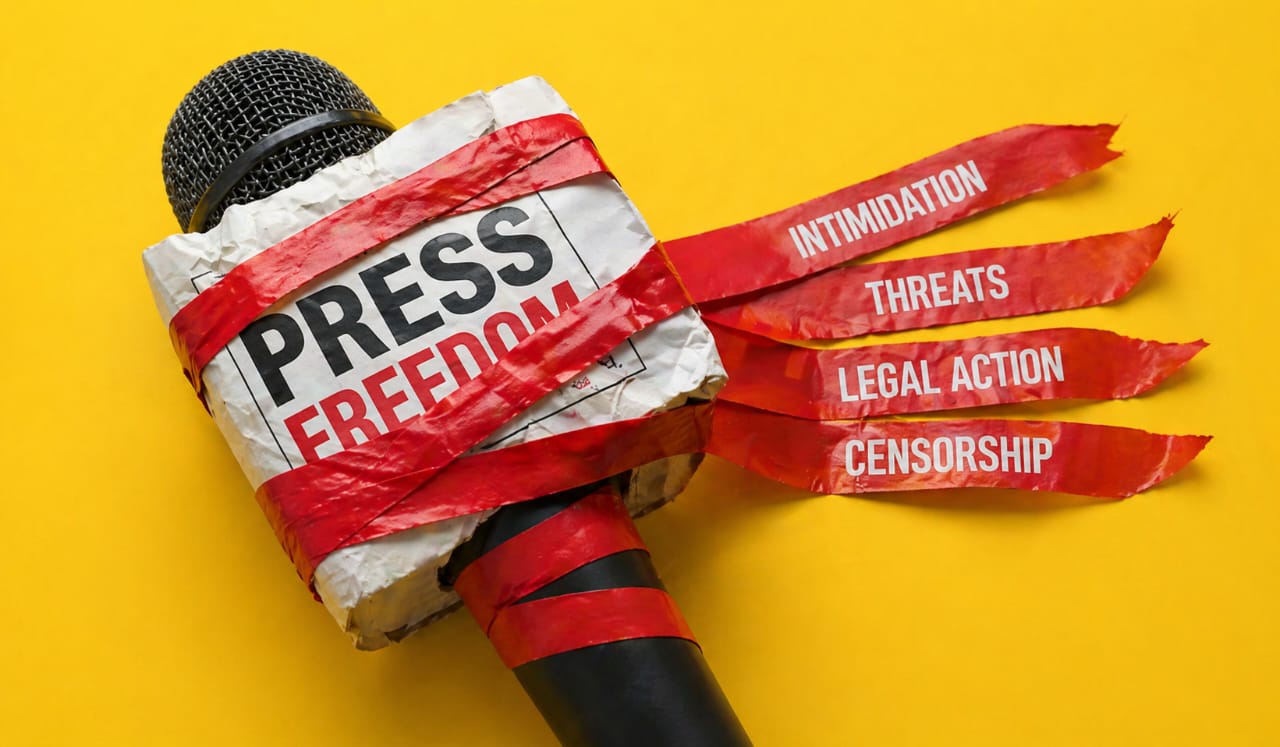
The United States has dropped to its lowest recorded position in the Reporters Without Borders annual press freedom index, falling seven places to 64th among 180 countries — a ranking that places America below nations it has historically cited as models for democratic governance, and that arrives as the organisation declared a global press freedom crisis for the first time in 25 years.
RSF’s 2025 report, released Thursday, found that for the first time more than half of the world’s countries were classified as “difficult” or “very serious” environments for journalism. Norway leads the index. Eritrea sits at the bottom. The United States, which remains in the “problematic” category rather than the more severe classifications, nonetheless recorded its steepest single-year decline in recent memory.
Clayton Weimers, executive director of RSF’s North America office, did not soften his assessment. “Trump and his administration have carried out a coordinated war on press freedom since the day he took office, and we will live with the consequences for years to come,” he said. “Our message is clear: Protect legal rights, ensure accountability for attacks on media professionals, and support independent media to restore American press freedom.”
The report identified two parallel forces reshaping the American media landscape. The first is direct government pressure on news organisations and individual journalists. The second is accelerating corporate consolidation that critics argue creates structural conditions for editorial self-censorship and ideological narrowing.
Read also: Tensions Flare Ahead Of US-Iran Truce Negotiations
On the consolidation front, just six companies — Comcast, Walt Disney, Warner Bros Discovery, Paramount Skydance, Sony and Amazon — now control the majority of US media. Skydance Media’s acquisition of Paramount Global, which includes CBS News, has drawn particular scrutiny: Skydance is owned by David Ellison, whose father Larry Ellison is a known confidant of Trump. Paramount Skydance is also in the process of acquiring Warner Bros, the parent company of CNN.
The regulatory pressure has been equally visible. FCC chair Brendan Carr announced in March that he would move to revoke the broadcast licences of stations running what he described as “hoaxes and news distortions” and failing to “operate in the public interest” in their coverage of the US-Israel war on Iran. Trump said he was “thrilled” by the statement. Carr has also threatened licence revocations over immigration coverage, a posture that press freedom advocates say is designed to produce a chilling effect on local news organisations even if no licences are ultimately pulled — the threat itself being the instrument.
The regulatory reach has extended to late-night television. Carr announced an investigation into several ABC channels in the wake of a joke made by the network’s flagship late-night host, Jimmy Kimmel, who quipped that Melania Trump had the “glow of an expectant widow” ahead of the White House Correspondents’ Dinner. Days after the joke aired, a gunman attempted to breach security at the event. The Trumps publicly connected Kimmel’s comment to the attack and called for his firing. Kimmel said the joke referred to the age difference between the 79-year-old president and the 56-year-old first lady, not to violence.
The FCC investigation found an unlikely critic in Republican Senator Ted Cruz, who said he did “not believe the FCC should operate as the speech police” — a notable dissent from within the president’s own party that underscored how far the regulatory pressure had extended.
Read more: China Won’t Tolerate Taiwan Independence – Xi To Opposition
The White House has maintained that Trump is the most transparent president in American history, pointing to his regular news conferences as evidence. RSF’s index measures a different set of variables: the legal framework protecting journalists, the independence of media from political and commercial interference, the safety of reporters, and the societal conditions that allow or inhibit reporting. On those measures, the United States moved in the wrong direction in 2025 by the organisation’s assessment — not dramatically enough to leave the “problematic” category, but enough to reach a historic low in a decade-long decline that has now accelerated under the current administration’s second term.
The global context amplifies the American numbers. When more than half the world’s countries are classified as difficult or very serious environments for journalism, a democracy ranking 64th is not simply a data point about one country’s media climate. It is a signal about what the world’s most powerful democracy considers acceptable conduct toward the press — and what governments watching from elsewhere may conclude they can do without consequence.