
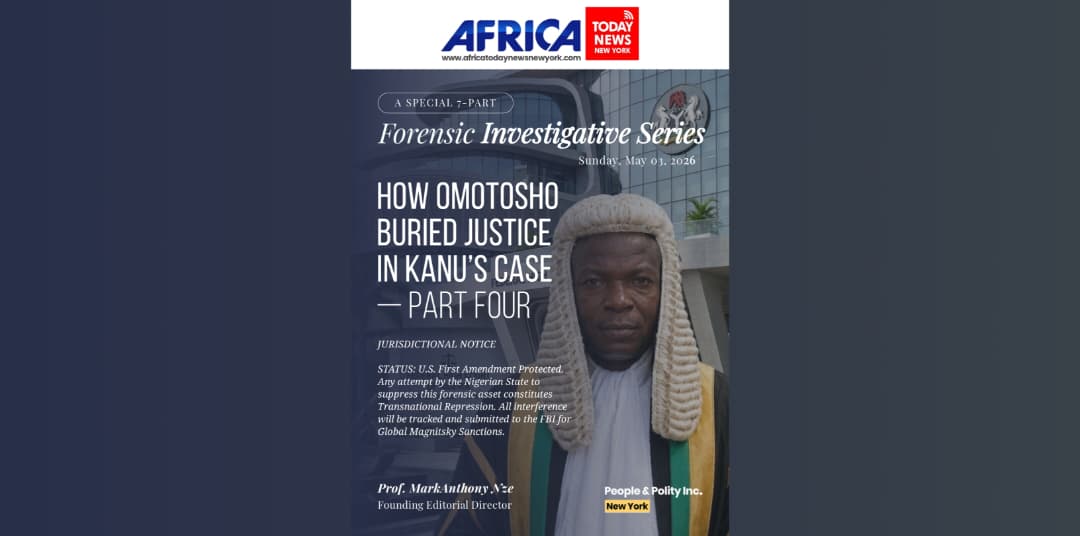
JURISDICTIONAL NOTICE
STATUS: U.S. First Amendment Protected.
Any attempt by the Nigerian State to suppress this forensic asset constitutes Transnational Repression. All interference will be tracked and submitted to the FBI for Global Magnitsky Sanctions.
♦♦♦♦♦♦♦♦♦♦♦♦♦♦♦♦♦♦♦♦♦♦♦♦♦♦♦♦
When courts convict by fear, proof is buried and every citizen enters the dock.
By Prof. MarkAnthony Nze
The Evidentiary Gap: Conviction by Atmosphere vs. Substance
Criminal justice begins to rot when proof no longer drives the trial and the court starts giving the state’s suspicion the dignity of fact. The bench remains occupied, the charge is read, exhibits enter the record, counsel address the court, and judgment arrives with the usual solemnity. But beneath that disciplined choreography, the real trial has shifted. Evidence has been displaced by mood. Fear has found a seat at the bar. Public anxiety has become the silent witness. And the accused is no longer being measured against proof, but against the danger the state has taught the courtroom to imagine.
That is the evidentiary crisis at the center of Federal Republic of Nigeria v. Nnamdi Kanu. Justice James Omotosho’s judgment, examined through the cold discipline of evidence, raises one question every Nigerian should fear: was Kanu convicted on strict legal proof, or was he condemned by atmosphere—the insecurity of the moment, the political toxicity of separatist agitation, and the state’s insistence that his words alone were enough to carry the weight of guilt?
Plainly, this is not procedural housekeeping or a private argument for lawyers to entertain in polished courtrooms. It is the central danger line in criminal justice: whether a person is convicted because evidence survived scrutiny, or because the state told a story frightening enough for the court to mistake it for truth.
A terrorism conviction cannot be built from smoke, anger, and official suspicion. It must be constructed like a chain of evidence strong enough to hold a citizen’s liberty without borrowing strength from fear. The court must see the exact words relied upon, the intention behind them, the audience they reached, the legal meaning they carried, the operational consequence alleged, the identifiable crimes said to have followed, and the statutory ingredients the prosecution was required to prove beyond reasonable doubt. Each link must be visible. Each must bear weight. Each must survive pressure. Once a single link is missing, the case is no longer a chain; it is a narrative. And when a court seals that narrative with judgment, justice has not spoken—power has been given a legal accent.
Read also: How Omotosho Buried Justice In Kanu’s Case—Part 3
Justice Omotosho’s judgment faltered at this exact point. Rather than demanding the merciless evidentiary bridge required in a terrorism trial, the court seemed to accommodate the state’s broad national-security narrative. That is why this part of the series must be blunt: the danger is not only that Kanu was convicted. The deeper danger is that the judgment may have lowered the evidentiary threshold for convicting any politically inconvenient Nigerian whose words can be made to sound dangerous in a frightened country.
Liberty rarely dies only through decrees. Sometimes it dies through evidentiary shortcuts.
The Constitution of the Federal Republic of Nigeria, 1999, does not permit the state to win criminal trials by mood. Section 36 protects fair hearing and anchors the principle that an accused person must be judged according to law, not public hostility, executive frustration, political temperature, or judicial impatience (Federal Republic of Nigeria, 1999). A court that allows suspicion to harden into proof has not merely made an error. It has betrayed the grammar of criminal justice.
In Kanu’s case, the evidentiary battleground was speech. The prosecution relied heavily on broadcasts, rhetoric, political statements, agitation, and expressions attributed to him. Speech evidence is among the most dangerous materials in a political trial because it can be inflated with frightening ease. Words can be selected, isolated, edited, emotionally framed, and placed beside violence to create the illusion of causation where causation has not been strictly proved. A fiery statement can be made to look like an operational command. A political threat can be dressed as a criminal instruction. A separatist slogan can be interpreted as a blueprint for terrorism. A public broadcast can be transformed into a weapon without proving who acted on it, when they acted, why they acted, and whether the accused intended that precise criminal result.
A serious judge must therefore handle evidence without romance, fear, or political sympathy—cutting through the state’s narrative until only proof remains.
Justice Omotosho should have forced the prosecution through the questions that separate law from propaganda. Which exact broadcast caused which exact crime? Which identified listener acted because of which identified statement? What was the chain of transmission from speech to action? Was there proof of intent, not merely anger? Was there proof of imminence, not merely fear? Was there proof of operational command, not just influence? Was there direct causation, not loose correlation? Was the alleged harm legally traceable to Kanu, or was the prosecution inviting the court to punish him for the general climate of insecurity in the South-East?
These questions are not forensic decorations; they are the evidentiary load-bearing walls of the prosecution’s case. Remove them, weaken them, or answer them with inference instead of proof, and the entire structure of guilt collapses from law into accusation.
The Terrorism (Prevention and Prohibition) Act, 2022, is not a loose political net for punishing defiance. It is a grave criminal statute aimed at grave conduct, and precisely because terrorism allegations carry devastating consequences, the law must be applied with strict precision (Federal Republic of Nigeria, 2022). A judge applying such a statute must not behave like an extension of the security apparatus. He must behave like a constitutional surgeon: cutting away exaggeration, removing political infection, isolating admissible evidence, and testing every element of the offence with cold legal discipline.
Justice Omotosho’s judgment allowed the prosecution’s theory to occupy the sacred space reserved for evidence. That is the evidentiary indictment at the center of the case. Suspicion cannot become proof because the state speaks loudly. A government narrative cannot become causation because the courtroom is afraid. National insecurity is not evidence against one man. Public fear is not criminal intent. Security panic is not proof beyond reasonable doubt. Once a court permits those substitutions, the injury no longer belongs to the accused alone; it becomes a wound on the judiciary itself.
Read also: How Omotosho Buried Justice In Kanu’s Case—Part 2
The United Nations Office on Drugs and Crime has repeatedly emphasized the complexity of terrorism prosecutions, especially where the evidence involves ideology, speech, internet communication, radical messaging, alleged influence, and public dissemination (United Nations Office on Drugs and Crime, 2010, 2012, 2018, 2020). These cases demand care because the risk of overreach is enormous. Courts must distinguish advocacy from incitement, propaganda from command, sympathy from participation, ideological identity from criminal action. A terrorism case cannot be built by throwing frightening words into a courtroom and asking fear to connect the dots.
Here lies the danger the Omotosho judgment exposes with chilling clarity: a terrorism prosecution can be made to look complete while its foundation rests on inference, atmosphere, and judicial indulgence toward the state’s narrative. The prosecution no longer has to build every evidentiary bridge if the court is willing to let fear supply the missing links. At that point, proof is dethroned. Suspicion is promoted. Accusation acquires the accent of law. And the courtroom, instead of testing the state’s case, becomes the place where the state’s fear is polished into judgment.
The Rabat Plan of Action offers a valuable international framework for assessing when expression crosses the line into punishable incitement. It requires a careful examination of context, speaker status, intent, content and form, extent of dissemination, and likelihood of harm, including imminence (United Nations Office of the High Commissioner for Human Rights, 2012). That framework exists because not every offensive or inflammatory statement is criminal incitement. Not every dangerous-sounding broadcast creates legal liability. The law must test whether the expression was intended to produce unlawful action and whether such action was likely, imminent, and traceable.
Such a legal audit should have controlled the entire Kanu judgment, forcing every allegation through the hard tests of intent, causation, imminence, and proof before any finding of criminal liability could stand.
A truly forensic court would have taken each broadcast relied upon by the prosecution and tested it against that threshold. What was the context? Was the speech political, ideological, symbolic, militant, or operational? Was the speaker issuing a direct instruction or engaging in inflammatory commentary? Was there evidence of intent to cause specific unlawful conduct? How widely was the statement disseminated? Who heard it? What happened afterward? Was the alleged harm imminent? Was the connection between the words and the crime direct, or merely assumed? Did the prosecution prove causation, or did it exploit coincidence?
If that analysis was absent, weak, or buried beneath general condemnation, then the judgment rests on a dangerous evidentiary void.
“Conviction by atmosphere” is not literary decoration; it is the old disease of political trials given its proper legal name. Fear enters first, then evidence is forced to follow behind it. An accused person is no longer treated as a citizen whose guilt must be proved, but as a symbol onto which the state projects disorder. Prosecutors supply the accusation. Security agencies attach the label. Media narratives prepare the public mind. By the time a judge ascends the bench, suspicion has often arrived before him and settled into the courtroom with the confidence of evidence. A disciplined court does not negotiate with that presence. It clears the room of rumor, fear, political heat, and official branding, then forces the case back to the only ground where liberty can be taken: admissible proof, tested under law. A captured court lets it remain, listens to it silently, and later calls its presence judgment.
There is a judgment. There are citations. There are statutory references. There is judicial language. But the hidden engine is not proof. It is mood. The defendant is not convicted because every link has been established; he is convicted because the climate around him makes guilt feel plausible, even inevitable. That is not the rule of law. It is the rule of emotional probability.
Emotional probability is not evidence, and no criminal court faithful to its oath should ever allow fear to acquire the dignity of proof. The moment suspicion is admitted into judicial reasoning as though it were fact, the trial ceases to be a disciplined search for guilt and becomes something more dangerous: a formal passage through which the state’s anxiety is converted into punishment. At that point, the accused is no longer measured only against what the prosecution proved. He is measured against what the state has successfully made the court fear.
The United Nations Human Rights Committee’s General Comment No. 34 states the discipline required where expression is placed in the dock: any restriction on speech must satisfy legality, necessity, and proportionality (United Nations Human Rights Committee, 2011). That standard is not decorative international language. It is the difference between lawful prosecution and political suppression. A state may punish genuine incitement, conspiracy, terrorist recruitment, financing, operational command, or material support when those offences are proved with strict legal precision. What it cannot do is collect inflammatory words, place them beside a climate of insecurity, and invite the court to extract terrorism from political temperature.
A serious court exists to resist that alchemy. In a prosecution built around broadcasts, rhetoric, agitation, and national-security anxiety, the judge’s function is not to strengthen the state’s suspicion, but to interrogate it until only evidence remains. The court must separate expression from command, anger from intent, influence from causation, ideology from operational participation, and political offensiveness from criminal liability. No citizen should be condemned because the atmosphere around him has become too toxic for the state to tolerate acquittal.
Justice Omotosho was not handling a routine criminal matter. He presided over a case already carrying the heavy burdens of extraordinary rendition allegations, international human rights scrutiny, separatist politics, ethnic sensitivity, security pressure, and national anxiety. The United Nations Working Group on Arbitrary Detention had placed Kanu’s treatment within a serious international rights framework (United Nations Working Group on Arbitrary Detention, 2022). The Supreme Court’s earlier involvement had also confirmed that the matter raised grave questions of jurisdiction, process, and state conduct (Supreme Court of Nigeria, 2023). Those circumstances demanded judicial patience of the highest order, the kind of restraint that slows power down and forces every allegation to pass through the narrow gate of proof.
What followed carried the scent of institutional impatience. The court treated finality as though it were virtue, when the deeper obligation was forensic disinfection. In a case of this magnitude, speed is never innocent by itself. It can be efficiency, but it can also become choreography: the measured movement of a proceeding toward a destination already desired. When a court glides past gaps in proof, softens the causation problem, and treats speech as though it naturally ripens into terrorism, the bench no longer looks like a guardian of liberty. It begins to resemble an instrument of conclusion.
Causation was the battlefield the prosecution had to cross, and no court should have allowed it to be crossed by inference. Without causation, the state had suspicion, anger, rhetoric, and political interpretation—but not criminal proof. Legal responsibility cannot be presumed because a defendant is influential, controversial, abrasive, or followed by people the government fears. Violence occurring in places where his message circulated does not automatically become evidence against him. Security belief is not causation. Prosecutorial confidence is not causation. Political hostility is not causation. The law required a disciplined showing that identifiable words materially caused, directed, encouraged, or facilitated identifiable criminal acts in a legally recognizable way. Anything short of that is not proof; it is forensic fiction.
A judge of true stature would have made that evidentiary gap the central issue of the case. He would have refused to let the prosecution hide inside the fog of national security. Names, dates, acts, listeners, instructions, operational structures, communication trails, financing evidence, command evidence, and direct causal proof would have been demanded with merciless precision. General unrest would have been separated from individual culpability. The state would have been reminded that the more frightening the charge, the more disciplined the proof must be. Terrorism does not lighten the burden of proof; it makes judicial restraint more urgent.
Justice Omotosho moved in the opposite direction. His judgment allowed the state to benefit from the fear generated by allegations the prosecution was required to prove. That is not a small weakness in reasoning. It is a grave judicial failure. A terrorism charge carries enormous emotional force, but the judiciary is not supposed to be impressed by that force. It is supposed to distrust it, test it, slow it down, and strip it of every dramatic excess until the legal elements stand alone.
A judge in such a case should be the last person willing to accept inference where proof is required. He should search for the missing link, resist the prosecution’s momentum, test every statutory ingredient, and remind the state that even a hated defendant is not a shortcut through the Constitution. Once that responsibility is abandoned, the courtroom becomes unsafe not only for the accused, but for every citizen whose words may one day offend power.
This case should alarm journalists, activists, opposition figures, regional advocates, labour leaders, religious critics, academics, and ordinary citizens. If words can be treated as criminal causation without a strict evidentiary bridge, every public voice becomes vulnerable. A protest speech can be tied to riots. A newspaper column can be linked to unrest. A social media post can be blamed for public anger. A political theory can be dragged into national insecurity. Once the state learns that atmosphere can substitute for proof, repression becomes legally efficient.
It closes when courts allow prosecutors to stretch words into crimes, judges abandon causation, and national security becomes the password that opens every constitutional door. By the time citizens understand what has happened, censorship no longer needs to be openly declared; fear has already trained the public to edit itself.
The Omotosho judgment must therefore be read as a warning document. It warns that terrorism law can be pulled beyond its proper boundaries. It warns that speech evidence can be inflated into operational guilt. It warns that public fear can contaminate judicial reasoning. It warns that legal form can survive while proof is emptied of constitutional substance. Most dangerously, it warns that an unchecked judiciary can become the final editor of the state’s accusation, converting allegation into doctrine and suspicion into precedent.
That is what makes the evidentiary gap so devastating. It is not merely a weakness in one case; it is a blueprint for future abuse. If prosecutors can secure conviction by placing controversial speech beside national insecurity, the state no longer needs to prove direct command. It only needs to show that the accused spoke dangerously in a dangerous time. That standard is intolerable in a constitutional democracy. It permits guilt to be built from reputation plus crisis. It allows inference to replace evidence. It lets a court punish a person not for what the prosecution proved he caused, but for what the state persuaded the court to fear he represented.
This is not criminal justice; it is symbolic punishment. Justice Omotosho’s judgment deserves indictment for normalizing the judicial conversion of atmosphere into substance. That conversion poisons the criminal standard of proof. It lets the court leap over missing links. It allows the prosecution to rely on the emotional structure of insecurity. It makes the defendant’s political identity perform the work that evidence should have done. The result is not merely a harsh judgment; it is a dangerous jurisprudential signal.
A judiciary unable to distinguish evidence from atmosphere is already in constitutional danger. A bench unable to separate rhetoric from causation is already vulnerable to capture. Courts that treat national-security claims as legal proof are already bending toward authoritarian use. When a judge permits that confusion in a case of this magnitude, he does not merely decide wrongly; he helps construct a doctrine that can later be deployed against the public.
Nigerians must therefore look beyond whether they like or dislike Kanu. The issue is larger than the defendant. It is whether the state must prove its case with evidence, or whether it can win by filling the courtroom with fear. It is whether judges will demand forensic proof or accept political plausibility. It is whether terrorism law will remain a precise instrument against actual criminal conduct, or become a broad weapon for crushing dissent. A republic cannot survive for long when courts confuse fear with fact.
Most dangerous of all, Justice Omotosho’s judgment handed the state something more enduring than a conviction: a method. It gave the state a method: identify a controversial figure, collect his most incendiary statements, place them beside national disorder, invoke terrorism, and let the courtroom treat the resulting atmosphere as proof. If that method stands, the next target may not be Nnamdi Kanu. It may be a journalist exposing military abuse, an activist mobilizing mass protest, a professor arguing for restructuring, a regional leader speaking too boldly, or a social critic whose words are later blamed for public unrest. Once causation becomes elastic, every citizen who speaks becomes a potential exhibit.
That is the public danger hidden inside the legal language of this case. A court worthy of the name should never convict by emotional gravity. It should never allow the state’s narrative to replace proof. It should never permit insecurity to swallow the presumption of innocence. It should never treat broadcasts as criminal commands without demanding the forensic chain connecting speech to action. It should never allow notoriety to become evidence.
Justice Omotosho crossed those forbidden lines. Part 4 is rather shocking because it shows that the case did not fail only in law; it failed in the deeper discipline of evidence. Where proof should have spoken, atmosphere shouted. Where causation should have been established, fear intervened. Where the court should have scrutinized, it accommodated. Where the judge should have restrained the state, he ratified its narrative.
When a courtroom reaches that condition, danger no longer looks like lawlessness. It looks orderly. A judge occupies the bench, the record is carefully kept, the language remains solemn, and judgment arrives with all the usual ceremony of law.
Yet the substance has shifted. Proof has lost command of the proceeding, fear has entered the reasoning, and the accused is judged not only for what the prosecution established, but for what the state persuaded the court to imagine. Once that method is accepted, it does not stay confined to one defendant. It travels—waiting for the next unpopular voice, the next provocative speech, the next protest, the next article, the next regional grievance, the next citizen whom power finds inconvenient. What begins as a terrorism case against one man becomes a legal grammar for silencing many. At the core of the Omotosho judgment lies its deepest danger: the injury does not end with the punishment of one defendant. A sentence can imprison a man, but a judicial method can endanger a nation. This judgment teaches power how to proceed next time—how to surround speech with fear, convert atmosphere into proof, dress suspicion in legal language, and invite the court to call the result justice.
Selected Verified Sources (APA 7th)
Federal High Court of Nigeria. (2025, November 20). Federal Republic of Nigeria v. Nnamdi Kanu (Charge No: FHC/ABJ/CR/383/2015) [Judgment].
Federal Republic of Nigeria. (1999). Constitution of the Federal Republic of Nigeria, 1999.
Federal Republic of Nigeria. (2022). Terrorism (Prevention and Prohibition) Act, 2022.
Supreme Court of Nigeria. (2023, December 15). Federal Republic of Nigeria v. Nnamdi Kanu (SC/CR/1361/2022) [Lead judgment by Justice Garba Lawal].
United Nations Human Rights Committee. (2011). General comment No. 34: Article 19: Freedoms of opinion and expression (CCPR/C/GC/34).
United Nations Office of the High Commissioner for Human Rights. (2012). Rabat Plan of Action on the prohibition of advocacy of national, racial or religious hatred that constitutes incitement to discrimination, hostility or violence.
United Nations Office on Drugs and Crime. (2010). Digest of terrorist cases.
United Nations Office on Drugs and Crime. (2012). The use of the Internet for terrorist purposes.
United Nations Office on Drugs and Crime. (2018). Handbook on criminal justice responses to terrorism.
United Nations Office on Drugs and Crime. (2020). Manual for judicial training institutes South-Eastern Europe: Counter-terrorism.
United Nations Working Group on Arbitrary Detention. (2022). Opinion No. 25/2022 concerning Mazi Nnamdi Kanu (Nigeria and Kenya). Human Rights Council.