
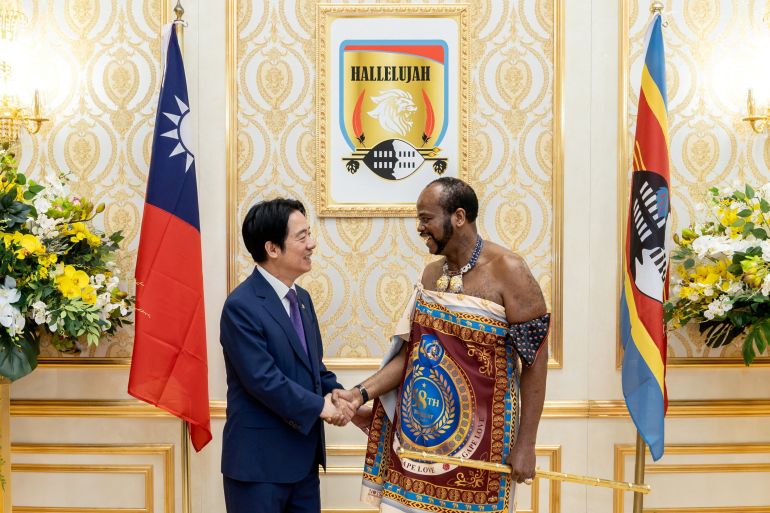
Taiwan‘s president arrived in Eswatini on Saturday, two weeks after Beijing’s aerial pressure campaign forced him to cancel the same trip — this time boarding an Eswatini government jet to get there, outmaneuvering the airspace blockade that China had engineered across the Indian Ocean.
Lai Ching-te announced his arrival in the small southern African kingdom through posts on Facebook and X, confirming a visit that neither his government nor Eswatini’s had publicly announced in advance. The secrecy was deliberate — last month, three Indian Ocean nations revoked overflight permits for Lai’s aircraft at what Taiwan’s government said was Beijing’s direct pressure, grounding him before he left and marking the first time a Taiwanese president had ever been forced to cancel a foreign trip through airspace denial.
This time, the aircraft that carried him belonged to Eswatini. Pictures posted by Lai showed him stepping off what appeared to be the kingdom’s government jet — the same plane that had brought Eswatini’s Deputy Prime Minister Thulisile Dladla to Taipei earlier in the week. The route around Beijing’s obstruction was built into the visit from the start.
Read also: US Drops To Unprecedented Press Freedom Low In RSF Index
“Taiwan will never be deterred by external pressures,” Lai wrote on X. “Our resolve and commitment are underpinned by the understanding that Taiwan will continue to engage with the world — no matter the challenges faced.”
China’s Foreign Ministry was characteristically furious, accusing Lai of having “secretly slipped aboard a foreign aircraft and sneaked out of Taiwan, lavishly squandering public funds.” It added that no degree of diplomatic maneuvering could alter the fundamental reality that “Taiwan is part of China” — the claim that Lai and his government reject as a matter of constitutional and democratic principle.
Eswatini is one of only 12 states that maintain formal diplomatic relations with Taiwan, a list that has been shrinking steadily as Beijing applies financial and diplomatic pressure on Taiwan’s remaining partners. The kingdom’s willingness not only to maintain ties but to provide the aircraft that circumvented China’s airspace strategy represents a pointed demonstration of loyalty at a moment when Taiwan needed it.
Read also: Global Defense Budgets Rise 2.9% As US Reduces Ukraine Aid
The April cancellation had drawn criticism from Washington and expressions of concern from the European Union, Britain, France and Germany — a rare moment of coordinated Western pushback against what was widely read as a new Chinese playbook for isolating Taiwan’s president from his own allies without firing a shot.
Saturday’s arrival answered that playbook with one of Taiwan’s own. When three countries close the sky, find a government that will lend you its plane.