
Japan’s prime minister spent the first days of May signing agreements across the Asia-Pacific at a pace that reflects something beyond routine diplomacy — a government that has looked at the Strait of Hormuz and decided that waiting for it to reopen is not a strategy.
Sanae Takaichi touched down in Canberra on Monday after stopping in Hanoi days earlier, leaving behind signed frameworks on energy, defense, critical minerals and emerging technology at each destination. The common thread running through both visits was explicit: the closure of the world’s most critical oil chokepoint is not a temporary inconvenience for Asia. It is a structural emergency, and countries that do not build alternative arrangements now will pay for the delay later.
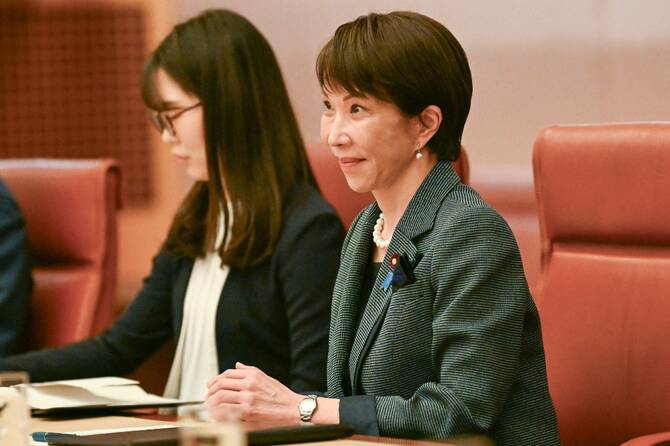
“The effective closure of the Strait of Hormuz has been inflicting enormous impact on the Indo-Pacific,” Takaichi told reporters in Canberra following talks with Prime Minister Anthony Albanese. The language was measured but the arithmetic behind it is stark. Around one-fifth of global oil shipments pass through the strait under normal conditions. The International Energy Agency says roughly 80 percent of that volume is bound for Asia — meaning the region consuming the most Gulf energy is also the region absorbing the most pain from Iran’s interdiction campaign.
Japan sits at the acute end of that exposure. The country imports virtually all of its oil and has no meaningful domestic production to fall back on. Every week the strait stays effectively closed is a week Japan is managing an energy equation that has no good solutions, only less bad ones.
Read also: Japan Ends Weapons Export Ban In Historic Policy Reversal
Australia is already part of those solutions — it is Japan’s largest LNG supplier, a relationship whose strategic weight has grown considerably since the war began. Japan, in return, supplies around 7 percent of Australia’s diesel imports. The mutual dependence creates the kind of alignment that makes formal agreements feel less like diplomacy and more like acknowledging what is already true. The Canberra visit formalized pledges across energy, trade, defense and critical minerals, with Albanese framing the agreements as insulation against the global disruptions the West Asia conflict continues to generate.
The defense dimension is not incidental. Japan and Australia have been deepening security ties for years, accelerated by shared concerns about Chinese influence in the region and the instability the Iran war has injected into maritime security across the Indo-Pacific. A previously announced deal worth 10 billion Australian dollars — approximately $6 billion — will see Japan’s Mogami-class stealth warships built for the Australian navy, a transfer of military capability that would have been diplomatically remarkable a decade ago and is now treated as the natural extension of an alliance both governments are actively building.
Critical minerals sat alongside energy in both the Canberra and Hanoi conversations. Japan needs stable access to the materials that go into semiconductors, EV batteries and military systems.
Australia has those materials and has been aggressively marketing its resource base as the alternative to Chinese-controlled rare earth supply chains that Tokyo, Washington and European capitals have all identified as an unacceptable strategic dependency. The pitch is finding willing buyers.
Read aslo: Iran Allows Iraqi Ships Through Hormuz As Transits Rise
In Hanoi, the agreements covered energy security, artificial intelligence, semiconductors, space and critical minerals — a portfolio that reflects how completely economic security has merged with national security in the thinking of governments navigating the current global environment. “We have agreed to deepen cooperation in such areas as energy, critical minerals, artificial intelligence, semiconductors, and space, which we consider to be new priorities for bilateral cooperation in economic security,” Takaichi said at a joint press conference with Vietnamese Prime Minister Le Minh Hung.
The Vietnam deal included concrete financial machinery: Japan’s Nippon Export and Investment Insurance will support crude oil supplies to Vietnam’s Nghi Son refinery, providing a financial buffer against the market volatility that has made supply planning extremely difficult for refineries across Asia since the war began.
None of these agreements replaces Gulf oil. Nothing can, at the volumes required, on the timelines available. What Japan is building instead is a web of relationships, financial instruments and supply chain alternatives that reduces how catastrophically exposed any single disruption leaves its economy. The Hormuz crisis did not create that strategic need — it made it impossible to defer.
Takaichi is flying home with signed documents from two capitals. The strait is still closed.