
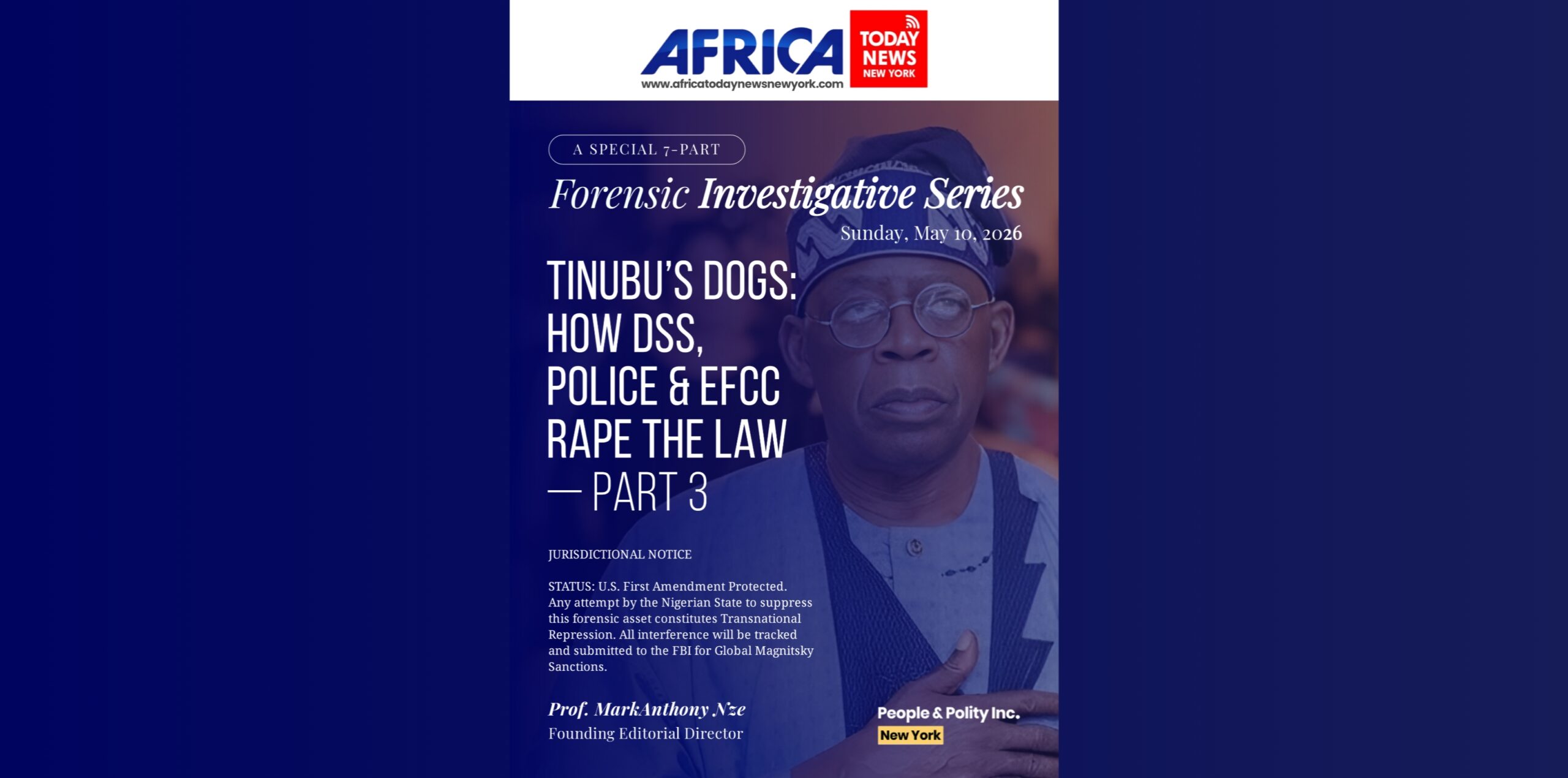
JURISDICTIONAL NOTICE
STATUS: U.S. First Amendment Protected.
Any attempt by the Nigerian State to suppress this forensic asset constitutes Transnational Repression. All interference will be tracked and submitted to the FBI for Global Magnitsky Sanctions.
♦♦♦♦♦♦♦♦♦♦♦♦♦♦♦♦♦♦♦♦♦♦♦♦♦♦♦
A forensic exposé of Nigeria’s anti-corruption machine: where seizure powers, freezing orders, public disgrace, plea bargains, and criminal summonses become instruments of selective fire in the hands of an agency accused of knowing whom power wants burned, spared, or kept warm.
The EFCC Furnace — Where Corruption Burns by Political Temperature
Anti-corruption power seduces the public because it speaks in the language of moral repair. Recovery. Accountability. Deterrence. Restitution. National cleansing. In a country ravaged by graft, people naturally welcome any institution bold enough to pursue diverted funds, expose false contracts, recover public money and make looters afraid. Yet moral authority becomes dangerous once political convenience enters the bloodstream. Evidence-led enforcement serves the republic; power-led enforcement converts justice into managed fire. Once an anti-graft agency starts reading factional interest, presidential comfort or electoral usefulness before reading the file, the courtroom becomes theatre and prosecution becomes discipline.
EFCC coercion rarely announces itself with the bluntness of street violence. It comes dressed in paper: invitation letters, restricted accounts, search warrants, forfeiture motions, remand applications, leaked allegations, press statements, staged photographs, negotiated pleas, seized property, and proceedings adjourned until exhaustion does what conviction has not. Each tool may be lawful when grounded in evidence, proportionality and due process. Unevenly applied, however, they form a prosecutorial arsenal. Bullets destroy openly; politicized files work more quietly, cutting through livelihood, reputation, mobility, credit, business confidence, family stability and political life before any court has pronounced guilt.
Numbers alone can make the EFCC look formidable. Reuters reported in March 2025 that the Commission said it recovered nearly $500 million in proceeds of crime in one year, its strongest annual recovery since the agency was created more than two decades earlier. During the same period, EFCC claimed more than 4,000 criminal convictions and seized 975 real estate properties, company shares, and 931,052 metric tons of petroleum products. On paper, those are the trophies of an aggressive anti-graft body. In forensic terms, they create a heavier burden of explanation. An agency with that scale of reach cannot credibly plead weakness whenever corruption sits close to political power, party finance, ministerial networks, governors, contractors, oil thieves, bankers, procurement cartels, or presidential comfort.
Read also: Tinubu’s Dogs: How DSS, Police & EFCC Rape The Law—Part 1
Against those recovery figures stands the national disgrace they have not erased.
Transparency International’s latest Corruption Perceptions Index delivers the verdict in cold numbers: Nigeria scores 26 out of 100 and ranks 142nd among 182 countries — a damning indictment of a state that keeps parading anti-graft victories while public-sector integrity remains buried near the global basement. Celebration becomes hollow when the country still smells of impunity. EFCC may count convictions; citizens count what remains untouched, who remains protected, and which files never seem to find their way to court.
Public trust does not collapse because an anti-corruption agency prosecutes. It collapses when prosecution appears to recognize political weather. A file wakes after a quarrel with power. Another sleeps after reconciliation. One suspect receives a public manhunt; another receives courtesy. One account is frozen with dramatic speed; another investigation drifts into official mist. One politically exposed person becomes a national example; another becomes an “ongoing matter.” Selective enforcement is not a small blemish on prosecutorial discretion. It is an assault on equality before the law. It tells citizens that criminal process has a party temperature.
Yahaya Bello’s case shows the EFCC at its loudest and most politically sensitive. Premium Times reported that the Commission declared the former Kogi State governor wanted in April 2024 after he failed to appear for arraignment in a money-laundering case involving more than ₦80 billion, specifically alleged Kogi State funds. SaharaReporters also reported the EFCC’s wanted declaration over alleged ₦80.2 billion. Bello remains entitled to the presumption of innocence, but the public facts matter: a former governor, a massive alleged sum, a wanted notice, contested appearances, and a courtroom process watched by citizens who have seen too many elite corruption cases begin with thunder and end in fog.
High-profile prosecution is not the same as justice. A wanted notice is not conviction. Arraignment is not restitution. Bail drama is not accountability. Media attention is not institutional cleansing. Nigeria has developed a dangerous appetite for anti-corruption theater: announce, raid, parade, adjourn, negotiate, forget. A serious republic measures anti-graft work by final judgments, transparent recoveries, equal treatment, durable deterrence, and the destruction of the networks that enabled the theft. Anything less is spectacle with a court date.
Poverty funds exposed corruption in its most obscene form. Reuters reported in April 2024 that EFCC had recovered ₦32.7 billion and $445,000 in an investigation into alleged fraudulent practices at the Ministry of Humanitarian Affairs and Poverty Alleviation. The probe followed President Tinubu’s suspension of Betta Edu, appointed less than six months earlier, and investigators were examining possible misuse of COVID-19 funds, a World Bank loan, and recovered Abacha loot allocated to poverty-alleviation programs. Banks allegedly involved in facilitating the fraud were also under investigation.
Money meant for poverty relief is not ordinary public money. It belongs, in human terms, to displaced families, hungry children, widows, sick citizens, unemployed youths, and communities already punished by inflation. Alleged theft from such a ministry is not only financial misconduct; it is bureaucratic predation against the vulnerable. Recovery matters, but recovery alone does not close the wound. Who authorized the transfers? Which officials processed them? Which banks enabled them? Which signatures moved the funds? Which supervisors looked away? How many prosecutions reached conclusion? How many convictions followed? Without those answers, the recovered billions become less a triumph than evidence of how deep the rot had already travelled.
Read also: Tinubu’s Dogs: How DSS, Police & EFCC Rape The Law—Part 2
Process can punish with a precision prison rarely achieves. A suspect may enter EFCC custody clothed in the presumption of innocence and come out already damaged beyond legal repair. Leakage does the first injury; spectacle deepens it. Raids become content. Photographs harden suspicion. Press statements attach fraud to a name before evidence meets cross-examination. Bank restrictions choke business activity, creditors panic, contracts freeze, associates retreat, and political allies discover the convenience of distance. Long before a judge weighs the file, public opinion has been invited to deliver its own sentence. In a lawful prosecution, publicity serves accountability without destroying fairness. Under politicized enforcement, publicity becomes punishment by procedure — reputation tried in the street, livelihood strangled in silence, dignity spent before the court has spoken.
Asset recovery also demands suspicion, not applause alone. Properties seized, petroleum products confiscated, company shares taken, funds recovered — these announcements produce headlines, but accountability begins after the seizure. Which court order authorized final forfeiture? Who valued the assets? Who manages them? Were they sold, abandoned, allocated, auctioned, deteriorated, or quietly returned through settlement? Which public account received the proceeds? Which projects benefited? Reuters reported that some recovered funds were reinvested in government projects, but ceremonial claims are not enough for a country whose history teaches citizens to distrust every unlit corridor of public finance.
Political selectivity remains the mortal wound. A genuinely independent EFCC would frighten ruling-party governors, opposition governors, ministers, oil-sector barons, subsidy manipulators, bankers, military procurement networks, contractors, party financiers, civil servants, presidential allies, and opposition patrons with equal appetite. No defector would feel cleansed by changing camp. No loyalist would expect courtesy as a reward for usefulness. No ruling-party financier would sleep better than an opposition treasurer. Anti-corruption law loses its soul the moment political alignment begins to cool prosecutorial heat.
Credibility dies not only from wrongful action, but from unexplained silence. Why does one case move like lightning while another grows moss? Why does one suspect get cameras while another gets private negotiation? Why are some banks named only in general language? Why do some politically exposed files vanish into “continuing investigation”? Why does the agency sometimes speak with prosecutorial thunder and sometimes with monastic silence? A public institution with coercive power owes citizens an account not only of its noise, but of its quiet.
Small offenders often meet the full theater of enforcement while grand corruption enters the mansion of procedure. Cyber-fraud suspects and petty financial offenders can be paraded quickly; politically insulated suspects accused of sums large enough to build hospitals, roads, schools, water systems, and police barracks often travel through years of technical objections, medical excuses, jurisdictional contests, adjournments, bail negotiations, settlement whispers, and elite patience. If punishment becomes less certain as alleged theft becomes larger, criminal justice has been turned upside down. Weak suspects get velocity. Powerful suspects get process.
More revealing than EFCC’s noise is its silence. Public confidence does not collapse only because suspects are arrested; it collapses because Nigerians can see the gaps between ferocity and restraint. Certain cases move with prosecutorial speed; others disappear into administrative fog. Some suspects are treated like fugitives before trial; others, carrying heavier political weight, seem to enjoy the luxury of time. Files do not need to be destroyed to lose moral force. Delay can preserve the powerful as effectively as acquittal. Silence can protect reputations more efficiently than a legal defense. In that uneven terrain, anti-corruption stops looking like blind enforcement and starts resembling a system of managed exposure: loud where power permits, quiet where power benefits.
Corrupt power does not fear an anti-graft agency that performs outrage for the cameras. Spectacle is cheap. Raids can be staged, recovery figures polished, press statements timed, suspects photographed, and headlines fed to a hungry public while the deeper machinery of theft remains intact. What threatens a looting class is disciplined enforcement: evidence followed without fear, silence explained without evasion, recovered assets traced without opacity, political allies pursued without hesitation, and discretion exercised as law rather than favor. EFCC’s most serious crisis is therefore not activity. It is credibility.
Nigeria offers more than enough work for any honest anti-corruption body. Contract inflation, subsidy fraud, oil theft, security-vote abuse, welfare-fund diversion, shell-company laundering, procurement rackets, ghost projects and bank-enabled illicit flows have eaten through public finance for years. A weakened EFCC would be a gift to thieves. Yet a powerful EFCC without visible impartiality presents its own danger. Sharp enforcement against exposed targets, caution around protected actors, and procedural tenderness for politically useful figures do not cleanse a republic. They teach citizens that justice has a private temperature.
Criminal process can ruin with clinical efficiency. A leaked invitation alters how a man is seen. A raid sends creditors into panic before the court has even opened the file. Account restrictions can paralyze salaries, contracts, loans and business confidence. Public statements may attach a name to fraud so tightly that even acquittal arrives wounded. Remand battles drain money; adjournments drain spirit; prolonged investigation drains life. In such hands, prosecution no longer functions merely as a route to trial. It becomes punishment administered through procedure.
Silence is often more incriminating than noise. A scandal erupts, officials promise investigation, funds are announced as recovered, unnamed banks are said to be under scrutiny, and then the matter enters Nigeria’s familiar fog. No clean acquittal, no final conviction, no full accounting — only delay performing the labor of protection. Time launders memory. Alliances shift. Public anger moves on. The file remains technically alive, yet politically dead.
Recovered assets also require suspicion, not applause alone. Announcing seized money is easy; proving its public return is harder. Citizens deserve to know where funds were lodged, who valued seized properties, which court orders authorized forfeiture, who manages recovered assets, whether auctions occurred, which projects benefited, and whether any portion quietly found its way back into elite hands through settlement, allocation or neglect. Without that chain of custody, recovery becomes relocation — stolen wealth moved from one dark room to another.
A lawful EFCC should be cold, disciplined and almost boring in its fairness. Follow the money. Preserve admissible evidence. Charge the principals. Name the enablers. Trace assets to final use. Protect cases from political weather. Avoid publicity that punishes before proof. Move against friends of power with the same appetite shown to enemies. Treat billion-naira theft with greater urgency than petty fraud. Let judges deliver guilt, not press officers.
Nigeria’s tragedy is that enforcement too often appears graded by usefulness. Weak suspects meet speed. Convenient targets meet cameras. Inconvenient figures meet heat. Protected actors receive patience. Useful men disappear into silence. That hierarchy is not justice; it is political triage disguised as prosecution. Once citizens believe loyalty can cool a file and proximity can soften procedure, anti-corruption loses its soul.
A compromised anti-graft agency is doubly poisonous. It leaves organized theft alive while corrupting the public meaning of accountability. Genuine prosecutions begin to smell political. Real recoveries sound incomplete. Honest investigators are dragged into institutional suspicion. Silence becomes evidence in the public imagination. Every raid carries a question mark; every plea bargain suggests bargain above justice; every abandoned file becomes another witness against the system.
EFCC does not need the romance of a “war against corruption.” War language is dangerous. Wars create enemies; courts try defendants. Wars reward propaganda; justice demands proof. Wars excuse collateral damage; constitutional prosecution forbids it. Anti-corruption work requires something harder than martial theatre: forensic accounting, statutory discipline, institutional independence, transparent recovery, restrained publicity and equal application under pressure.
Part 3 therefore places EFCC under scrutiny not because corruption deserves shelter, but because anti-corruption must never be allowed to operate above law. A prosecutor with selective fire is not a cure for graft. It is another species of abuse. When criminal process becomes politically steerable, the republic is not cleansed; it is disciplined. Opponents become cautious. Allies become comfortable. The public becomes cynical. Thieves become strategic.
Tinubu’s dogs do not all patrol with rifles, sirens and armored trucks. Some operate in quieter costume: summonses, freezing orders, forfeiture motions, remand applications, asset notices, timed leaks and press statements polished until coercion begins to resemble public duty. No cell is needed for the lesson to land. Suspicion stains the name. Account restrictions choke the financial arteries. Creditors panic. Contracts stall. Business partners retreat with sudden moral concern. Political allies develop selective amnesia. A life is left hanging in the smoky corridor between allegation and proof.
Here lies the genius — and the obscenity — of the EFCC furnace: it burns without admitting fire. Punishment travels through process, while officials recite accountability with straight faces. Due process remains somewhere in the building, perhaps seated in reception, waiting to be called after reputational damage has finished its work. A press statement lights the match. A leaked file spreads the smoke. A frozen account tightens the noose. Adjournments lengthen the sentence that no court has pronounced.
Captured anti-corruption does not abolish justice; it performs it. It has learned the etiquette of selective outrage — thunder for enemies, whispers for allies, raids for the expendable, invitations for the connected, “fresh evidence” when politics requires heat, and amnesia when loyalty deserves shade. Inside that furnace, some suspects are roasted for public consumption, others are smoked just enough to become obedient, while friends of power sit close to the flame like honored guests at a barbecue advertised as national cleansing.
Real terror begins when law becomes politically literate. Evidence no longer leads; loyalty is read first. Anti-corruption stops functioning as a public shield and becomes a private grill. Citizens are shown smoke and told to call it justice. The powerful feel the heat and understand immediately whether it means punishment, warning, negotiation, or theater.
Selected Verified Sources — APA 7th Edition
Economic and Financial Crimes Commission (Establishment) Act, 2004.
Premium Times. (2024, April 17). EFCC set to arraign ex-Governor Bello for N80 billion money laundering.
Premium Times. (2024, April 18). Updated: EFCC declares ex-governor Yahaya Bello wanted.
Reuters. (2024, April 15). Nigeria’s anti-graft agency recovers nearly $30 mln in corruption probe.
Reuters. (2025, March 10). Nigeria’s anti-graft agency recovers nearly $500 mln in one year.
Transparency International. (2025). Nigeria: Corruption Perceptions Index.