
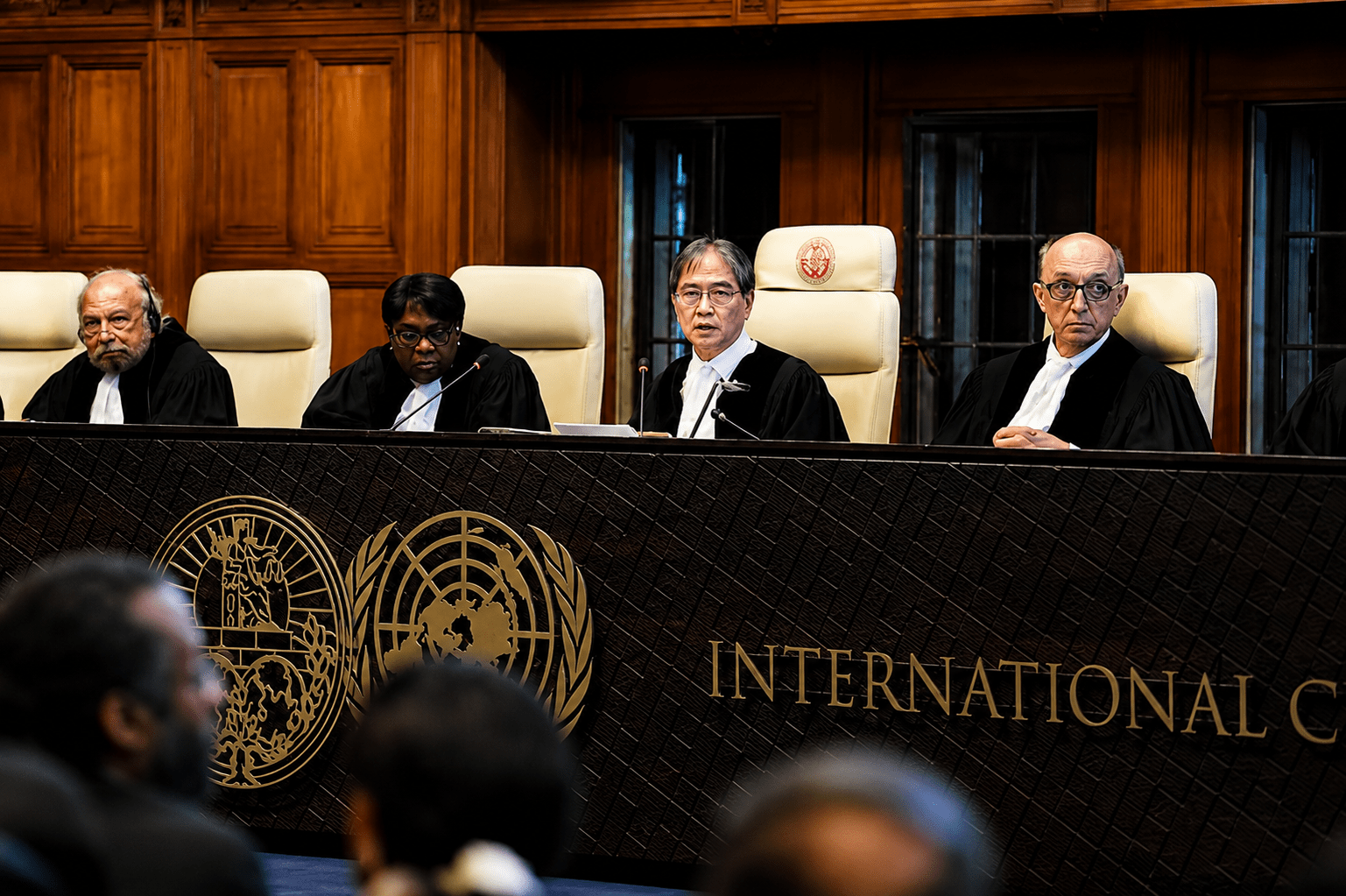
The United Nations General Assembly adopted a landmark climate accountability resolution by overwhelming consensus Thursday, converting a 2025 international court ruling on states’ legal obligations to the climate into a formal roadmap for action — and putting governments on notice that the era of treating climate protection as a political option rather than a legal duty may be closing.
The resolution’s passage drew immediate reaction from human rights organizations that have spent years pushing international institutions toward binding climate accountability. Amnesty International called the vote a meaningful advance for climate justice, framing it as a direct product of the International Court of Justice’s advisory opinion issued last year — a rare unanimous ruling in which the world’s top court declared that protecting the global climate system is a legal obligation, not a matter of political discretion.
Vanuatu drove both efforts. The Pacific island nation, which has publicly warned for years that rising sea levels could render it uninhabitable, spearheaded the diplomatic campaign that produced the ICJ opinion in 2025 and then led the push to convert that ruling into Thursday’s General Assembly resolution.
The origins of the entire effort trace back further still — to a group of young law students from the Pacific who first took the case to the world’s highest court, recognizing that their islands faced an existential threat that legal systems had not yet been asked to formally address.
The road from student advocacy to General Assembly resolution covered years and crossed continents.
Read also: Geneva Watches UN Influence Decline In Peace Capital
A core group of states collaborated on the initial draft text, drawing cross-regional representation from Barbados, Burkina Faso, Colombia, Jamaica, Kenya, the Marshall Islands, the Federated States of Micronesia, the Netherlands, Palau, the Philippines, Singapore, and Sierra Leone — alongside Vanuatu. The geographic spread was deliberate, designed to demonstrate that climate accountability is not the concern of small island states alone but a shared demand from the Global South and beyond.
The resolution is intended to operationalize the ICJ opinion — translating the court’s legal findings into a framework for concrete state action. The ICJ had stated explicitly that countries carry a collective duty not only to prevent further climate harm but to remediate damage already done. Thursday’s vote endorses that framework and, its proponents argue, gives governments a basis on which to be held to it.
Camile Cortez, Amnesty International’s senior campaigner on climate justice, described the moment as a counterweight to the fragmentation that has defined international climate politics in recent years. Political decisions by certain world leaders — rolling back domestic climate protections, revoking phaseout regulations for fossil fuels, and withdrawing from multilateral commitments — have eroded the global response precisely when scientists say stronger action is most urgent. Against that backdrop, Cortez said, a near-unanimous General Assembly vote endorsing the ICJ’s climate ruling represents a renewed opening for international cooperation.
Read also: America Ready To Hit China With Visa Penalties Over Migration
The numbers behind the human rights dimension of the climate crisis are not abstract. Fossil fuel infrastructure alone already poses documented risks to the health and livelihoods of an estimated two billion people — roughly one in four people alive on the planet today. That figure sits at the center of Amnesty International’s argument that climate change is not an environmental problem that occasionally touches human rights, but a human rights crisis with environmental origins.
The resolution does not create new enforcement mechanisms on its own.
What it does is establish a shared international reference point — grounded in the ICJ’s legal authority — that governments, courts, and civil society organizations can invoke in demanding accountability from states that fall short of their obligations. Climate litigation has accelerated sharply in national and international courts over the past decade. Thursday’s resolution hands future plaintiffs and advocacy groups a stronger hook.
For Vanuatu and the other small island states that have carried the diplomatic weight of this effort, the resolution is both vindication and necessity. Rising seas do not wait for consensus documents or court opinions.
But the argument these nations have advanced — that the world’s most climate-vulnerable populations are owed legal protection, not just sympathy — now carries the formal endorsement of the General Assembly.
The students who first brought that argument to the ICJ started something they could not have been certain would reach this far. It did.