
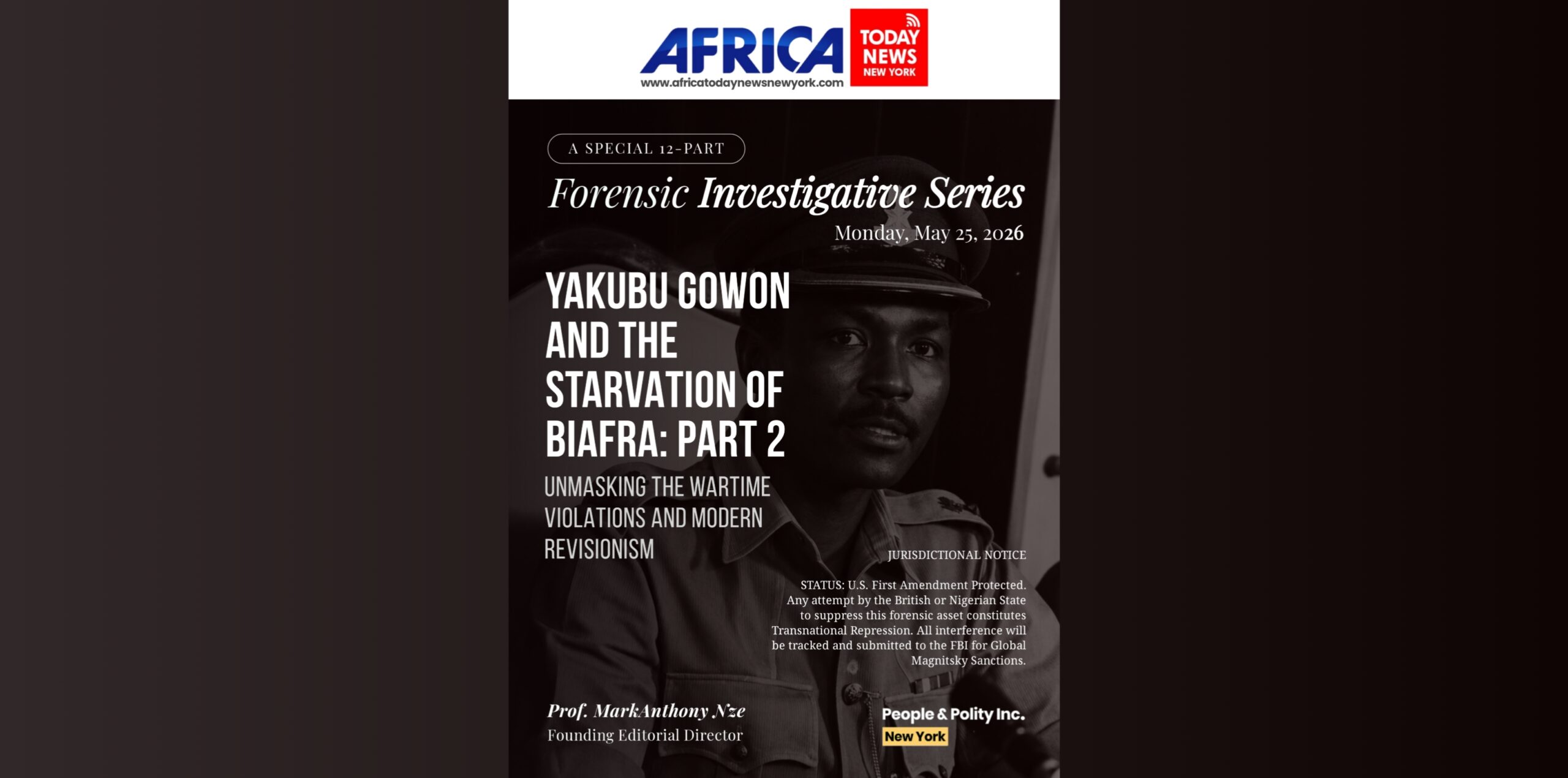
JURISDICTIONAL NOTICE
STATUS: U.S. First Amendment Protected.
Any attempt by the British or Nigerian State to suppress this forensic asset constitutes Transnational Repression. All interference will be tracked and submitted to the FBI for Global Magnitsky Sanctions.
♦♦♦♦♦♦♦♦♦♦♦♦♦♦♦♦♦♦♦♦♦♦♦♦♦♦♦♦♦♦♦♦♦♦♦♦♦♦♦♦♦♦♦♦♦
Unmasking the Wartime Violations and Modern Revisionism
A legal record of how the Federal Military Government hid behind sovereignty while violating the minimum humanitarian protections owed to civilians, the wounded, aid workers, and populations trapped inside internal war.
Geneva Was Not Silent About Humanity
Biafra was not abandoned by law because humanity had not yet been invented on paper. By 1967, the Geneva Conventions had already marked a minimum legal boundary for armed conflicts “not of an international character.” Common Article 3 did not need the later precision of 1977 to make one point unmistakable: persons taking no active part in hostilities were not outside the protection of law. Civilians, the wounded, detainees, medical workers, and those removed from combat were not disposable because a state described the war as domestic.
Gowon’s government understood the value of classification. Call the war an internal rebellion, and sovereignty becomes the first defense. Call Biafra a secessionist enclave, and humanitarian access becomes a matter of federal permission. Call starvation a military pressure point, and the civilian body is quietly moved into the battlefield. None of those moves erased the minimum humanitarian obligations already recognized in Geneva. They only exposed how ruthlessly state power can behave when it believes recognition, allies, and diplomatic language will protect it.
Sovereignty Was Used as a Shield, Not a Restraint
No serious legal argument denies that Nigeria had a claim to territorial integrity. A state facing secession may defend its borders. It may confront armed rebellion. It may restore public order through lawful means. But sovereignty is not a license to degrade civilians into instruments of pressure. National survival does not suspend humane treatment. Territorial integrity does not authorize the denial of food, medicine, and relief to trapped populations.
Lagos treated sovereignty as if it were a closed room. Inside that room, the Federal Military Government could define the conflict, control the routes, regulate relief, and cast international concern as interference. Once the state claimed exclusive authority over the crisis, it also claimed the power to decide how much civilian suffering would be tolerated in the name of unity. That was the breach: not simply that war occurred, but that humanitarian restraint was subordinated to federal victory.
Read also: Yakubu Gowon And The Starvation Of Biafra: Overview
Common Article 3 Drew the Minimum Line
Common Article 3 exists because even internal war must have limits. It prohibits violence to life and person, cruel treatment, torture, hostage-taking, outrages upon personal dignity, and sentences passed without judicial guarantees. Its text may not have spoken in the later, direct terms of Protocol II Article 14, but its moral and legal purpose was plain: people outside active combat cannot be treated as expendable material.
A government does not comply with Geneva’s humanitarian purpose by avoiding one form of direct killing while sustaining another form of civilian destruction through deprivation. The law’s minimum floor cannot be reduced to a technical checklist. Humane treatment is not compatible with a policy environment where food, medicine, and relief become bargaining instruments. Gowon’s war crossed that boundary because civilian survival became conditional on the strategy of the besieging state.

Chart note: Chart 1 sets out the central legal problem in Part 2: Geneva’s minimum humanitarian line existed, but the federal war practice placed civilian survival under pressure. The chart distinguishes between the law’s basic protections and the conduct under scrutiny. It does not argue that Common Article 3 contained every later rule with modern precision. It argues that the federal strategy violated the humanitarian floor by making civilians, the wounded, relief channels and trapped populations subordinate to military objectives.
Classification Became an Instrument of Abuse
Legal classification did real work in Biafra. If the conflict was described as internal, foreign governments could defer to Nigerian sovereignty. International institutions could hesitate. Relief agencies could be forced to negotiate with the authority controlling the perimeter. Civilian suffering could be recast as an unfortunate consequence of rebellion rather than a foreseeable result of federal policy.
Biafran children did not become less civilian because diplomats called the conflict domestic. Wounded people did not lose humanitarian status because Lagos preferred the language of rebellion. Relief workers did not become illegitimate because the state feared what their access would reveal. Classification may shape diplomacy, but it does not alter the human body. Hunger does not ask whether a war is international or internal before it kills.
Britain’s Role Belongs in the Breach
Britain’s relevance begins where legal restraint met political convenience. British support for the federal side, including arms, diplomatic cover, and protection of strategic interests, helped sustain a war effort whose humanitarian consequences were visible. Public concern could coexist with practical assistance. Official sympathy could sit beside policy continuity. That contradiction is not background. It is part of the record.
A foreign state does not need to draft the blockade order to become morally exposed by the blockade’s consequences. If it knows civilians are starving, if it understands that the recognized government is restricting access, if it continues to support that government for reasons of oil, influence, territorial stability, or post-imperial interest, then its position cannot be hidden behind neutrality. Britain’s conduct belongs in the evidentiary chain because the federal war effort did not operate in isolation. It moved within a field of international recognition, arms supply, and diplomatic protection.
Read also: Yakubu Gowon And The Starvation Of Biafra: Part 1
Humanitarian Access Was Not a Favour
Relief access is often misdescribed as charity. In a famine zone, it is not charity. It is the difference between survival and death. Once civilians are trapped and food systems collapse, humanitarian access becomes a legal and moral necessity. A state that controls access to a starving population does not merely manage logistics. It holds life in its hands.
Gowon’s government could not lawfully treat relief as a nuisance to be tolerated only when it served federal objectives. Aid workers, doctors, church networks, and neutral agencies were not asking for a courtesy. They were responding to civilian collapse. When relief is obstructed, delayed, politicised, endangered, or made conditional, the breach deepens. A state cannot claim humane treatment while making the essentials of life dependent on its military calculus.

Chart note: Chart 2 maps the movement from legal framing to humanitarian breach. It shows how internal-war classification, sovereignty, access control and permission-based survival form one chain. The decisive point is that civilian protection cannot depend on the discretion of the party applying the siege. Once food, medicine and relief become matters of federal permission, the minimum humanitarian line has already been placed under stress.
Civilian Immunity Was Not Optional
Civilian immunity is not decorative law. It is one of the restraints that prevents war from becoming social destruction. Civilians are not lawful targets because they reside in contested territory. Children are not pressure points because the state seeks surrender. Mothers, infants, the elderly, the sick, and the wounded do not become instruments of negotiation because the government frames the conflict as rebellion.
Biafra exposed the cruelty of indirect civilian targeting. The population could be reached without being lined up and shot. Food could be stopped. Medicine could be delayed. Roads could be sealed. Relief flights could be restricted. Markets could be broken. Fuel could disappear. A civilian population can be attacked through the conditions of its survival. Geneva’s humanitarian purpose was designed to resist exactly that descent.
Minimum Humanity Was Breached by Method
Gowon’s war crossed the humanitarian line through method. Starvation did not require a single dramatic order. It required control. Control over land routes. Control over ports. Control over airspace. Control over relief. Control over the terms on which trapped civilians could receive help. Once those controls predictably produced mass deprivation and were maintained despite visible suffering, the claim of lawful restraint became indefensible.
A legal breach is not always a single act. It can be a pattern. It can be a perimeter. It can be a permission regime. It can be a delay repeated until delay becomes deadly. It can be the use of sovereignty to restrict the very access civilians need to remain alive. That is why Part 2 cannot treat Geneva as a weak historical footnote. Geneva set the floor. The federal war pushed civilians beneath it.
Later Law Exposed the Earlier Conduct
Protocol II’s later Article 14 did not create the moral reality that starving civilians is wrong. It codified a clarity that conflicts like Biafra forced the world to confront. The later prohibition against starvation of civilians as a method of combat stands as legal memory. It says, in the language international law eventually found, that what states had tried to hide inside internal war could no longer be left to ambiguity.
For Gowon’s defenders, the timing of that later codification may seem useful. They may argue that the law spoke more clearly after the war. But law’s later precision does not cleanse earlier cruelty. A child did not become human in 1977. A mother did not acquire moral status because treaty language improved. Civilian starvation was not acceptable before it was named with greater force. The later rule exposes the conduct; it does not excuse it.

Chart note: Chart 3 places the Biafran crisis between the Geneva minimum rule of 1949 and the later legal memory of Protocol II. The visual is not an excuse chart; it is an exposure chart. It shows that the world later spoke more clearly about starvation because conflicts like Biafra demonstrated what states could do when sovereignty, blockade and internal-war classification were used against civilians.
Closing Charge
Part 2 proves a narrow but essential point: Gowon’s government did not merely benefit from legal ambiguity. It crossed the humanitarian boundary already visible in Geneva by making civilian survival subordinate to military pressure. Sovereignty was invoked. Classification was manipulated. Relief access was controlled. Britain and other external actors helped preserve the federal advantage while the consequences were visible.
The breach was not abstract. It was measured in hunger, restricted medicine, trapped civilians, wounded bodies, and aid workers negotiating with the authority enforcing the siege. Geneva had already drawn a line around minimum humanity. Gowon’s war stepped across it and called the crossing national survival.
Historical Sources, Legal Authorities, and Evidentiary Record — APA 7th Edition
International Committee of the Red Cross. (1949). Geneva Convention Relative to the Protection of Civilian Persons in Time of War (Fourth Geneva Convention). Common Article 3 text.
International Committee of the Red Cross. (1977). Protocol Additional to the Geneva Conventions of 12 August 1949, and Relating to the Protection of Victims of Non-International Armed Conflicts (Protocol II). Article 14.
Van Dijk, B. (2024). Preparing for war: The making of the 1949 Geneva Conventions. Oxford University Press.
Dannenbaum, T. (2022). Siege starvation: A war crime of societal torture. Chicago Journal of International Law, 22(2), 368–405.
Moir, L. (2018). The law of internal armed conflict. Cambridge University Press.
Sivakumaran, S. (2021). The law of non-international armed conflict. Oxford University Press.
Umozurike, U. O. (1971). The Biafran war in the context of international law. Journal of African Law, 15(1), 33–51.
Bothe, M., Partsch, K. J., & Solf, W. A. (2019). New rules for victims of armed conflicts. Martinus Nijhoff Publishers.