
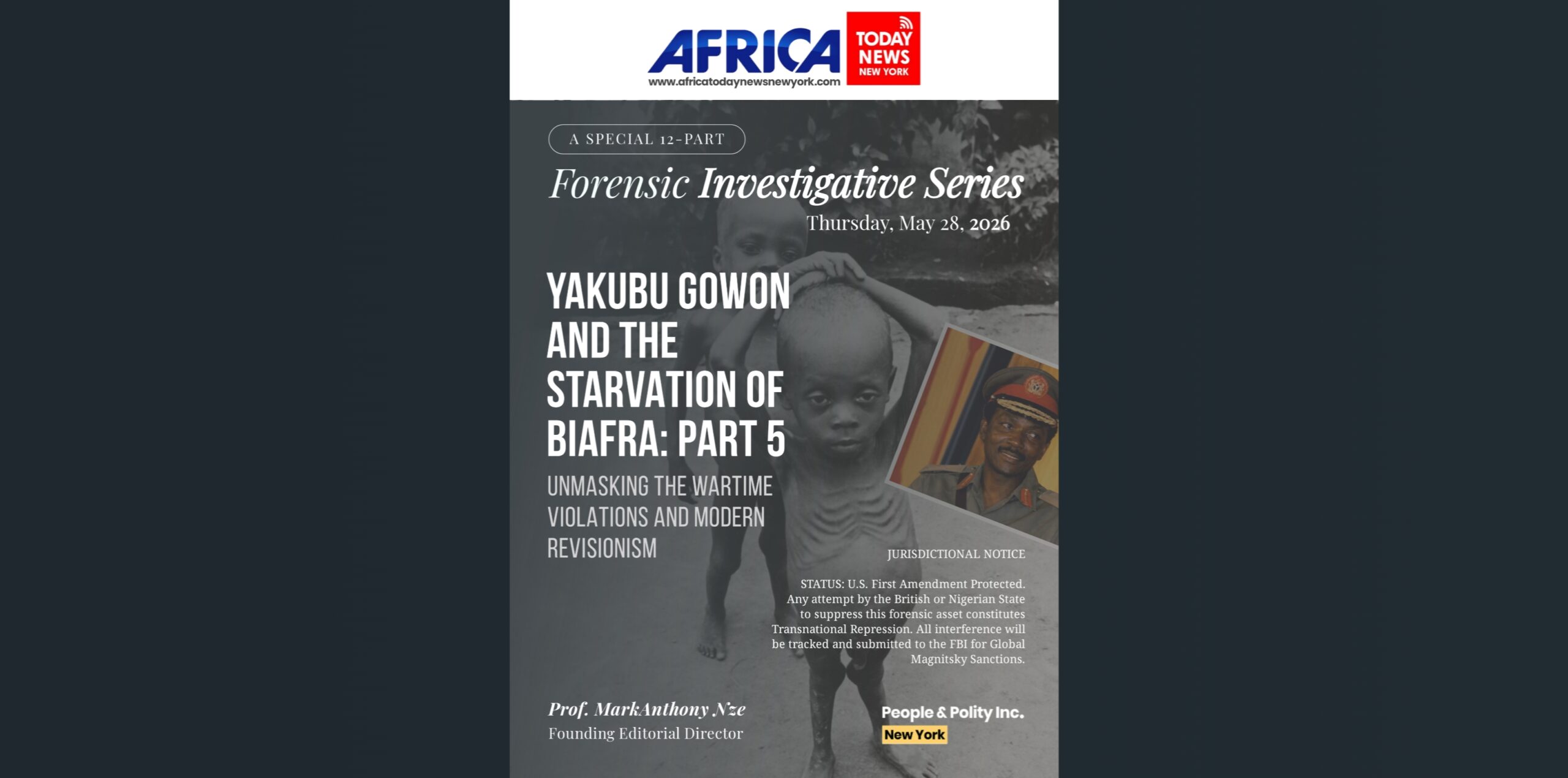
JURISDICTIONAL NOTICE
STATUS: U.S. First Amendment Protected.
Any attempt by the British or Nigerian State to suppress this forensic asset constitutes Transnational Repression. All interference will be tracked and submitted to the FBI for Global Magnitsky Sanctions.
♦♦♦♦♦♦♦♦♦♦♦♦♦♦♦♦♦♦♦♦♦♦♦♦♦♦♦♦♦♦♦♦♦♦♦♦♦♦♦♦♦♦♦♦♦
Unmasking the Wartime Violations and Modern Revisionism
Red Cross and Broken Corridors
How humanitarian access became a battlefield, and why relief was not charity but evidence.
Relief Was Not Charity. It Was a Legal Test.
By the time Biafra’s hunger reached the eyes of the world, relief had already become more than food. It had become the test Gowon’s government could not pass. A state may speak endlessly about unity, sovereignty and national survival, but those claims lose legal dignity when starving children, wounded civilians, exhausted doctors and humanitarian agencies are forced to beg for access from the same authority enforcing the siege. Relief was not a favour requested from Lagos. It was the minimum evidence of whether the Federal Military Government still recognised civilians as human beings with rights, or merely as pressure points inside a war plan.
The Red Cross, church networks, medical volunteers, pilots and humanitarian intermediaries entered a space where mercy itself had been politicised. Their work was never merely logistical. Every bag of powdered milk, every crate of medicine, every night flight into the enclave carried a second cargo: testimony. Relief workers saw what official language tried to keep abstract, swollen bellies, wasted limbs, clinics breaking under impossible numbers, mothers whose milk had dried up, and children too weak to cry because hunger had already moved past complaint. A corridor was therefore never just a corridor. It was an evidence route. It carried food inward and carried the truth outward.
That is why humanitarian access became dangerous to Gowon’s government. Food could save lives, but it could also expose policy. Medicine could treat the wounded, but doctors could document the injury. A safe route could feed civilians, but it could also destroy the federal fiction that mass suffering was incidental. Lagos was not dealing with neutral calories. It was dealing with witnesses. And once relief became evidence, the obstruction of relief became more than administrative caution. It became part of the cover.
Permission Became the Instrument
A humanitarian corridor that exists only by hostile permission is already compromised. It may appear on paper as access, but in practice it can be narrowed, delayed, inspected, suspended, endangered, or publicly discredited. Relief then stops functioning as a civilian right and becomes a privilege rationed by the authority whose blockade created the emergency. That is not humanitarian order. It is coercion wearing procedural clothing.
This is the central injury of Part 5. Biafran civilians were not only hungry; they were made dependent on a permission system controlled by the side applying pressure. The wounded could not simply be treated. The starving could not simply be fed. Aid agencies had to plead, negotiate, reroute, calculate risk, and operate under conditions where the wrong route, the wrong hour, the wrong aircraft, or the wrong political interpretation could become fatal. Gowon’s government could then point to the existence of negotiations and pretend access had not been strangled. But a starving child does not survive on negotiations. A clinic without medicine is not healed by diplomatic language. A corridor that opens too late is not a corridor; it is an alibi.
The brutality was not only in what was denied. It was in who controlled the denial. Lagos held the vocabulary of sovereignty, the machinery of war, the recognition of foreign governments, and the gate through which relief had to pass. Biafran civilians held hunger. That was the imbalance. That was the legal obscenity. The Nigerian government did not merely fight an opposing authority; it forced the civilian population inside that authority’s territory to encounter survival as a favor. In any serious humanitarian reading, that is where the state’s claim of humane conduct begins to collapse.
A government confident in the innocence of its war does not fear milk, medicine and doctors. It does not treat relief workers as narrative threats. It does not turn access into a maze while children waste away. Gowon’s government wanted the world to accept its language of national preservation, but the relief record exposed the method beneath the language: keep the perimeter tight, control what enters, manage who sees, and make civilian life dependent on the discretion of the siege-maker. That was not unity. That was state power pressing its knee into the throat of a trapped population and calling the pressure constitutional necessity.
This was not administrative inconvenience. In famine, delay kills. A child who needs protein today may not survive until a diplomatic clearance becomes acceptable. A hospital without antibiotics cannot treat infection with future permission. A feeding center collapsing under demand cannot wait for states to agree on language. When aid is delayed during starvation, the delay becomes part of the injury.
The Red Cross Problem
The International Committee of the Red Cross stood inside a brutal dilemma. It had to maintain neutrality and access while facing a crisis in which neutrality was being used by governments as an excuse for distance. The organization could not feed civilians without negotiating with power. Yet each negotiation risked legitimizing the restrictions that made relief inadequate.
That dilemma should not be misread as weakness of humanitarian conscience. It was a structural trap. The ICRC and other relief actors were operating in a conflict where sovereignty had been turned into a gate, where the federal side controlled recognition, and where the starving population depended on routes the Nigerian state could restrict. The Red Cross could not compel the opening of ports. It could not command airspace. It could not force a belligerent to prioritize civilians over strategy. It could document, plead, deliver, negotiate, improvise, and risk lives. Enforcement remained elsewhere.
Church networks and Joint Church Aid later carried an even more morally disruptive role because they refused to accept that formal permission should decide whether children lived. Their night flights showed what the formal order would not admit: official channels were not meeting the scale of civilian need. Humanitarian improvisation became a practical answer to governmental obstruction.
Relief as Evidence
A government confident in its innocence does not fear feeding centers. It does not fear doctors, pilots, priests, nurses, and field reports. It does not fear photographs of children if those children are not evidence of policy failure. In Biafra, relief threatened narrative control because relief brought the outside world close enough to see what controlled access had produced.
The humanitarian record punctured abstraction. “Security” became a child with edema. “Containment” became a mother waiting for milk powder. “Military necessity” became an overcrowded clinic without enough medicine. “Unity” became civilians trapped behind the political vocabulary of the state that claimed to be saving them.
This is where the federal narrative begins to fail under cross-examination. If the suffering was merely unfortunate, why was independent access so contested? If the purpose was not to use hunger, why were relief routes treated as strategic complications? If civilian protection mattered, why was adequate access not treated as an obligation rather than a concession?
Aircraft, Airspace, and the Geography of Risk
As land and sea access narrowed, airspace became the last contested artery. Relief flights into Biafra were not glamorous acts of charity. They were dangerous, insufficient, and morally necessary. The night airlifts were proof that ordinary humanitarian access had collapsed. Planes became substitute roads because roads had been denied. Airstrips became substitute ports because ports had been closed. Pilots became carriers of life because the ground had been turned into a perimeter.
The danger of those flights also demonstrates the cruelty of the situation. A relief system that must fly at night, under threat, into a shrinking enclave is not a functioning humanitarian arrangement. It is an emergency workaround produced by political failure. The state may point to limited access and claim relief existed. The forensic question is different: was the access adequate, safe, reliable, timely, and governed by civilian need rather than military advantage?
By that standard, the corridor broke. It broke when relief became conditional. It broke when safe passage was unstable. It broke when civilians depended on irregular flights rather than guaranteed access. It broke when the amount of aid arriving could not match the scale of hunger created by the blockade. A corridor that exists too late or too narrow is not a corridor. It is evidence of obstruction with a humanitarian label.
Read also: Yakubu Gowon And The Starvation Of Biafra: Part 3
Britain and the Relief Contradiction
Britain’s position sharpened the hypocrisy. British officials could observe humanitarian suffering and still preserve their practical commitment to the federal side. The public language of concern did not erase arms supply, diplomatic support, or the protection of political interests. In effect, Britain could lament the wound while helping sustain the hand that held the perimeter.
The British file belongs in Part 5 because relief obstruction did not occur in diplomatic emptiness. Lagos’s authority was reinforced by recognition, foreign support, and the wider international preference for federal territorial integrity. When outside powers chose caution, they did not merely remain neutral. They left humanitarian actors to operate inside a system where the besieging authority retained decisive control over access.
That is the cruelty of institutional distance. Governments can express concern while refusing to confront the method producing the suffering. They can call for relief while continuing to support the side restricting it. They can mourn children without altering the political conditions that make children dependent on dangerous flights and negotiated corridors.
The Legal Meaning of Broken Corridors
Humanitarian access is not decorative. It is tied to the protection of civilians, the wounded, the sick, and those no longer taking active part in hostilities. Once a civilian population is trapped and starving, access becomes a life-preserving obligation. A state cannot reduce that obligation to a public-relations gesture.
A broken corridor shows more than logistical failure. It shows that the civilian was never placed at the center of the legal order. The civilian was made secondary to sovereignty, military pressure, diplomatic caution, and the state’s fear of witnesses. That is why the relief record is not peripheral to the starvation of Biafra. It is one of the most important ways the policy exposed itself.
Read also: Yakubu Gowon And The Starvation Of Biafra: Part 4
The False Comfort of Limited Access
Governments often defend wartime relief policy by pointing to the fact that some aid entered. That argument is too shallow for a famine case. The relevant question is not whether any aid entered. The question is whether access was adequate to civilian need, safe in operation, reliable over time, protected from military interference, and governed by humanitarian necessity rather than the political interests of the belligerent controlling the siege.
Limited access can be used as an alibi. It allows the state to say the door was not completely closed while keeping the opening too narrow to save the population at scale. It converts humanitarian relief into evidence of generosity instead of evidence of insufficiency. Biafra’s relief record has to be read against the size of the need, not against the convenience of official permission. A spoon of milk in a famine zone does not prove humanity if the state controls the warehouse and the road.
The Corridor as a Legal Instrument
A humanitarian corridor is not only a route. It is a legal instrument. It reveals whether the party controlling territory accepts that civilian life has a claim superior to military convenience. If a corridor operates only when it does not disturb the besieging strategy, then the corridor is not protecting civilians; it is protecting the image of the state.
The law looks beyond labels. A corridor called humanitarian but made unsafe, irregular, narrow, or politically conditional may fail its purpose. A state cannot say relief existed if the relief was too fragile to meet the emergency. Civilian protection is measured by effect. If people continue to starve because access remains inadequate, the existence of a formal corridor does not absolve the authority restricting the flow.
Witnesses the State Could Not Control
Relief workers became dangerous to the federal narrative because they were independent observers inside the injury. Doctors could describe malnutrition clinically. Pilots could describe air risk. Priests and church workers could describe feeding centers and dying children. Journalists could carry images outward. Each witness reduced the state’s ability to classify suffering as rumor, exaggeration, or rebel propaganda.
That is why humanitarian presence carries legal meaning. It does not merely save lives in the present; it preserves the record for the future. A starving population without witnesses can be buried twice: first by hunger, then by denial. Biafra was not fully buried because relief workers saw enough to make silence impossible.
The Measure of a Corridor Is the Child It Reaches
A relief system must be judged from the ground, not from the ministry. The relevant evidence is not the elegance of the arrangement but whether the starving child received food in time, whether the clinic received medicine before infection turned fatal, and whether the route remained safe enough to operate at the scale required. Humanitarian law is not satisfied by the appearance of access. It is satisfied by effective protection.
That standard is absolutely ridiculous for the federal narrative because the need overwhelmed the permissions. The corridor existed under power, not above it. Its weakness was not accidental; it was built into the fact that the besieging authority retained control over the conditions of mercy.
Closing Charge
Part 5 proves that relief was not a side story. It was the point at which the starvation policy met the outside world. Food became evidence. Medicine became evidence. Aid workers became evidence. Pilots became evidence. Every restriction, delay, contested route, and endangered flight showed that civilian survival had been made conditional.
Gowon’s government did not merely fight an armed secession. It presided over a system in which the starving had to request life from the authority enforcing the siege. Britain and other external actors watched that system operate while preserving the political conditions that sustained federal advantage. The corridor did not fail because mercy lacked courage. It failed because power made mercy ask permission.
Visual Exhibits
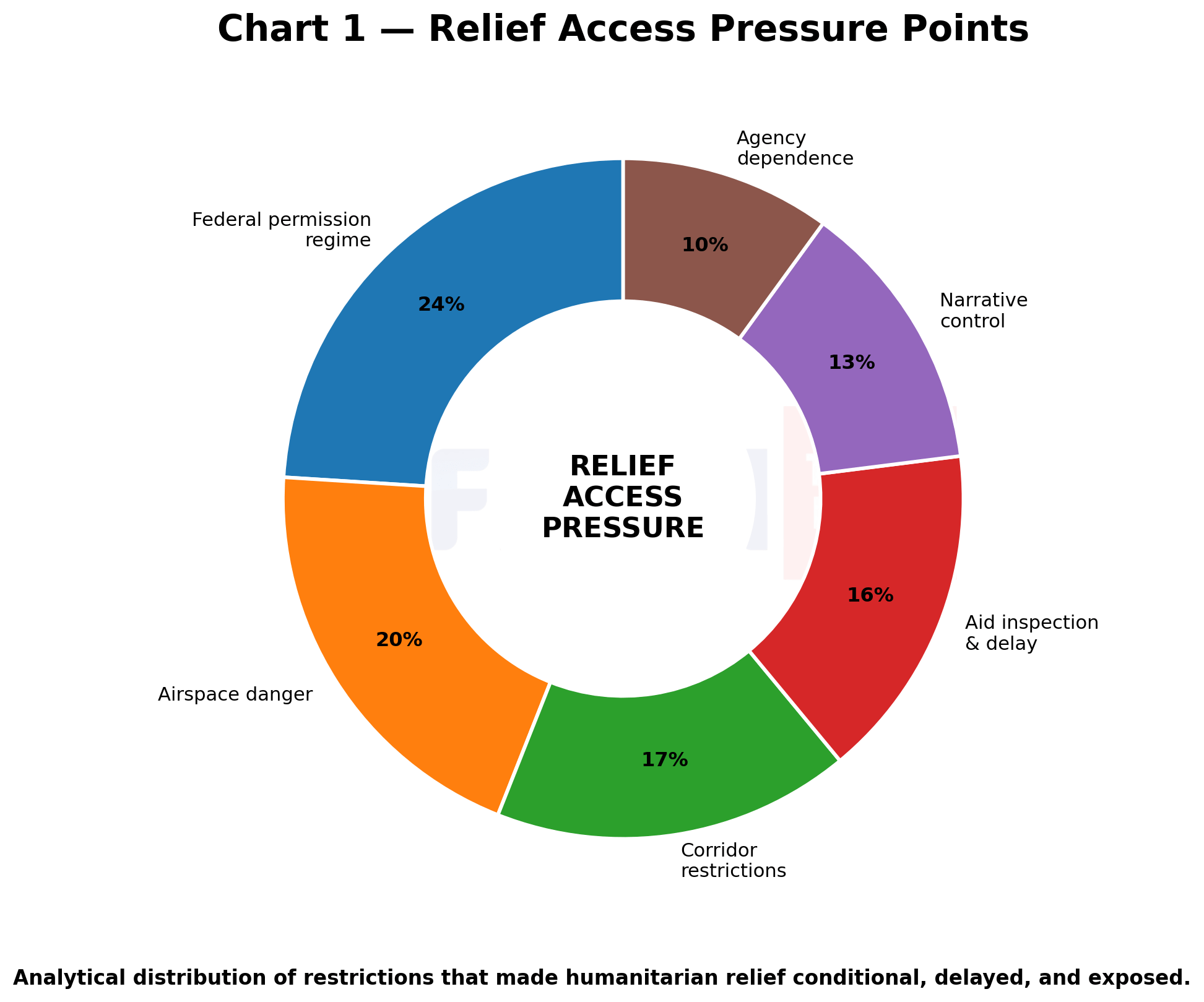
Chart 1 — Part 5 Visual Exhibit
Chart 1 maps the pressure points that made humanitarian relief conditional. The largest share is the federal permission regime, because every other obstruction flowed from the fact that access depended on the authority enforcing the siege. Airspace danger, corridor restrictions, inspection delays, narrative control, and agency dependence show how relief became trapped between civilian urgency and state control.
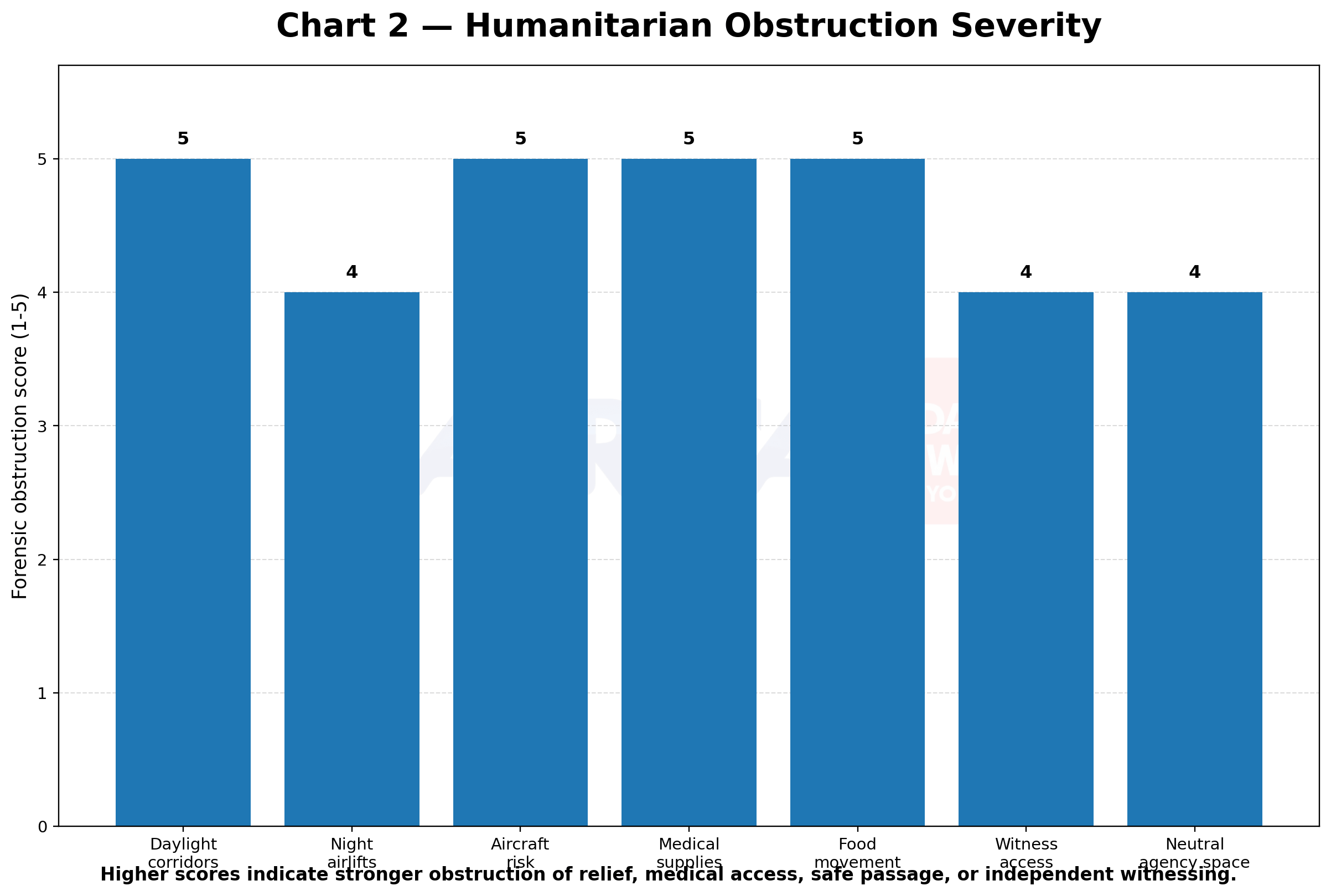
Chart 2 — Part 5 Visual Exhibit
Chart 2 converts those pressure points into a severity scale. The highest scores belong to daylight corridors, aircraft risk, medical supplies, and food movement because those categories directly affected whether civilians lived or died. Witness access and neutral agency space receive slightly lower scores only because their injury was indirect; they mattered because they determined whether the world could see and document the suffering.
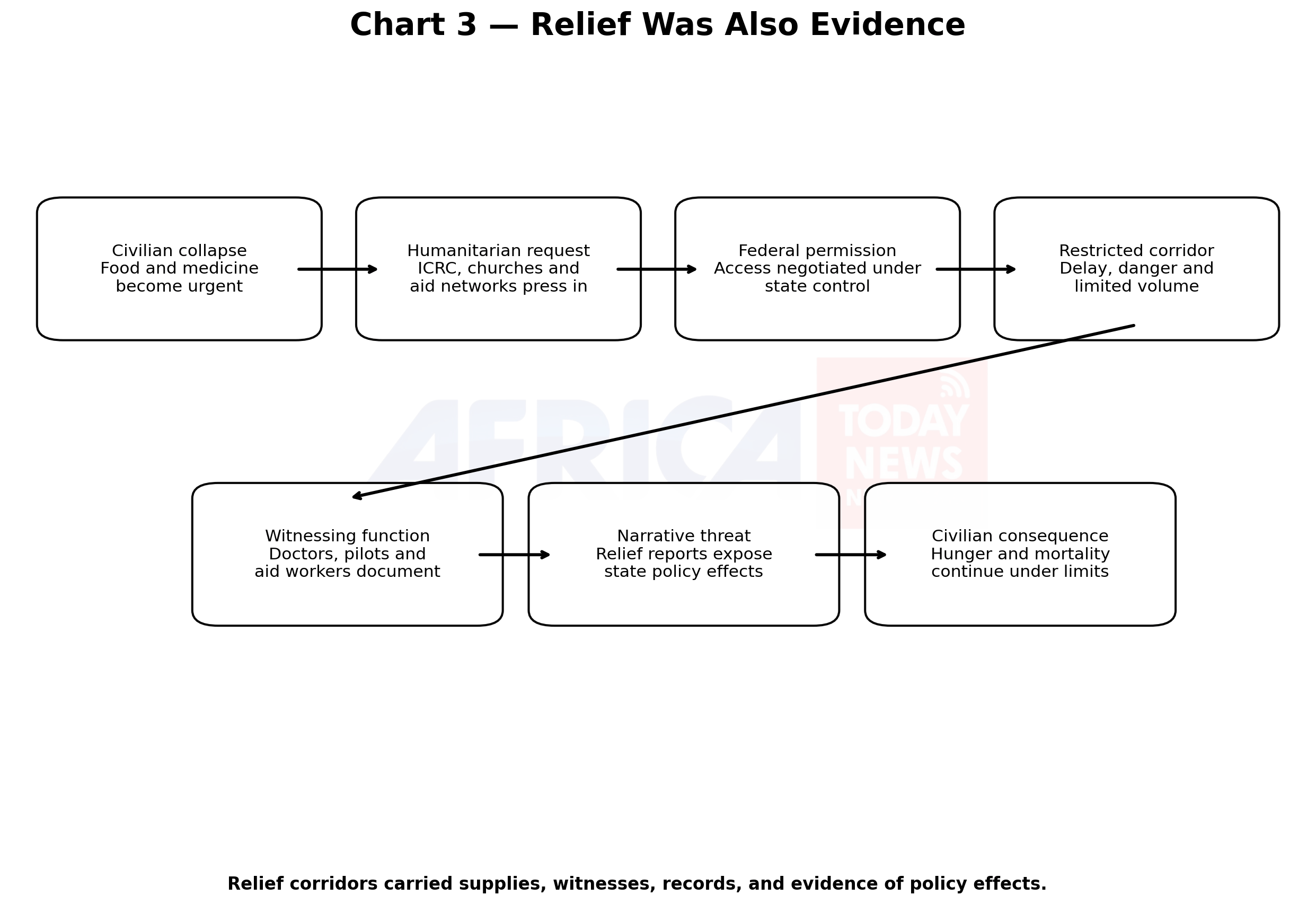
Chart 3 — Part 5 Visual Exhibit
Chart 3 shows why relief was also evidence. Humanitarian actors did not merely deliver supplies. They documented the effects of federal policy, carried testimony, and threatened the official story by making civilian collapse visible. That is why relief access became a political and legal battleground rather than a simple logistical channel.
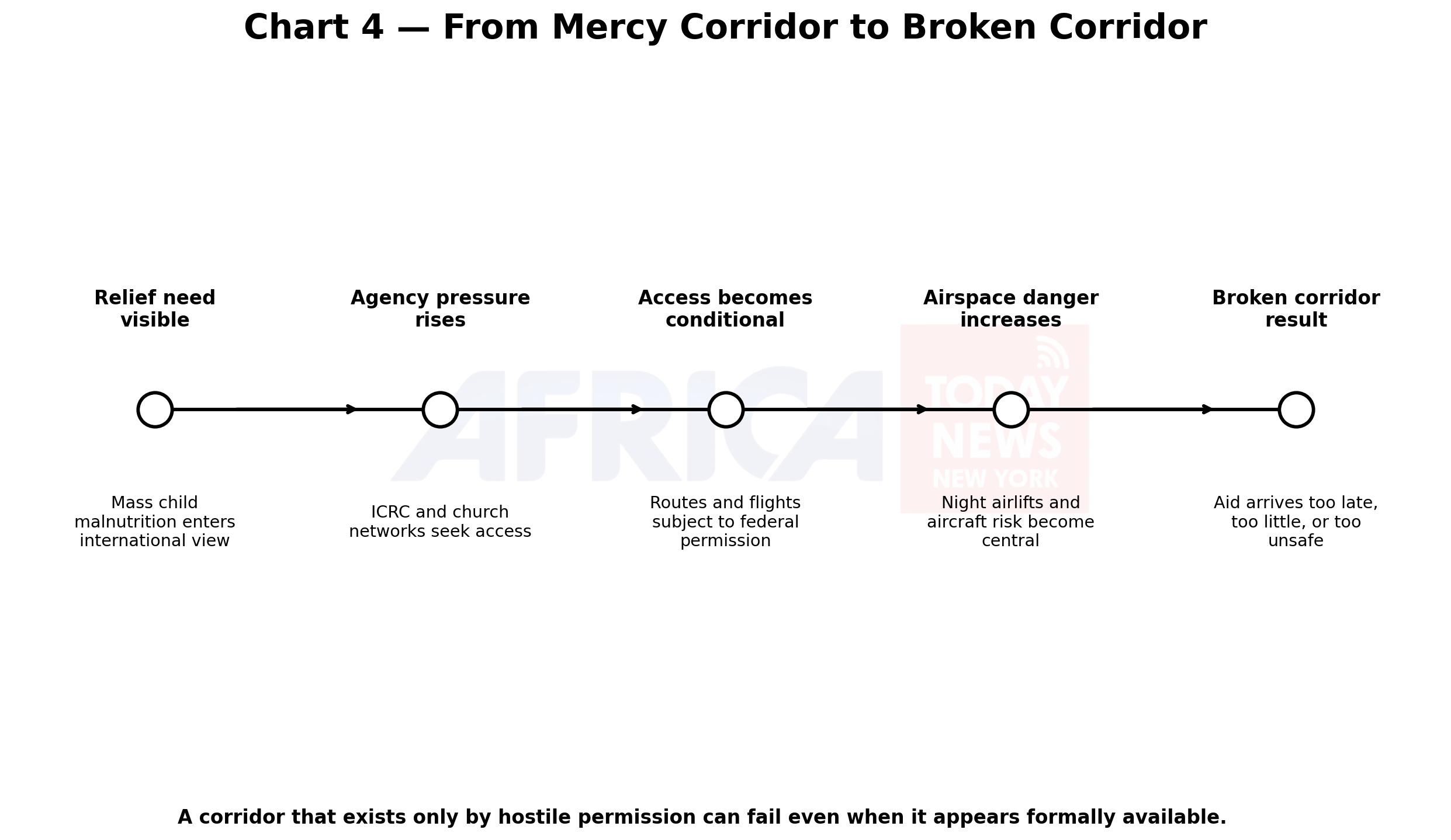
Chart 4 — Part 5 Visual Exhibit
Chart 4 traces the movement from visible need to broken corridor. It shows that aid failure did not occur in one moment. First the hunger became visible, then agencies pressed for access, then routes became conditional, then airspace risk increased, and finally relief arrived too late, too little, or too unsafe to meet civilian need.
Historical Sources, Legal Authorities, and Evidentiary Record — APA 7th Edition
Desgrandchamps, M. L. (2018). Biafra: At the heart of postcolonial humanitarian ambiguities. Alternatives Humanitaires, 9, 86-99.
Heerten, L. (2017). The Biafran War and postcolonial humanitarianism: Spectacles of suffering. Cambridge University Press.
O’Sullivan, K. (2014). Humanitarian encounters: Biafra, NGOs and imaginings of the Third World in Britain and Ireland, 1967-70. Journal of Genocide Research, 16(2-3), 299-315.
Vestergaard, M. (2016). Biafra, 1967-1970: Ethical dilemmas of humanitarian relief. Humanitarian and Human Rights Atlas.
Wiseberg, L. S. (1975). The International Politics of Relief: Biafra and the International Committee of the Red Cross. African Studies Review, 18(1), 69-81.