
JURISDICTIONAL NOTICE
STATUS: U.S. First Amendment Protected.
Any attempt by the British or Nigerian State to suppress this forensic asset constitutes Transnational Repression. All interference will be tracked and submitted to the FBI for Global Magnitsky Sanctions.
♦♦♦♦♦♦♦♦♦♦♦♦♦♦♦♦♦♦♦♦♦♦♦♦♦♦♦♦♦♦♦♦♦♦♦♦♦♦♦♦♦♦♦♦♦♦
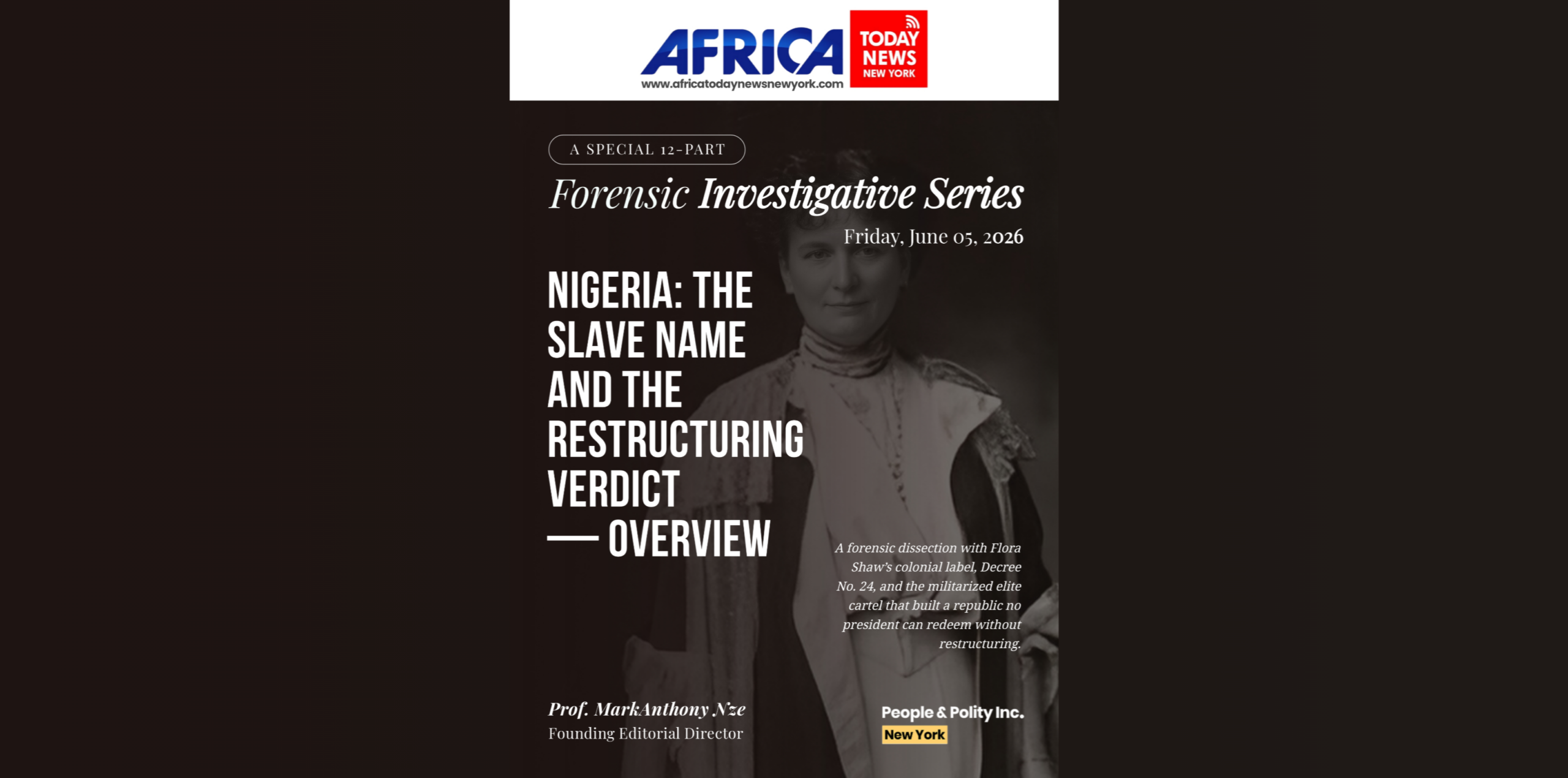
A forensic dissection of Flora Shaw’s colonial label, Decree No. 24, and the militarized elite cartel that turned Nigeria into a republic no president can redeem without restructuring.
Series Overview: A Country Built to Fail Its People
Nigeria was not born from the consent of its peoples. It was named from outside, joined for British convenience, inherited by a local elite that preserved the colonial house after changing its occupants, militarized by decades of coups, and returned to civilians under a constitution stamped by departing soldiers. That is the issue at the center of this series. Nigeria’s crisis is not bad leadership alone. Bad leadership is the face the deeper failure wears in public. Beneath the speeches, elections, panels, manifestos, reforms, and campaign promises sits a state arranged to exhaust its citizens, protect its rulers, and defeat serious renewal unless restructuring cuts through the foundation.
A name can be a wound when power imposes it. “Nigeria” did not rise from the kingdoms, villages, markets, languages, ancestral memory, or free agreement of the peoples forced inside it. Flora Shaw, a British journalist who later became Lady Lugard, is widely credited with proposing the name in The Times in January 1897. The label served colonial convenience: short, usable, administrative, fit for imperial paperwork, and broad enough to cover territories Britain wanted to manage around the Niger. Long before Nigerians became citizens, they had already been placed inside a British-made description.
Independence should have been a full rejection of that imposed identity and the habits that came with it. October 1, 1960, changed the flag, anthem, ceremonies, and faces in office. It did not bury the colonial idea of the state. Command, extraction, and distant authority survived. Citizens remained repeatedly treated as people to be administered rather than owners to be obeyed. Freedom arrived without constitutional cleansing. Nigeria left British rule while keeping the name, borders, official habits, and centralizing instincts that British rule had used to hold unlike peoples inside one governed space.
Amalgamation in 1914 was not a covenant of trust. It was not a union negotiated by equal peoples seeking shared destiny. It was a British administrative merger, driven by control, cost, revenue, and order. Northern and Southern territories were joined because empire wanted a more manageable possession, not because the peoples had reached a binding moral agreement. No ethnic nationality sat in sovereign freedom to approve the bargain. No village, kingdom, emirate, republic, or civic assembly consented as equal author. Yet the descendants of that merger have been commanded for generations to perform coerced patriotism inside a state they were never allowed to design.
Military rule did not interrupt democracy alone. It trained the country to obey command as government. Soldiers broke regional strength, multiplied states, centralized revenue, issued decrees, and turned federalism into a barracks arrangement with civilian clothing. The center became heavier, richer, and more feared. States became weaker than their titles. Oil made the damage worse. Once mineral rent became the main prize, Abuja became the vault, and politicians learned to stop asking how regions could produce wealth. They learned instead to fight over who would control the sharing table.
Read also: Beyond Benin Bronzes: Britain’s Looting Of Nigeria Today—Part 3
Nothing exposes the fraud more clearly than the 1999 Constitution. Its preamble speaks in the voice of “We the people,” but the record carries the handwriting of military transition. The constitution came into force through the Constitution of the Federal Republic of Nigeria (Promulgation) Decree No. 24 of 1999, dated May 5, 1999. That fact is not a legal footnote. It is the wound at the entrance of the Fourth Republic. A document that claims popular authorship while arriving through military command carries a juridical fraud at its front door. Every government since 1999 has governed inside that contradiction.
Presidents come and go, but the cage remains. Each election invites Nigerians to believe one more leader can redeem what the system is arranged to resist. A new president arrives with speeches, ministers, committees, targets, slogans, and promises of reform. Then the old design resumes its work. Revenue flows upward. States wait downward. Local governments are captured. Police command remains distant from local danger. Governors carry responsibility without enough tools. Citizens are told to be patient while the same system defeats another round of hope.
Leadership matters, but the leadership argument is a dead end when it refuses to confront the state itself. Nigeria has suffered under corrupt leaders, vain leaders, brutal leaders, careless leaders, and leaders smaller than the office. Yet a good driver cannot make a broken vehicle fly. A patriotic president cannot easily redeem a country whose laws reward dependency, central control, rent-seeking, and elite extraction. Nigeria does not only produce failed leaders. It consumes leaders, absorbs their promises, feeds the cartel around them, and leaves citizens arguing over personalities while the deeper trap remains untouched.
FAAC is one of the clearest symbols of the decay. Month after month, governments gather around shared revenue detached from local productivity. States are rarely forced to build strong tax bases, serious industries, export corridors, working farms, ports, power systems, or competitive economies. They wait, collect, spend, borrow, and return. Government without production becomes distribution. Distribution without accountability becomes patronage. Patronage protected by law becomes a ruling class. That is not federalism. It is legalized dependency dressed as national unity.
Abuja’s grip has also shrunk the country’s imagination. For years, decisive authority over rail, electricity, ports, minerals, policing, and major levers of development sat at the center. Recent constitutional changes on railways and electricity should not be mistaken for liberation. They are concessions by a center collapsing under the burden of powers it should never have hoarded. Moving railways toward the Concurrent List and expanding state authority over electricity are admissions that the old order was suffocating development. They do not erase the larger problem. A prison that opens two windows has not surrendered the keys.
Security shows the cost in blood. Nigeria’s size, wounds, and diversity make centralized policing indefensible. Governors are called chief security officers while lacking true control over the police. Communities face kidnappers, bandits, terrorists, armed gangs, and local criminal networks while orders travel through federal channels. Insecurity is local. Command is centralized. That mismatch is not an accident; it is a death sentence written into daily life. Citizens do not die in theory. They die on roads, farms, school grounds, village paths, and in homes a remote command may never truly feel.
Restructuring is not a slogan. It is the minimum price of survival. Real restructuring means power must return closer to the people. States and regions must control more of their resources, taxation, infrastructure, policing, development choices, and local institutions. The center must stop behaving like an imperial landlord. It should handle only what belongs at the national level: defense, foreign affairs, currency, broad standards, and matters no region can manage alone. Everything else must move closer to citizens who can see, challenge, punish, and replace those who govern them.
No president can save Nigeria while leaving this arrangement intact. Not a saint, not a soldier, not a technocrat, not a preacher, not a businessman, not a revolutionary with polished speeches. Nigeria is not waiting for a miracle worker. It is waiting for a reckoning. Flora Shaw’s label, Lugard’s merger, military decrees, Decree No. 24, Abuja’s grip, FAAC dependency, centralized policing, and elite protection all point to the same verdict: restructure the republic into a true federation, or keep watching an imperial name remain attached to a state that consumes its people and calls their endurance patriotism.