
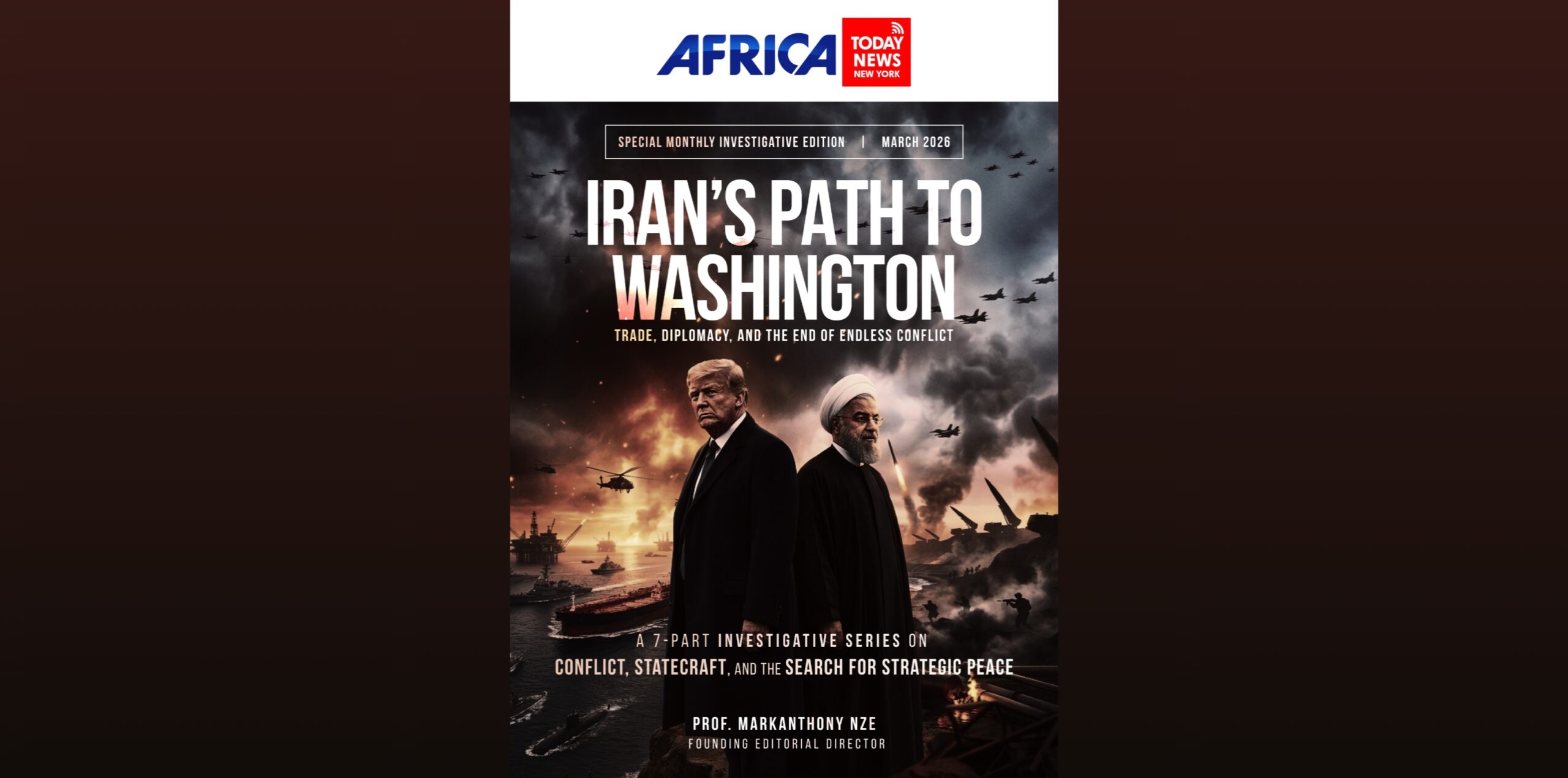
Trade, Diplomacy, and the End of Endless Conflict
A 7-part investigative series on conflict, statecraft, and the search for strategic peace
Prof. MarkAnthony Nze
Founding Editorial Director
Editorial Note
There are moments when a crisis stops being a sequence of events and becomes a test of political imagination. The present confrontation among Iran, Israel, and the United States has reached that point. It is no longer accurate to describe this as a familiar regional standoff managed through proxies, sanctions, covert action, and diplomatic intermittence. The crisis has entered a more dangerous phase—one in which direct force, nuclear opacity, civilian exposure, and economic shock now intersect with unusual intensity. The old language of “manageable tension” is beginning to fail. What has taken its place is a harder question: whether the region’s principal actors still possess the discipline to prevent escalation from becoming the new normal.
This special monthly investigation was commissioned in recognition of that shift. Journalism cannot meet a moment like this with headlines alone. It must also explain structure: how a region already burdened by mistrust, militarization, and unresolved nuclear fears arrived at a point where diplomacy and war now proceed almost side by side. On February 27, 2026, U.S.–Iran talks ended without a deal, even as mediators reported progress. On the same date, the International Atomic Energy Agency reported serious verification concerns, including more than eight months without access to verify previously declared highly enriched and low-enriched uranium, and warned of a loss of continuity of knowledge. These are not passing technical details. They are signs of a strategic environment in which uncertainty itself is becoming combustible.
The essays that follow proceed from a simple conviction: this crisis cannot be understood through a single lens. It is at once a confrontation over security doctrine, a struggle over deterrence, a failure of durable diplomacy, a dispute over nuclear transparency, an energy shock with worldwide implications, and a contest over legal and moral legitimacy. To reduce it to slogans—whether of resistance, preemption, or punishment—is to miss what is most important. Serious public understanding requires a fuller map. It requires tracing how Israeli preventive logic, Iranian survival instincts, and American strategic leverage now interact in ways that can produce both rational calculation and collective instability.
That larger instability is already visible well beyond the battlefield. The Strait of Hormuz remains one of the most critical chokepoints in the world economy. According to the U.S. Energy Information Administration, it has carried more than one-quarter of global seaborne oil trade and roughly one-fifth of global oil and petroleum product consumption, while about one-fifth of global liquefied natural gas trade also moves through it. On March 11, 2026, the International Energy Agency announced the largest oil-stock release in its history—400 million barrels from emergency reserves—to address disruptions stemming from the conflict. When a regional war compels a release of that scale, the issue is no longer merely regional. It has become a question of global exposure.
This is why Africa Today News, New York has chosen to present the investigation not as commentary in fragments, but as a structured editorial inquiry. Each part is designed to illuminate one dimension of the crisis while contributing to a larger argument: that no durable order can be built on permanent escalation, and no strategic actor—however militarily capable—can bomb its way to lasting clarity. The pieces explore how cold hostility became open confrontation; why Israeli doctrine continues to treat delay as danger; how Tehran is fighting simultaneously for deterrence, regime continuity, and narrative control; why Washington remains caught between containment and deeper entanglement; how the nuclear file has become more dangerous as visibility declines; how energy and shipping risks now radiate outward into the wider world economy; and why civilian harm and legal credibility increasingly shape the political meaning of the war itself.
This publication also makes a clear editorial judgment. However grave the crisis has become, the case for disciplined engagement is stronger now than the mythology of endless confrontation. Iran’s leaders may continue to derive political meaning from defiance, but defiance has not delivered economic recovery, strategic ease, or durable security. The United States, for all its contradictions, still remains the one actor with the leverage, alliances, and institutional reach to connect pressure, verification, and diplomacy in a form that could still produce an enforceable settlement. That does not make Washington blameless. It does make it central. And it raises the question that sits at the heart of this issue: whether Iran is finally prepared to treat peace with the United States not as capitulation, but as strategy.
That question is neither sentimental nor ideological. It is rooted in a fact now visible across every part of this crisis: the costs of escalation are no longer theoretical. They are measured in damaged inspections, failed talks, disrupted energy flows, wider insecurity, and the civilian burdens that accumulate when restraint becomes politically unfashionable. The purpose of this issue, then, is not to offer rhetorical comfort. It is to provide a serious framework for reckoning with one of the defining geopolitical tests of the present moment—and with the narrowing but still real possibility that statecraft, if chosen, may yet prove more durable than force.
Prof. MarkAnthony Nze, PhD, MCIM, MCIoJ, CMgr MCMI, MAAUP
Founding Editorial Director, Africa Today News, New York
Executive Overview
A high-stakes map of the conflict, the actors, and the narrowing path away from regional rupture
There are moments in international politics when events move faster than the language designed to contain them. The present confrontation among Iran, Israel, and the United States is one of those moments. What was once described as a shadow conflict—managed through proxies, covert operations, sanctions, cyber pressure, and intermittent diplomacy—has entered a more perilous phase, one in which direct military action, nuclear anxiety, economic disruption, and political brinkmanship now coexist in the same compressed arena. The old distinctions between deterrence and war, pressure and diplomacy, signaling and escalation, have begun to erode. In their place stands a harsher reality: a region no longer merely living with instability, but edging toward the normalization of direct confrontation as a governing condition.
This investigation begins from a simple but consequential premise. The crisis is not only about missiles, uranium, or retaliation. It is about the collision of three strategic imaginations, each convinced that delay carries greater danger than action. Israel approaches the moment through the logic of prevention, shaped by the belief that existential threats must be disrupted before they fully mature. Iran responds through the logic of survival, treating visible retaliation and narrative control as essential to regime continuity, deterrent credibility, and national pride. The United States, meanwhile, occupies the most consequential and uneasy position of all: a superpower trying to preserve order while exercising pressure, support an ally while avoiding full strategic ownership of the war, and keep diplomacy alive even as force continues to define the atmosphere in which diplomacy occurs.
That triangular tension is the real heart of the crisis. It is not a mere accumulation of bilateral disputes. It is a live contest among different visions of security, legitimacy, and regional order. Each side can present its behavior as rational. Israel argues that waiting invites catastrophe. Iran argues that restraint without reciprocity invites further coercion. The United States argues that leverage is necessary if diplomacy is to have meaning at all. Yet when these logics operate simultaneously, they produce something larger than rational competition. They generate a system in which all parties may feel strategically justified while collectively pushing the region toward outcomes none can fully control.
The significance of that shift extends beyond the battlefield. The current crisis has revealed how quickly regional conflict can transmit itself into global consequence. Nuclear uncertainty now overlaps with disrupted verification. Military strategy now collides with the law of armed conflict in urban and civilian environments. Energy insecurity now travels from the Gulf into freight rates, inflation, insurance costs, food systems, and sovereign vulnerability far beyond the Middle East. In this respect, the war is not simply a Middle Eastern story. It is a test of whether the contemporary international system still possesses the institutional strength to contain escalation before it becomes economic habit, diplomatic paralysis, and humanitarian routine.
At the center of this investigation lies the nuclear file, but not in the old, simplified sense. The issue is no longer only how close Iran may or may not be to a weapons threshold. It is also whether military escalation has further damaged the architecture of transparency itself. A nuclear dispute becomes more dangerous when visibility declines, when inspection regimes weaken, and when every strike increases uncertainty about what has survived, what has moved, and what may now be hidden. In such a climate, suspicion acquires strategic force of its own. The less the world can verify, the more easily worst-case assumptions become the basis for real decisions.
And yet this investigation does not proceed from fatalism. It does not assume that endless war is inevitable, nor does it indulge the illusion that peace will emerge automatically from exhaustion. Its argument is harder, but also more hopeful: that however grave the present crisis, the path away from a durable war order still exists, though it is narrowing. That path will not be built on sentiment, and certainly not on slogans about reconciliation detached from power. It will depend on structure—credible diplomacy, enforceable verification, restored political channels, disciplined restraint, and a recognition by all parties that unmanaged escalation is not strategy but drift.
The analysis that follows therefore examines the crisis not as a sequence of isolated episodes, but as an interlocking system. It traces the movement from cold hostility to open conflict; explores Israel’s doctrine of striking before the threshold; studies Iran’s response as a contest over deterrence, survival, and narrative authority; interrogates Washington’s unresolved dilemma between containment and co-belligerency; assesses the nuclear file after the bombs; maps the global economic aftershocks through energy and maritime insecurity; and confronts the civilian and legal dimensions of escalation that increasingly shape the conflict’s moral and political meaning.
Taken together, these chapters advance a broader conclusion. For all its contradictions, American power still occupies the most decisive place in any plausible route back to structure, negotiation, and strategic stability. That does not make Washington innocent, nor does it excuse the ambiguities of its policy. It does, however, reflect a difficult truth: no other actor presently possesses the leverage, institutional reach, alliance architecture, and diplomatic weight required to convert raw confrontation into an enforceable settlement. Iran, in turn, faces a choice that is becoming harder to postpone. It can continue to treat resistance as identity, even as that posture deepens isolation and risk. Or it can recognize that peace with the United States, however fraught, is not capitulation but strategy—a means of preserving national continuity, economic possibility, and geopolitical dignity in a region where perpetual escalation has already exacted too much.
That is the question beneath every page that follows. Not simply who can strike harder, retaliate faster, or endure longer, but who can still imagine a political future larger than the next exchange of force. In the end, the true divide is no longer between war and peace in the abstract. It is between a region imprisoned by recurrent confrontation and one willing, however reluctantly, to choose disciplined coexistence over endless brinkmanship.
Issue Framework
An investigative map of conflict, power, and the narrowing road to peace
| Section | Investigative Focus | Core Analytical Question |
| Editorial Note | A defining editorial statement from the Editorial Director introducing the purpose, scope, and public significance of this special monthly investigation | Why does this investigation matter at this moment, and how should its findings be understood? |
| Executive Overview | A high-stakes map of the conflict, the actors, and the narrowing path away from regional rupture | How did the Iran–Israel–U.S. confrontation become a crisis with regional and global consequences? |
| Part 1 — From Cold Hostility to Open Conflict | How decades of distrust, sanctions, proxy confrontation, and failed resets gave way to direct regional war | At what point did managed hostility collapse into open confrontation? |
| Part 2 — Israel’s Strategic Doctrine: Strike Before the Threshold | Why Israeli security doctrine treats delay as danger and prevention as necessity | Why does Israel see preemption as a strategic imperative rather than a policy option? |
| Part 3 — Iran’s Response: Survival, Deterrence, and Narrative Control | How Tehran is fighting to preserve state authority, retaliatory credibility, and political cohesion | How does Iran balance retaliation, regime survival, and the politics of perception under pressure? |
| Part 4 — Washington’s Dilemma: Containment or Co-Belligerency? | How the United States became both the manager of escalation and a participant in its risks | Can Washington still claim the role of stabilizer while remaining embedded in the machinery of war? |
| Part 5 — The Nuclear File After the Bombs | Why military strikes may damage infrastructure while deepening opacity, mistrust, and nuclear uncertainty | Has force made the nuclear threat smaller, or merely harder to verify and contain? |
| Part 6 — Energy, Shipping, and the Global Cost of Regional War | How Gulf instability travels through oil, trade corridors, insurance markets, and the wider world economy | How does a regional war migrate into global inflation, logistics stress, and economic insecurity? |
| Part 7 — Civilians, Legitimacy, and the Law of Escalation | Why civilian harm, legal credibility, and moral authority now shape the meaning of the war | Who is winning the struggle for strategic legitimacy as the human costs of war deepen? |
| Closing Insight | A culminating reflection on what peace would require and why strategic restraint now matters more than symbolic victory | Can this confrontation still be redirected toward disciplined coexistence rather than permanent crisis? |
| Selected Sources | A curated record of the principal reports, institutional materials, and journalistic sources informing this investigation | Which sources most substantively ground the analysis presented in this issue? |
| About the Author | A professional profile of Prof. MarkAnthony Nze as Editorial Director, investigative journalist, and policy analyst | Who is the author behind this investigation, and what institutional perspective informs the work? |
Part 1—From Cold Hostility to Open Conflict
How decades of distrust, pressure, and proxy confrontation gave way to direct regional war
The historical roots of the present Iran–United States–Israel crisis do not lie in a single grievance, treaty dispute, or military incident. They lie in the slow accumulation of mutually reinforcing fears: fear in Tehran that Washington and its regional allies seek not simply behavioral change but strategic suffocation; fear in Israel that Iran’s nuclear advances, missile infrastructure, and regional network have created an intolerable future threat; and fear in Washington that Iranian escalation, if not contained, will redraw the balance of power across the Middle East in ways hostile to U.S. interests. What makes the current moment distinct is that these fears are no longer being managed within the old repertoire of pressure, proxy contestation, and intermittent diplomacy. They are increasingly being expressed through direct confrontation.
For years, policymakers could still speak of a “shadow war.” The phrase carried a certain analytical comfort. It suggested a conflict that was dangerous but bounded—violent, but not yet fully uncontained. Israel relied heavily on covert disruption, intelligence penetration, and selective military pressure. Iran projected power through regional partners, strategic ambiguity, and nuclear latency rather than overt state-on-state warfare. The United States, while central to the architecture of sanctions and deterrence, still sought to preserve a degree of distance between coercion and total war. That structure has now weakened to the point of near collapse. Recent Reuters reporting on failed U.S.–Iran talks under threat conditions, combined with the IAEA’s account of disrupted safeguards access following military attacks on declared Iranian facilities, shows that diplomacy, verification, and force are no longer sequential instruments. They are now colliding in the same political space (International Atomic Energy Agency [IAEA], 2026; Reuters, 2026).
That collision matters because it transforms the meaning of the crisis. Earlier phases of U.S.–Iran tension were often interpreted through a sanctions-versus-enrichment framework: Washington tightened economic pressure, Tehran advanced its nuclear program or regional posture, and diplomats tried to convert leverage into a negotiated pause. The logic was coercive, but it remained legible. Today, the conflict is no longer reducible to that formula. It has become a three-sided contest in which Israeli preventive doctrine, Iranian retaliatory deterrence, and American coercive diplomacy overlap without producing a stable hierarchy of control. In practical terms, no actor is fully outside the crisis, yet no actor appears able to govern its tempo with confidence.
The enduring role of sanctions is central to understanding how this structure hardened. Sanctions were never merely punitive tools; they became an organizing principle of the relationship itself. Over time, they reshaped diplomacy by turning economic relief into a highly conditional and politically fragile commodity. The U.S. Department of State’s February 2026 sanctions action against Iranian procurement networks and what it described as a “shadow fleet” illustrates that the sanctions architecture remains active, adaptive, and deeply embedded in Washington’s approach to Iran (U.S. Department of State, 2026). This matters analytically because it shows that even when diplomatic channels reopen, they do so inside a landscape still defined by financial siege, export controls, reputational risk, and institutional distrust. Negotiation under those conditions becomes possible, but not durable by default.
The nuclear issue, moreover, has evolved from a matter of limits into a matter of visibility. That is one of the most consequential shifts in the present crisis. The IAEA’s February 2026 report does not simply reiterate old concerns; it underscores a more serious problem: the Agency has faced major constraints in verifying activities at facilities affected by military attacks, and it has stated plainly that without access and cooperation it cannot provide assurance regarding the status of declared nuclear material and facilities in Iran (IAEA, 2026). This is not a technical footnote. It goes to the heart of why the current crisis is more dangerous than earlier ones. Deterrence is already unstable in adversarial relationships; it becomes far more unstable when transparency erodes at the same time.
Reuters’ reporting on the February 2026 Geneva talks reinforces this point from the diplomatic side. The talks ended without an agreement, even though mediators described signs of progress, and they unfolded against a backdrop of overt military threat and U.S. force buildup (Reuters, 2026). The significance of that episode lies less in the absence of a deal than in the structure of the negotiation itself. Talks that take place while coercive deadlines loom may generate urgency, but they also shrink political room for reciprocal compromise. They encourage each party to negotiate as if conceding under duress would signal weakness to domestic and external audiences alike. In that environment, diplomacy becomes less a route out of confrontation than another theater within it.
Israel’s place in this history is equally essential. Although the present section centers on the roots of the divide, those roots cannot be explained solely through bilateral U.S.–Iran antagonism. Israel has long viewed the combination of Iranian missile capacity, nuclear capability, and regional influence as a strategic challenge that time itself worsens. From that perspective, delay is not neutral; delay is deterioration. That doctrine has increasingly converged with a broader regional climate in which preventive action appears, to its advocates, more rational than waiting for a more dangerous threshold to be crossed. Yet that same logic, when translated into repeated force, pushes Iran toward an equal and opposite conclusion: that visible retaliation is necessary to preserve deterrence and regime credibility.
This is the tragic architecture of the present crisis. Each side can narrate its own conduct as defensive, precautionary, and rational. Yet the interaction of those rationalities produces an escalatory system in which mistrust is not merely inherited from history; it is reproduced by current strategy. The roots of the divide therefore lie not only in memory, but in mechanism. A sanctioned state, a damaged verification regime, diplomacy under pressure, and military doctrines built around anticipation rather than restraint have together created a confrontation that is no longer cold, not yet total, and increasingly difficult to arrest before the next threshold is crossed.
Read also: Japan Unlocks Emergency Oil Reserves For Market Release
Part 2—Israel’s Strategic Doctrine: Strike Before The Threshold
Why Israeli security doctrine treats delay as danger and prevention as necessity
Before dawn, the logic of war is often clearest to those who fear waiting more than fighting. In Israel’s case, that fear has hardened into doctrine. Long before missiles begin to fly and diplomats begin to issue their carefully calibrated appeals for restraint, Israeli strategic thinking starts from a colder premise: an existential threat is most dangerous not when it is fully realized, but when it is still ripening behind ambiguity, delay, and international hesitation. That instinct—part memory, part geography, part statecraft—has shaped Israeli security policy for decades. In the present confrontation with Iran, it has become the organizing principle of a campaign that seeks not merely to respond to danger, but to interrupt its future.
To understand Israel’s current actions, it is not enough to say that the state feels threatened. Nearly every state at war claims to feel threatened. What distinguishes Israel is the degree to which it has institutionalized preemption as a strategic virtue. Talbot (2023), writing on the evolution of the Begin Doctrine, shows how deeply embedded this tradition remains in Israeli defense thinking: the refusal to allow a hostile regional adversary to acquire weapons of mass destruction has endured not as a slogan, but as a governing assumption. What has changed is not the doctrine’s core idea. What has changed is the character of the Iranian target.
Iran is not Osirak. It is not a single reactor, a single site, or a single moment of vulnerability. It is a layered state system with dispersed nuclear assets, hardened facilities, missile depth, scientific continuity, and regional reach. That distinction is decisive. A preventive strike against a finite installation is one thing; a preventive strategy against a distributed national capability is another. As Dolzikova (2025) argues in her study of attacks on nuclear facilities, military action may degrade infrastructure, complicate operations, and delay technical progress, but it rarely erases the political determination and institutional knowledge that sustain a program over time. This is the trap inside Israel’s doctrine. The more resilient and dispersed the target becomes, the more prevention expands—from singular strike to rolling campaign, from narrow counterproliferation to systemic pressure.
That expansion is now plainly visible. What Israeli strategy appears to recognize is that Iran’s nuclear program cannot be isolated from the broader military ecosystem that protects it and gives it strategic meaning. Nuclear latency is bound up with missile production, command networks, energy infrastructure, air defense, industrial repair capacity, and the political ability of the Iranian state to absorb punishment while projecting resolve. Once that judgment is accepted, the target list naturally widens. Reuters’ March 2026 reporting on strikes that hit fuel depots and refineries around Tehran, producing toxic clouds and broad environmental concern, illustrates that this campaign has moved well beyond the destruction of discrete nuclear sites (Rao & Zafra, 2026). The message embedded in those strikes is unmistakable: Israel is not simply trying to damage what Iran has built. It is trying to weaken what Iran can still sustain.
There is military logic to that strategy, and serious analysis should acknowledge it. A state that believes it is confronting an entrenched adversary will often conclude that degrading retaliatory capacity is as important as disrupting nuclear capability itself. If Iranian deterrence rests partly on missiles, partly on command resilience, and partly on the confidence that its state infrastructure can continue functioning under pressure, then a campaign aimed at those supporting systems can appear strategically coherent. Young (2026), writing for Carnegie, notes that early phases of the U.S.-Israeli assault emphasized decapitation and command disruption, suggesting a broader theory of coercion: shock the adversary, compress its ability to coordinate, and shape the war before it finds a stable rhythm of reply. In this reading, the campaign is not tactical improvisation. It is an attempt to break the architecture of endurance.
And yet this is where doctrine begins to collide with reality. Preventive war has always carried a profound contradiction. It claims legitimacy from the future while inflicting damage in the present. It is justified by what might happen if nothing is done, but it is judged by what immediately follows from action. That contradiction becomes sharper when the object of prevention is not a weapon already deployed, but a threshold that remains politically and technically contested. The IAEA’s February 2026 report is crucial on this point. The Agency made clear that following military attacks on Iranian nuclear facilities and the subsequent suspension of Iranian cooperation, it faced serious obstacles to verification and could no longer provide the same degree of assurance regarding material, facilities, and safeguards implementation (International Atomic Energy Agency [IAEA], 2026). This is not a secondary complication. It is a strategic warning. A strike may damage nuclear infrastructure, but if it also reduces transparency, it can leave the outside world less certain—not more—about what remains, what has moved, and what may be rebuilt beyond view.
That is why the traditional language of “setback” can be misleading. A program can be set back physically while becoming more opaque politically. Brookings scholars, including Einhorn (2025), have made precisely this point: military force may delay Iran’s capabilities, but it is unlikely by itself to eliminate the underlying program, and it may strengthen incentives for Tehran to reconstruct under even tighter secrecy. In other words, tactical success does not answer the larger strategic question. It may even deepen it. If the purpose of prevention is to stop a threat from maturing, but the effect is to drive that threat into less visible forms, then prevention risks becoming both necessary and self-defeating at once.
There is also a burden of persuasion that Israeli strategy cannot escape. Military doctrine may be designed in secure rooms, but its legitimacy is tested in the open. Israel must convince not only its own public, but also allies, markets, and a skeptical international audience that force is being used because the alternatives have genuinely narrowed. That becomes harder as the campaign broadens. Strikes on energy infrastructure may be integrated into a larger warfighting rationale, but they also produce civilian exposure, environmental harm, and a visual politics of destruction that can erode the moral clarity on which preventive doctrine depends (Rao & Zafra, 2026). In modern conflict, every explosion is both an act of force and an argument. It says something about necessity, proportionality, and what kind of order the attacker believes it is defending.
Israel’s doctrine, then, is neither irrational nor sufficient. It is rational in the severe way that states become rational when they believe time itself is working against them. But it is insufficient because force can delay, disrupt, and degrade without resolving the deeper political struggle over Iran’s capabilities, intentions, and regional role. The real significance of this doctrine lies in its double truth: Israel may be correct that waiting carries mortal risk, and still be wrong to believe that striking earlier solves the problem in durable form. That is the tension driving the present crisis. Israel is trying to stop a future it fears. In doing so, it may be helping create another one—a Middle East in which direct war, not shadow conflict, becomes the normal instrument of strategic prevention.
Read also: Day 11: Trump Threatens Iran with 20x Strikes Over Oil Blockade
Part 3—Iran’s Response: Survival, Deterrence, and Narrative Control
Why Israeli security doctrine treats delay as danger and prevention as necessity
States do not reveal themselves most clearly in times of peace. They reveal themselves when the sky is no longer neutral—when every statement carries military consequence, when succession rumors become strategic signals, and when survival itself must be performed in public. Iran’s response to the present crisis has unfolded in exactly that register. It has not been a simple act of retaliation, nor can it be explained as spontaneous fury after foreign attack. It has been a layered exercise in state preservation, a deliberate effort to prove that the Islamic Republic remains governable, retaliatory, and narratively intact even as its adversaries attempt to present it as penetrated, destabilized, and strategically cornered.
That distinction matters. In moments like this, military exchanges do not only destroy infrastructure; they contest political meaning. Israel and the United States have sought to frame the conflict as one in which Iranian capability can be broken faster than Iranian strategy can adapt. Iran, by contrast, has had to answer with something more demanding than vengeance. It has had to demonstrate continuity. As Africa Today News, New York reported in its March 1 account of the opening phase of the crisis, the military confrontation quickly widened across multiple provinces, with Iran’s retaliation extending beyond symbolic response into a broader regional message about reach, cost, and escalation potential (Africa Today News, New York, 2026a). That is the first key to understanding Tehran’s posture: retaliation is not merely punishment. It is proof of institutional survival.
Iran’s leadership has long understood that deterrence in the Middle East is not maintained by silence. It is maintained by calibrated visibility. To absorb a major strike and fail to answer would invite further coercion. To answer too widely, however, risks validating the case for a much larger war. This is the narrow corridor within which Iranian strategy has had to move. The goal is not emotional catharsis. The goal is to preserve the perception that the state can still impose consequences on its enemies while stopping short of a response so uncontrolled that it invites strategic collapse. The language surrounding Iran in recent days has only intensified that pressure. Africa Today News, New York’s March 6 and March 9 reports on threats tied to Iran’s future leadership illustrate the extent to which the conflict has expanded from military confrontation into open psychological warfare, with external rhetoric aimed not only at Iranian capabilities but at the symbolic authority of succession itself (Africa Today News, New York, 2026b, 2026c).
That escalation in rhetoric is more than theatrical excess. It touches a nerve at the center of the Iranian state. Regimes built on ideological legitimacy and centralized authority cannot treat leadership continuity as a private matter when adversaries are publicly discussing it as a strategic variable. Under such conditions, every official appearance, every command announcement, every retaliatory strike, and every media briefing serves two audiences at once. One is external: the United States, Israel, Gulf actors, and the wider international system. The other is domestic: elites, security institutions, and an anxious public that must be persuaded to ensure the state remains coherent. Iran’s response, then, has been military in form but constitutional in implication. It is trying to show that the command structure still functions, the chain of authority still holds, and the republic cannot be rhetorically decapitated into submission.
This is where Tehran’s narrative discipline becomes central. Modern conflict is fought not only through weapons but through sequencing, framing, and the management of uncertainty. Iran has an interest in appearing wounded but not disabled, angry but not reckless, adaptable but not improvised. That is a far more difficult balance than it sounds. External observers often interpret Iranian messaging as bombast, yet much of it is better understood as deterrent theater aimed at filling the space between action and perception. A missile strike says one thing; the official explanation of its timing, proportionality, and intended scope says another. Together they create the political architecture of response. The purpose is to deny adversaries the consoling belief that they alone control escalation.
But Iran’s strategy carries its own contradictions. Every act of visible retaliation may restore a measure of deterrence while simultaneously deepening the very siege conditions the state seeks to escape. A government that replies forcefully can reassure its core supporters and signal resolve to foreign adversaries. It can also intensify sanctions pressure, widen diplomatic isolation, and justify broader attacks under the banner of counter-escalation. In that sense, Iran is trapped inside a familiar but increasingly unforgiving paradox: it must retaliate enough to avoid looking vulnerable, but not so much that it makes vulnerability structurally permanent. Africa Today News, New York’s reporting on the opening phase of the crisis underscores how quickly the conflict moved from strike and counterstrike into a region-wide confrontation touching Gulf security, airspace, and the wider rules of engagement (Africa Today News, New York, 2026a). Once a response enters that environment, it is no longer solely Iran’s message. It becomes part of a multinational escalation script.
That is why Part 3 cannot be reduced to the language of revenge. Iran is not only retaliating. It is governing under fire. It is trying to hold together military deterrence, elite cohesion, and public narrative at the same time. The leadership understands that a state can survive material damage more easily than symbolic disintegration. If it appears unable to answer, it looks penetrable. If it appears unable to communicate authority, it looks divisible. If it appears unable to define the meaning of the crisis for its own population, it risks losing not just the information war but the internal logic of rule.
In the end, Iran’s response reveals something larger than battlefield calculation. It shows how states under extreme pressure fight on parallel fronts: one of force, one of perception, and one of political continuity. Tehran’s immediate objective is not victory in any grand historical sense. It is something both narrower and more urgent—to persuade enemies that it remains dangerous, persuade citizens that it remains intact, and persuade its own system that survival is still being managed rather than merely endured.
Part 4—Washington’s Dilemma: Containment Or Co-Belligerency?
How the United States became both the manager of escalation and a participant in its risks
Washington has spent years trying to preserve an illusion that is now becoming harder to sustain: that the United States can remain both indispensable to Israel’s security and somehow not fully responsible for the escalatory logic that security posture produces. That ambiguity once served American policy well. It allowed successive administrations to project deterrence, reassure allies, pressure Iran, and still reserve the diplomatic language of de-escalation for moments of crisis. In the present war, however, that middle position is under unusual strain. The problem is no longer whether the United States prefers restraint in theory. The problem is whether it can still plausibly act as a restraining power while participating in the very architecture of force that is remaking the conflict.
This is Washington’s central contradiction. The United States does not want a limitless Middle East war. It does not want a region-wide missile campaign against its bases, a prolonged shock to energy markets, or a political replay of the open-ended wars that hollowed out public confidence in American strategy after 2001. Yet it also does not want an Iran that can credibly threaten Israel, intimidate Gulf partners, or exploit diplomatic delay to widen its nuclear leverage. These objectives are individually intelligible. Together, they produce a policy that oscillates between coercive pressure and crisis management, between the language of imminent threat and the language of guarded off-ramps. Reuters’ reporting on the February 2026 Geneva talks captured this tension with unusual clarity: negotiations continued, but under the shadow of a massive U.S. military buildup and the explicit possibility of attack if diplomacy failed. That is not diplomacy replacing force. It is diplomacy conducted inside force’s countdown clock.
In practice, this means Washington is no longer merely supporting a partner from the sidelines. Congressional Research Service reporting shows that the United States joined Israel in military operations against targets inside Iran on February 28, 2026, while simultaneously debating war powers, oversight, force posture, and what exactly the administration’s end state might be. The same report notes that U.S. operations were embedded in a larger policy mix that included direct statements about eliminating threats, destroying missile capacity, and encouraging political change inside Iran. Once those elements converge—kinetic participation, political signaling, and a declared role in shaping the adversary’s future—the distinction between backer and belligerent starts to fray.
That distinction matters because American power has always done more than alter battlefields; it alters how every other actor calculates risk. Israel interprets visible U.S. commitment as strategic depth. Iran interprets it as confirmation that the confrontation is not simply with Jerusalem but with the broader American-led order that has sought for decades to contain, sanction, and isolate it. Gulf states read it through another lens again: as both insurance and danger, reassurance against Iranian coercion and exposure to Iranian retaliation. Once Washington becomes operationally present in a direct war with Iran, it ceases to be merely the guarantor of the regional balance. It becomes one of the forces redefining that balance in real time.
The deeper difficulty is that the United States still appears uncertain about the political horizon of the conflict. That uncertainty is not trivial; it is strategic. If the objective is deterrence, then force must be calibrated to restore boundaries. If the objective is rollback, then force will naturally widen. If the objective drifts toward regime change—even rhetorically—then the war acquires a different character entirely, because the target is no longer only capability but sovereignty itself. Brookings analysts have warned that this is precisely where the danger lies: regime decapitation and battlefield success can coexist with profound uncertainty about what follows, including state fragmentation, institutional collapse, or the emergence of even harder-line successors. In that sense, the problem is not merely that Washington lacks a clean plan. It is that military efficacy can create political overconfidence at exactly the moment when strategic humility is most needed.
There is also a domestic American dimension that deserves more scrutiny than it often receives in foreign policy writing. War with Iran does not enter an institutional vacuum. It enters a constitutional system in which presidents claim urgency, Congress debates authorization after the fact, and the public is asked to distinguish between “limited operations” and war itself. The CRS report makes clear that questions over the War Powers Resolution, congressional notification, and the legal basis for the use of force have already become part of the policy struggle. That debate is not procedural clutter. It is one of the few mechanisms through which the United States tests whether strategic necessity has outrun democratic consent. The longer the conflict endures, the more those questions move from the margins to the center.
And yet Washington’s predicament cannot be understood only in legal or institutional terms. It is also moral and reputational. American officials still want the freedom to speak in two registers at once: the register of disciplined statecraft and the register of overwhelming force. But in wars like this, the world tends to make its own judgment. Allies watch for consistency. Adversaries watch for hesitation. Uncommitted states watch for hypocrisy. If the United States presents itself as the indispensable steward of regional order while participating in operations whose political endpoint remains indeterminate, it risks looking less like a stabilizer than like a great power gambling that military superiority can substitute for strategic clarity.
That is the real dilemma confronting Washington. It is not choosing between war and peace in some simple moral register. It is choosing how much ownership it is willing to assume for a conflict whose consequences it may not fully control. To remain half inside and half outside the war is no longer a stable position. The United States can still contain escalation at moments, still open channels, still shape the tempo of events. But it is increasingly doing so not as an external manager of crisis, but as a participant whose credibility, liabilities, and strategic inheritance are already tied to the outcome. The old language of distance is wearing thin. What remains is a harder question: whether America is still containing a regional war, or whether it has already become indispensable to its continuation.
Part 5—The Nuclear File After The Bombs
Why military strikes may damage infrastructure while deepening opacity, mistrust, and nuclear uncertainty
Wars often begin with declarations of certainty. The adversary is closer than ever. The window is closing. Action cannot wait. Yet when the smoke settles over nuclear sites, certainty is usually the first casualty. That is where the Iran crisis now stands. After the strikes, the central question is no longer only how much damage was inflicted. It is whether the campaign has made the nuclear problem more solvable or merely more opaque. That distinction matters because the danger in nuclear crises is rarely confined to what has been destroyed. It also lies in what can no longer be seen, measured, or verified.
For years, the Iranian nuclear issue was understood through a hard but intelligible policy sequence: pressure, negotiation, inspection, and partial rollback. However imperfectly, that sequence at least preserved a governing logic. If diplomacy advanced, inspectors gained access. If talks stalled, sanctions tightened. If enrichment accelerated, international scrutiny followed. The present crisis has fractured that order. Military force, diplomatic bargaining, and safeguards monitoring are no longer arranged in sequence; they are colliding in the same political moment. Reuters reported in late February 2026 that the latest U.S.–Iran talks ended without a deal despite signs of progress, and they unfolded under explicit military threat and a major U.S. force buildup. That setting is not conducive to trust-building. It is diplomacy conducted under compression, where each concession risks looking like surrender and each delay increases the appeal of force.
The IAEA’s February 27, 2026 safeguards report makes clear why this matters. The Agency said it had requested Iran to facilitate access to safeguarded facilities and locations, yet had not received the cooperation necessary to restore confidence in the monitoring environment. More troubling still, the report underscored that the Agency could not re-establish continuity of knowledge in the way it once could, precisely because access, surveillance, and technical engagement had been disrupted. In plain terms, the international community is now confronting not just a nuclear dispute, but a visibility crisis. And visibility is the lifeblood of nonproliferation. A program that cannot be fully monitored becomes more dangerous not only because of what it might do, but because of what others may assume it is doing.
This is where Washington’s role acquires unusual significance. Critics will say, not without reason, that the United States helped create the high-pressure environment in which diplomacy has struggled to survive. But it is equally true that no other power now possesses the leverage, institutional reach, and diplomatic weight necessary to reconstruct a credible verification framework. Europe can urge restraint. Regional mediators can shuttle messages. International inspectors can document gaps. But only Washington has the practical capacity to connect sanctions relief, security guarantees, compliance benchmarks, and verification mechanisms into a single enforceable structure. That is why, even after the bombs, the path away from escalation still runs more plausibly through American statecraft than around it.
That does not mean military pressure is meaningless. The Brookings analysis published after the 2025 Israeli strikes made an important point that remains relevant now: force can degrade facilities, impose delay, and signal seriousness, but it is unlikely by itself to eliminate Iran’s nuclear program in durable form. The reason is structural. Nuclear capability is not housed only in buildings. It is housed in expertise, organizational memory, procurement networks, and political will. Destroying centrifuges is one thing; destroying the logic that sustains the program is another. Indeed, strikes can create the opposite incentive, strengthening arguments within Iran that secrecy, dispersal, and reduced cooperation are now matters of national survival rather than bargaining leverage.
That is the paradox now confronting all sides. Israel may succeed in imposing operational setbacks. The United States may succeed in demonstrating that the costs of defiance are real. But if those gains are not translated into a renewed inspection regime and a disciplined negotiating channel, the result may be a nuclear file that is harder to read and therefore harder to stabilize. This is not a theoretical concern. The IAEA’s reporting already points to a more damaged verification landscape, and once continuity of knowledge is lost, rebuilding it is neither quick nor politically simple. Every gap in monitoring expands the space for suspicion. Every expansion of suspicion increases the demand for further coercion. And every round of coercion makes diplomacy more brittle.
Iran, in turn, now faces a strategic choice more consequential than any public declaration of resistance. It can continue to treat opacity as leverage, betting that ambiguity will preserve deterrence and national pride. Or it can recognize that ambiguity in the current climate is not strengthening its position but narrowing its options. A state under sanctions, under military threat, and under deepening inspection deficits does not gain durable security by making itself harder to verify. It gains temporary bargaining power at the price of long-term instability. If Tehran genuinely wants to prevent this crisis from maturing into a permanent war order, it will have to return to a politics of access, restraint, and measurable commitments.
The hardest truth in the aftermath of the strikes is that neither side can bomb its way to strategic clarity. Iran cannot retaliate its way into international confidence. Israel cannot strike its way into permanent assurance. And the United States cannot rely on pressure alone to produce a stable settlement. But if one actor still retains the ability to turn coercion into structure, it is Washington. That is not because American policy has been flawless. It is because the United States remains the only power capable of assembling the full architecture a post-strike nuclear settlement would require: enforcement, incentives, allies, inspectors, and the political weight to make compliance meaningful. The choice before Iran, then, is not between dignity and surrender. It is between a negotiated return to visibility and a future in which the nuclear file becomes the standing justification for endless confrontation.
Part 6—Energy, Shipping, And The Global Cost Of Regional War
Why civilian harm, legal credibility, and moral authority now shape the meaning of the war
The most revealing measure of a Middle Eastern war is often not the first missile launch, but the first insurance recalculation. Long before the full human and political consequences of conflict are understood, markets begin translating danger into price, delay, and scarcity. That is precisely what this crisis has done. What began as a military confrontation among Iran, Israel, and the United States has rapidly become an economic event with global reach, exposing how deeply the architecture of world trade still depends on fragile waterways, concentrated energy flows, and the assumption that strategic chokepoints will remain open even when the region around them is not. Reuters reported this week that the conflict has rattled businesses worldwide, raising energy prices, tightening supplies of key inputs, and casting doubt on trade routes central to the movement of goods ranging from food to auto parts.
That broader exposure is not accidental. It is structural. The Persian Gulf is not merely one energy province among many. It is one of the core transmission mechanisms through which regional conflict becomes global economic stress. The Strait of Hormuz remains the most important pressure point in that system. According to the U.S. Energy Information Administration, flows through Hormuz in 2024 and early 2025 accounted for more than one-quarter of global seaborne oil trade and roughly one-fifth of global oil and petroleum product consumption. Around one-fifth of global liquefied natural gas trade also moved through the strait in 2024, largely from Qatar. That concentration gives the waterway a significance beyond geography: it is not simply a route through which commodities pass, but a bottleneck through which expectations about inflation, shipping reliability, and industrial continuity are constantly being repriced.
This is why the crisis cannot be understood only as a problem of oil prices. Oil is the headline, but diesel, LNG, shipping insurance, freight costs, refinery inputs, and delivery schedules are the deeper story. Reuters’ March 10 reporting on diesel markets showed how quickly disruption in and around Hormuz can move beyond crude benchmarks into the operational bloodstream of the world economy. Diesel matters because it is the fuel of movement itself—trucking, shipping, heavy industry, agriculture, construction. When diesel prices spike sharply, the effect is not abstract. It spreads through food systems, manufacturing costs, port logistics, and consumer prices. Analysts cited by Reuters warned that the current conflict could trigger a second round of cost-push inflation, not because the world is short of every form of energy at once, but because the fuels most tightly linked to physical transport are proving unusually vulnerable.
That vulnerability arrives at a moment when maritime trade is already under strain. UNCTAD’s 2025 Review of Maritime Transport warned that shipping had entered a period of exceptional fragility, with freight markets shaped by route disruptions, rising costs, and persistent geopolitical uncertainty. It projected maritime trade growth slowing sharply, and it emphasized that disruptions in one strategic corridor can ripple through the entire logistics chain by extending voyage times, tightening vessel availability, and increasing insurance and compliance costs. In other words, the system was already brittle before this war intensified. The present crisis has not created a new fragility out of nowhere; it has collided with a trading system that had less resilience than policymakers often assumed.
This is where the current conflict becomes especially revealing. It demonstrates that regional war no longer needs to produce a full physical closure of a waterway to achieve strategic effect. Mere disruption, credible threat, and sporadic attacks on commercial traffic can be enough to raise costs dramatically. Reuters reported today that ships have been hit in the Gulf and that the widening conflict is now visibly affecting commercial navigation. Once that happens, shipowners, insurers, refiners, and commodity traders do not wait for legal declarations or perfect clarity. They act on risk. Tankers reroute. Premiums rise. Delivery windows widen. Buyers seek alternatives that may be more expensive or less reliable. The economic weapon is uncertainty itself.
The energy response now under discussion underscores how severe that uncertainty has become. The International Energy Agency announced on March 11 that its 32 member countries had agreed to make 400 million barrels from emergency reserves available to the market, the largest release in the agency’s history, in response to disruptions stemming from the war. That decision is significant for two reasons. First, it shows that governments judge the disruption to be systemic rather than speculative. Second, it reminds us that emergency reserves are not a substitute for stable sea lanes. They can buy time. They cannot restore strategic normalcy. Reuters noted that markets remained unconvinced even after the release plan was announced, a sign that traders are pricing not just temporary shortage but prolonged insecurity around Gulf transit.
The World Bank had already warned, in both its April and October 2025 Commodity Markets Outlook reports, that an expanded Middle East conflict posed a serious upside risk to energy prices and could deliver broader macroeconomic damage through oil, fertilizer, and food channels. Those warnings now read less like scenario planning than early diagnosis. Commodity shocks do not stay in commodity markets. They feed into sovereign budgets, current-account pressures, industrial planning, and household insecurity. A sustained increase in energy costs can squeeze importing economies in Africa and South Asia, complicate post-inflation recovery in Europe, and aggravate fiscal stress in poorer states already carrying high food-import bills. The global cost of this war, then, is not only borne by energy traders or wealthy importers. It is transmitted downward, often most harshly, to societies far from the battlefield.
There is also a geopolitical irony at work. Iran may see pressure on Gulf shipping as one of the few levers capable of imposing real external cost on its adversaries and their partners. In a narrow sense, that calculation is understandable. A state under sanctions and military attack will naturally search for asymmetric means of raising the price of escalation. But this logic also exposes the limits of coercion as strategy. Disrupting trade routes can frighten markets and compel attention, yet it rarely creates prosperity for the state wielding the threat. On the contrary, it strengthens the international coalition for maritime security, hardens the case for sanctions enforcement, and deepens the perception that Iran is choosing leverage over reintegration. That is one reason a balanced but sober reading of the crisis still leans toward the American position: however imperfect U.S. policy may be, Washington remains the actor most invested in keeping the arteries of global commerce open rather than weaponizing their fragility.
That point should not be romanticized. The United States is not a neutral custodian of world order. It is a strategic power with alliances, interests, and a long record of interventions that others view with suspicion. But on the question of energy stability and shipping continuity, the distinction still matters. The world economy is not served by a regional order in which chokepoints become bargaining chips and merchant traffic becomes collateral signaling. It is served, however unevenly, by a system that keeps transit open, markets legible, and disputes channeled into negotiation before insurers and navies become the most important voices in the room.
In the end, Part 6 points to a truth larger than oil. The war’s economic significance lies in how quickly it converts geography into inflation, insecurity into freight cost, and local confrontation into global strain. Every strike in the Gulf now carries two audiences: the immediate adversary and the wider world that depends on uninterrupted movement through narrow waters. That is why peace, for Iran as much as for anyone else, cannot be treated as a sentimental aspiration. It is an economic imperative. A country seeking recovery does not secure its future by making the world fear the routes around it. It secures its future by making itself valuable to the stability those routes require.
Part 7—Civilians, Legitimacy, And The Law Of Escalation
Why civilian harm, legal credibility, and moral authority now shape the meaning of the war
Wars are often narrated first through strategy and only later through suffering. Generals speak of deterrence, governments speak of necessity, analysts speak of balance and thresholds. Yet the deeper truth of escalation usually appears elsewhere: in the school that should never have been near a target list, in the neighborhood forced to breathe toxic air because a refinery became a node in someone else’s military logic, in the unexploded bomblet that waits on a street long after the speeches have ended. That is where this conflict now must be judged. Not only by who struck first, nor even by who gained the momentary advantage, but by what kind of political order each side is creating through the civilian consequences of war.
This matters because legitimacy in modern conflict is no longer a decorative concern attached after the fighting. It is part of the fighting. States do not merely wage war; they argue it. Every strike is also a claim about law, necessity, restraint, and moral hierarchy. Israel argues that preventive action is required because the danger of waiting is greater than the danger of striking. Iran argues that retaliation is necessary because vulnerability invites further coercion. The United States argues, more selectively, that force can be employed without abandoning the language of de-escalation. But the law of armed conflict does not grant any party a blank check for strategic eloquence. It asks harder questions. Were civilians and civilian objects adequately distinguished from military targets? Were feasible precautions taken? Was the expected civilian harm excessive in relation to the concrete and direct military advantage anticipated? Those are not rhetorical tests. They are the legal guardrails that stand between war as coercion and war as drift into brutality.
The current crisis suggests how quickly those guardrails can weaken under pressure. The UN human rights system has already warned that the conflict is “playing out worst fears” for civilians, with impacts on civilian infrastructure and a widening geography of harm. The Office of the High Commissioner for Human Rights has called for an immediate cessation of attacks by all parties, while UN experts have emphasized that attacks on civilians, educational facilities, and medical institutions would constitute grave violations of international humanitarian law and human rights law. These are not abstract admonitions. They are signals that the conflict is no longer being judged solely through military categories; it is being measured against the extent to which civilian life is being folded into strategic messaging.
One of the most disturbing examples is the reported blast at an elementary school in Minab, Iran. Associated Press reporting, drawing on satellite imagery and expert analysis, found evidence suggesting that the explosion was likely caused by a U.S. airstrike, with more than 165 people reportedly killed, most of them children. American officials had not publicly accepted responsibility at the time of the report, but the existence of an internal investigation itself conveys the gravity of the allegation. If the reporting is borne out, the episode would raise profound questions not only about targeting intelligence, but about the reliability of claims that technologically advanced militaries can consistently separate military necessity from catastrophic civilian error. Precision, in such cases, becomes less a guarantee than a promise under legal stress.
Iran’s conduct raises a different but equally serious legal problem. AP reporting indicates that Israeli officials say Iran has been using cluster munitions on a near-daily basis during the present war. Such weapons disperse bomblets over wide areas and often leave unexploded ordnance behind, making them especially dangerous in or near populated zones. Although Iran, Israel, and the United States are not parties to the Convention on Cluster Munitions, the absence of treaty accession does not erase broader legal concerns under customary humanitarian law, especially the rules against indiscriminate attacks and the obligation to take precautions in attack. In practical terms, cluster munitions compress military and civilian space in a way that makes distinction harder and post-strike civilian safety far more precarious. Their use is therefore not merely controversial; it is reputationally disastrous for any state seeking to persuade the world that its retaliation remains disciplined and proportionate.
Israel’s campaign presents another version of the same legitimacy dilemma. Reuters reported that strikes on fuel depots and refineries around Tehran produced toxic clouds and environmental concerns across the capital. Israeli officials defended those sites as linked to missile fuel and military logistics. That may be an intelligible military argument. But legality and legitimacy are not exhausted by the existence of some military nexus. Modern urban warfare places extraordinary weight on the expected civilian effects of striking dual-use infrastructure. When attacks on energy facilities produce broad public-health risks, prolonged disruption, and environmental harm, the legal and political scrutiny intensifies. What begins as a question of military relevance rapidly becomes a question of whether a campaign is externalizing cost onto civilian populations faster than it is generating lasting strategic gain.
The United States, for its part, faces a distinctive burden. Because it presents itself not merely as a participant but as a custodian of a rules-based international order, its margin for legal and moral contradiction is narrower than that of openly revisionist actors. This is where balanced reading still tends to lean in Washington’s favor, though only cautiously. The United States retains the institutional vocabulary—investigations, public legal justification, alliance consultation, congressional scrutiny, engagement with international monitoring—that can, at least in principle, convert battlefield excess into accountability and policy correction. That does not absolve American actions. But it does distinguish a system that still contains mechanisms for review from one that treats opacity as strategic advantage. The question is whether Washington will use those mechanisms seriously enough to preserve the credibility it claims.
Iran’s challenge is sharper. If Tehran wants the world to see its actions as resistance rather than recklessness, it cannot rely indefinitely on the argument that all retaliation is self-evidently justified by prior attack. International humanitarian law does not disappear when a state claims to be acting defensively. The same is true for Israel. Preventive logic does not erase the duty to distinguish, to calibrate, and to avoid excessive civilian harm. And for the United States, strategic partnership does not remove the obligation to ask whether the war’s legal rationale is being stretched beyond recognition. The same rules apply to all; what differs is the political credibility each side retains when accused of violating them.
There is a broader pattern here that deserves attention. As wars lengthen, civilian harm often stops appearing as accidental from the perspective of those living beneath it. It begins to look structural. Repeated attacks on infrastructure, repeated displacement, repeated exposure to unexploded ordnance, repeated ambiguity over who struck what and why—these do not merely injure people. They alter the social meaning of law itself. If legal principles exist only as language after the fact, while daily life becomes more exposed and less protected, then the normative center of the conflict collapses. At that point, legitimacy is no longer a contest over who complied best. It becomes a contest over who destroyed the credibility of restraint more completely.
This is why Part 7 is not a moral detour from strategic analysis. It is strategic analysis. Civilian suffering is not incidental to the outcome of the war; it is part of how the outcome will be defined. A state that wins tactically but loses the argument about law and humanity may find that military gains harden political resistance, deepen diplomatic isolation, and make postwar order harder to build. In that sense, the law of escalation is not simply about what parties may or may not do. It is about whether they can still imagine victory as something other than the accumulation of pain.
The sober conclusion is that all three principal actors—Iran, Israel, and the United States—are now operating in a battlespace where legitimacy is as contested as territory. But the burden falls most heavily on the party that still wants to claim stewardship of order. If Washington truly wishes to be seen as the indispensable channel through which this crisis can be turned back toward diplomacy, it will need to insist not only on deterrence, but on accountability, restraint, and visible respect for the rules it says distinguish order from chaos. Iran, meanwhile, will have to decide whether continuing to weaponize fear serves its future any better than it serves its immediate pride. And Israel will have to reckon with an old strategic truth: that a doctrine of prevention, however compelling in the language of survival, cannot remain legitimate if the civilians caught beneath it become the clearest evidence of its cost.
Closing Insight
What peace would require, and why strategic restraint now matters more than symbolic victory
In the end, the most consequential crises are not remembered solely for the violence they unleash, but for the political truths they expose. This one has exposed several at once. It has shown that the old grammar of Middle Eastern conflict—proxy warfare, sanctions, covert operations, deterrent signaling, and stalled diplomacy—can no longer fully contain the pressures now building across the region. It has shown that military superiority, however formidable, does not automatically produce strategic clarity. And it has shown that a conflict sustained by fear, pride, and accumulated grievance can continue long after its original rationale has ceased to offer a plausible path to security. That is the deeper significance of the present confrontation among Iran, Israel, and the United States. It is not simply another episode in a familiar cycle. It is a test of whether the region’s principal actors can still distinguish between power and purpose. The ability to strike, retaliate, and endure is not the same as the ability to shape a durable political outcome. Indeed, one of the most sobering lessons of this investigation is that all three actors have, in different ways, become captives of their own strategic logic. Israel fears the danger of waiting. Iran fears the humiliation of restraint. The United States fears the consequences of both escalation and retreat. Each position contains a measure of reason. Yet taken together, they form a system that rewards immediate force more readily than long-term settlement. And still, for all its danger, this crisis has not yet closed the door to a different future. That is the point that matters most.
The path to de-escalation has narrowed, but it has not disappeared. If anything, the violence of the present moment has made its necessity more obvious. No serious observer can now claim that military action alone will resolve the nuclear question, restore regional balance, secure maritime flows, protect civilian life, and stabilize the political imagination of the Middle East. The idea that force, by itself, can solve what history, ideology, and statecraft have made so intricate is not realism. It is impatience dressed in strategic language. The harder truth is that peace in this context will not arrive as reconciliation in the sentimental sense. It will arrive, if at all, through discipline. Through verification rather than wishful thinking. Through negotiated restraint rather than theatrical escalation. Through the patient reconstruction of political channels that have been damaged by years of mistrust but remain indispensable precisely because mistrust is so deep. That kind of peace is not glamorous. It does not satisfy maximalists. It does not flatter those who prefer the moral simplicity of total victory. But it is the only peace that stands a chance of surviving contact with reality. For Iran, this conclusion carries particular weight. The Islamic Republic has long defined itself, in part, through defiance of American power. That posture has delivered symbolism, ideological coherence, and a certain narrative of sovereignty. But it has not delivered strategic ease. It has not insulated the country from economic suffocation, regional vulnerability, diplomatic isolation, or the recurring prospect of war. There comes a point at which resistance, however emotionally resonant, ceases to function as grand strategy and becomes instead a habit of national attrition. Iran is now dangerously close to that point. The wiser course would be to recognize that peace with the United States need not mean submission, erasure, or historical amnesia. It could mean something more serious: a decision to preserve the state through calibrated coexistence rather than permanent brinkmanship. That, ultimately, is why the United States remains central to any plausible resolution.
Not because American policy has been pure, and not because Washington is free of contradiction. It is neither. But because, for all its inconsistencies, it still possesses the leverage, institutional reach, and diplomatic capacity to convert pressure into framework, confrontation into process, and crisis into negotiation. No other actor currently commands that combination of power and structure. If there is to be an enforceable peace—measured, imperfect, but real—it will almost certainly require American engagement at its core. The choice, then, is no longer between ideal outcomes. It is between continuing a politics of escalation whose costs are now visible to the world, or accepting the more difficult labor of strategic coexistence. History rarely offers clean exits from entrenched conflict. But it does, at critical moments, offer a narrowing window in which political maturity matters more than rhetorical defiance. This may be such a moment. If so, the central question is not whether the region can afford peace. It is whether it can afford much more of the alternative.
Selected Sources (APA 7th Edition)
Africa Today News, New York. (2026, March 1). What we know about the US–Israel strike and Iran’s response
Africa Today News, New York. (2026, March 6). Trump insists on hand-picking Iran’s next leadership
Africa Today News, New York. (2026, March 9). Iran’s new chief needs my say-so to survive, Trump warns
Associated Press. (2026, March 6). Evidence suggests the deadly blast at an Iranian school was likely a US airstrike.
Associated Press. (2026, March 10). Israel says Iran is using cluster munitions. What to know about the weapons.
Brookings Institution. (2025, June 16). Israel strikes Iran: What happens next?
Brookings Institution. (2026, March 2). After the strike: The danger of war in Iran.
Dolzikova, D. (2025, April 4). Nuclear facilities as targets of military attack: Assessing drivers and implications for nuclear safety. Royal United Services Institute.
International Atomic Energy Agency. (2026, February 27). NPT safeguards agreement with the Islamic Republic of Iran (GOV/2026/8).
International Energy Agency. (2026, March 11). IEA member countries to carry out largest ever oil stock release amid market disruptions from Middle East conflict.
International Committee of the Red Cross. (2025, March 11). Global initiative to galvanise political commitment to international humanitarian law.
International Committee of the Red Cross. (2025, March 19). International humanitarian law and the challenges of contemporary armed conflicts.
International Committee of the Red Cross. (n.d.). Targeting under international humanitarian law.
International Committee of the Red Cross. (n.d.). Urban warfare and violence.
Office of the United Nations High Commissioner for Human Rights. (2026, March). Middle East crisis plays out worst fears; talks only way out.
Reuters. (2026, February 27). US-Iran talks end with no deal but potential signs of progress.
Reuters. (2026, March 2). Iran conflict disrupts global shipping as tankers are stranded, damaged.
Reuters. (2026, March 9). How US-Israeli war on Iran is upending global business.
Reuters. (2026, March 10). Diesel markets, upended by Middle East conflict, threaten global economic slowdown.
Reuters. (2026, March 10). Strikes create toxic clouds over Tehran.
Reuters. (2026, March 11). Sea drones target oil tankers in the Middle East as conflict risks widen.
Reuters. (2026, March 11). US ignites Iran war, but Gulf Arab states pay the price, Gulf sources say.
Talbot, B. (2023). Israel’s Begin doctrine: Preventive strike tradition and Iran’s nuclear pursuits. Æther: A Journal of Strategic Airpower & Spacepower, 2(4), 1–14.
Thomas, C., Blanchard, C. M., Sharp, J. M., & Zanotti, J. (2026, March 1). U.S. and Israeli military operations against Iran: Issues for Congress (IN12662). Congressional Research Service.
United Nations Conference on Trade and Development. (2025). Review of maritime transport 2025: Staying the course in turbulent waters.
U.S. Department of State. (2026, February 25). Sanctions to disrupt Iran’s weapons procurement networks and shadow fleet.
U.S. Energy Information Administration. (2025, June 16). Amid regional conflict, the Strait of Hormuz remains critical oil chokepoint.
U.S. Energy Information Administration. (2025, June 24). About one-fifth of global liquefied natural gas trade flows through the Strait of Hormuz.
World Bank. (2025, April 29). Commodity markets outlook, April 2025.
World Bank. (2025, October 29). Commodity markets outlook, October 2025.
Young, M. (2026, March 10). The greatest dangers may lie ahead. Carnegie Endowment for International Peace.
About the Author
Professor MarkAnthony Nze, PhD, MCIM, MCIoJ, CMgr MCMI, MAAUP is a New York–based investigative journalist, governance analyst, and strategic management scholar whose work interrogates institutional integrity, compliance breakdowns, and policy risk across health and social care, media, law, public administration, and emerging markets. He is the Publisher and Founding Editorial Director of Africa Today News, New York, and serves as tenured Professor and Academic Director at the New York Center for Advanced Research (NYCAR), where he leads applied research on governance innovation, strategic leadership, and geopolitical risk assessment.
His scholarship and public commentary focus on governance systems, market-entry structures, institutional risk design, and the political and economic pressures shaping decision-making across contemporary institutions. He also oversees NYCAR’s free, globally accessible professional certification programs in Health and Social Care.
Professor Nze holds a PhD in Economics and Management from Apsley Business School, London, together with advanced professional qualifications in law, strategic communication, filmmaking, international business law, and health and social care management. He is a member of the American Association of University Professors and a Chartered Manager (CMI, UK).
Institutional Affiliation: Africa Today News, New York | New York Center for Advanced Research (NYCAR)
Contact: [email protected]