
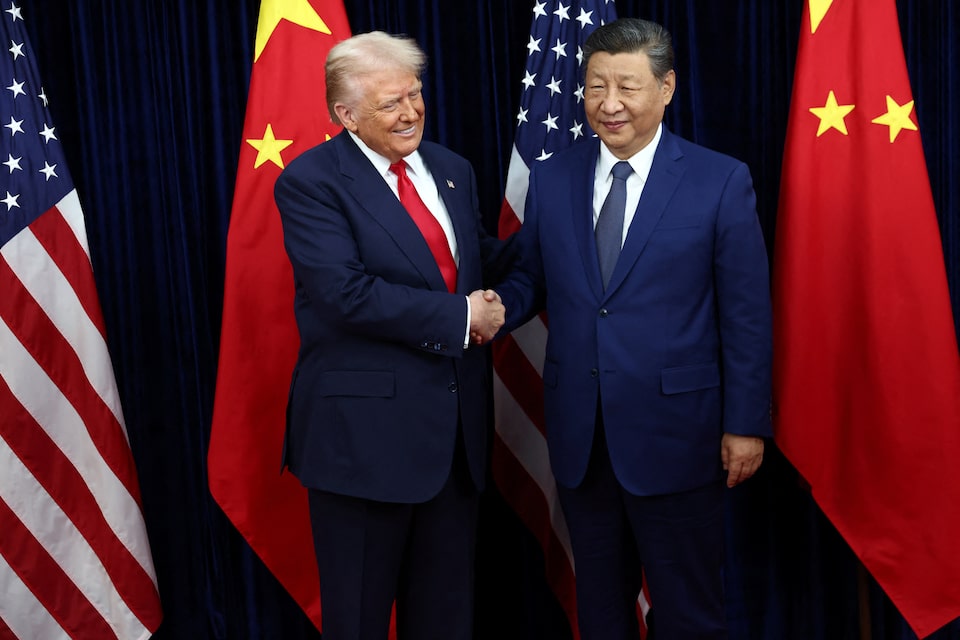
U.S. President Donald Trump said Thursday that he and Chinese President Xi Jinping reached an agreement to cut tariffs and step up cooperation against the illicit fentanyl trade, marking a major development in economic relations between Washington and Beijing.
Speaking to reporters aboard Air Force One after talks in Busan, South Korea, Trump described the face-to-face meeting which was their first since 2019, as “an amazing meeting,” rating it “12 out of 10.”
Under the agreement, the United States will reduce tariffs on Chinese imports to 47% from 57%, including halving duties on trade in fentanyl precursor chemicals from 20% to 10%. In return, China pledged to crack down on fentanyl production, resume large-scale U.S. soybean purchases, and keep rare earth exports flowing to global markets.
Read Also: China Reaffirms Force Option To Take Over Taiwan
Trump said he was encouraged by Beijing’s willingness to curb the flow of fentanyl, a synthetic opioid that remains the leading cause of overdose deaths in the United States.
“President Xi will work very hard to stop the flow,” Trump said. “We reduced the tariff because I believe they are really taking strong action.”
Xi, speaking through a translator at the start of the meeting, described occasional friction between the world’s two largest economies as “normal” and called for cooperation. “I am willing to continue working with President Trump to lay a solid foundation for China–U.S. relations,” he said.
The meeting took place on the sidelines of the Asia-Pacific Economic Cooperation (APEC) summit and lasted nearly two hours, capping Trump’s whirlwind Asia tour that included trade deals with Japan, South Korea, and Southeast Asian nations.
Trump said China agreed not to impose new restrictions on rare earth exports, crucial minerals used in electric vehicles, smartphones, and advanced defense systems. Beijing had tightened controls earlier this month, raising concerns about supply disruptions.
“They’re not going to impose the rare earth controls,” Trump told reporters, adding that he signed multiple pacts during his Asia trip aimed at diversifying global rare earth supplies through partnerships with Japan and Southeast Asian nations.
Beijing had also sought an easing of U.S. export controls on sensitive technology and the rollback of new port fees on Chinese vessels. Trump did not comment directly on those requests but said China would buy “tremendous amounts” of U.S. agricultural products “starting immediately.”
Despite the upbeat tone, both nations continue to compete fiercely in areas such as semiconductors, AI technology, and maritime influence in the Indo-Pacific.