
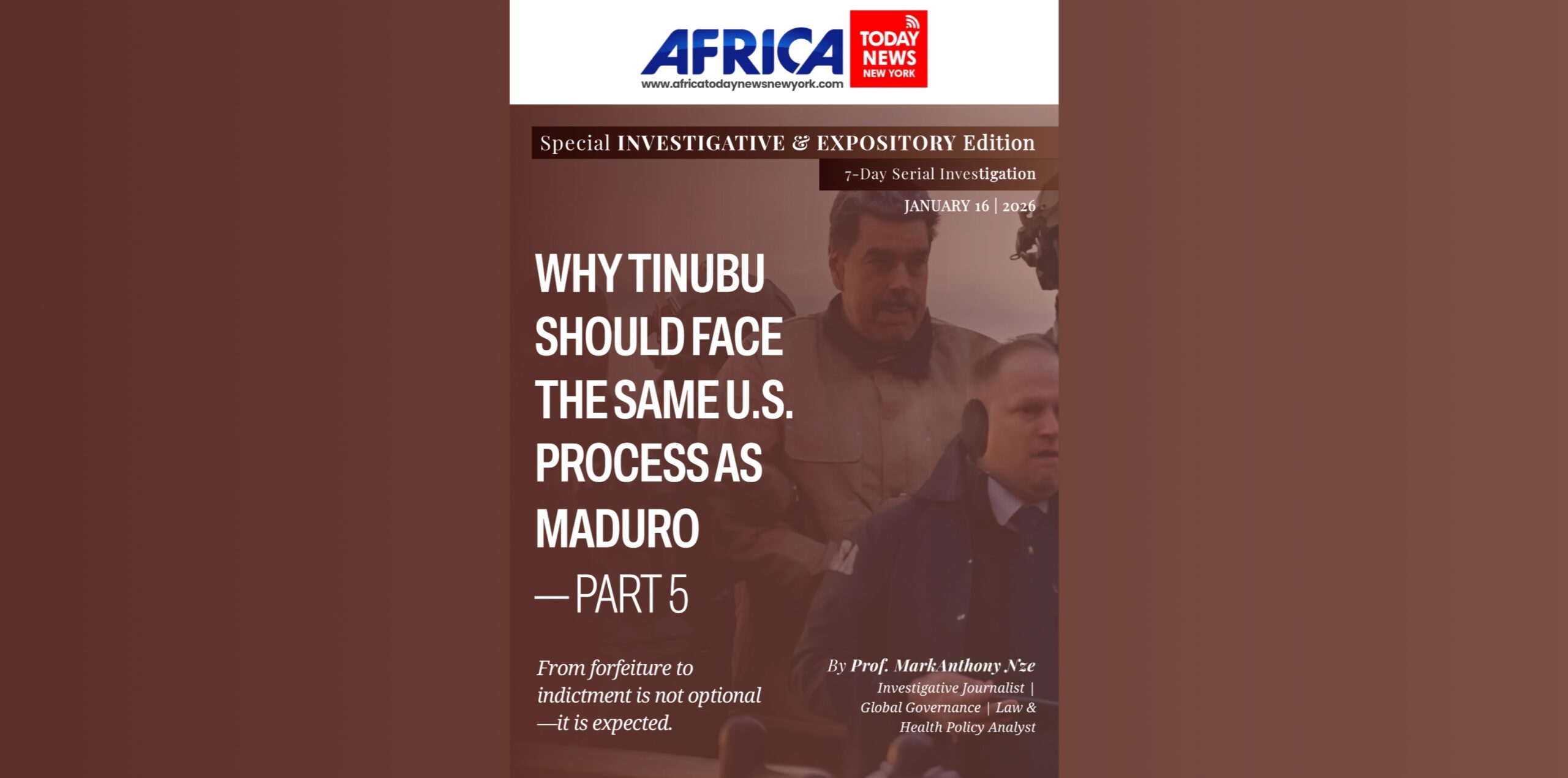
The Path Not Taken: Tinubu and the Missing Middle
From forfeiture to indictment is not optional—it is expected.
By Prof. MarkAnthony Nze
The American criminal process isn’t a choose-your-own-adventure. It is a sequence with guardrails. The government asserts probable cause, seizes assets under law, consolidates evidence, seeks grand jury review, and either indicts or formally declines—leaving a paper trail either way. Follow that path and legitimacy compounds. Skip it and the system looks like power without process. Applied to the forfeiture action associated with Bola Ahmed Tinubu, what stands out is not the spark at the beginning but the silence in the middle. In a legal architecture designed to culminate, the record thins precisely where the law expects density.
This is not a morality play. It is a mechanics check.
The Sequence Congress Wrote—and the One the File Suggests
Start where the Constitution starts: probable cause. It is a trigger, not a terminus. It authorizes searches, seizures, arrests—and continued investigation (U.S. Courts, 2022). When the United States lodges a verified forfeiture complaint, it swears that the evidence clears that threshold, not casually but under penalty of perjury. Congress then hard-wired what follows. Under CAFRA, seizure sits inside a timeline and an evidentiary arc pointing toward adjudication or escalation; the government must proceed to test its claim or step back in the open (18 U.S.C. § 983). The statute contemplates action and resolution. It does not contemplate a vanishing act.
Seizure is supposed to be the moment the case gets serious. Evidence is traced, money mapped, witnesses vetted, parallel tools deployed. DOJ policy treats forfeiture in narcotics and money-laundering matters as a preservative move—locking down assets while prosecutors decide whether the criminal case should follow (Department of Justice, 2023). Courts expect that discipline. In forfeiture litigation, judges demand specifics—show me the link between these dollars and that crime—not vibes (United States v. $124,700 in U.S. Currency, 2020). The same consolidation that sustains forfeiture should carry into the charging review.
When the evidence coheres, the democratic gate swings into view: the grand jury. This is not decorative ceremony. It is the community checkpoint that converts executive suspicion into public accusation. The process is secret while it runs, but it is not endless. It ends in a bill or a declination—either outcome recorded, either outcome accountable.
From there, two clean exits preserve integrity. Indictment? Proceed to arrest, arraignment, trial—public testing of evidence. Declination? Close the loop—and say so. Oversight bodies are blunt: unresolved enforcement actions corrode trust; closure, either way, is the safeguard (Office of the Inspector General, 2021). Federal courts sing the same refrain: once coercive power is triggered, the government’s conduct must stay reviewable and accountable; abandonment without explanation grates against due-process norms (United States v. Batato, 2016).
That is the map. Congress wrote it. Courts enforce it. DOJ trains prosecutors to follow it. And where the Department has wanted to escalate, it has—publicly and completely. The Maduro prosecution is an exemplar: investigation, grand jury, indictment, warrants, full public charging under narcotics and money-laundering statutes (Department of Justice, 2020). Civil measures were not a substitute for criminal accountability; they were a prelude to it.
Read also: Why Tinubu Should Face The Same U.S. Process As Maduro—Part 4
“No Indictment” Is Not Innocence; “No Record” Is Not Governance
Into that settled pattern, inject a common confusion: the idea that “no indictment” equals exculpation. It doesn’t. Absence of charges can reflect timing, gaps, cooperation, priorities, or a formal declination. What confers legitimacy is not silence; it is reasons. Forfeiture scholarship is clear: when enforcement advances unevenly or stops without record, skepticism rises and the system itself looks selective (Carpenter II, 2023; Harvard Law Review, 2020). Inequality is inferred less from outcomes than from opacity (Didwania, 2025). In other words, the story the public tells in a vacuum is always worse than the story the record can sustain—so put the record down.
Applied to the Tinubu-associated forfeiture, the front end exists: probable cause asserted; assets seized under serious statutes. What’s missing is the middle: consolidated evidence presented to a grand jury; an indictment unsealed—or a formal declination explaining why prosecution would not proceed. In routine practice, even when prosecutors decide not to indict, the loop closes. Property is returned. Forfeiture is resolved on the merits. Dismissal is entered with reasons. The file shows the fork and the choice.
Here, the public record thins exactly where the law expects thickness.
This Isn’t About Morals. It’s About Mechanics—and Fairness
This analysis does not accuse; it audits the process. The same architecture that has produced visible escalation against other targets—probable cause, grand jury review, charging—did not complete its work here. That divergence demands explanation because the architecture demands completion. Oversight agrees: Inspector General audits warn that unresolved actions corrode confidence and invite perceptions of selective enforcement (Office of the Inspector General, 2021). Global integrity assessments reach the same conclusion: selective application of financial-crime law erodes deterrence and credibility (Transparency International, 2022). In a system where legitimacy rides on equal process, equal sequence is the floor.
Transparency Is the Backstop When Process Breaks
When the chain snaps, transparency law is supposed to catch the fall. FOIA doctrine permits narrow secrecy where disclosure would cause defined harms, but it resists procedural amnesia once the government has already wielded enforcement power (Pozen, 2019). Courts increasingly distinguish necessary secrecy from avoidance—especially when records are old and the public interest is high (Electronic Privacy Information Center, 2023). Recent Supreme Court decisions on property and due process press the same principle: the state must complete its work in daylight; retention or deprivation without justification violates constitutional norms (Tyler v. Hennepin County, 2023; Culley v. Marshall, 2024). The logic travels: an enforcement path that begins and then disappears invites judicial impatience.
Four Lawful Endings—Choose One, and Write It Down
Once probable cause was asserted and assets seized, four legitimate endpoints existed:
1. Escalate to a grand jury and, if warranted, indict—then arrest, arraign, and try.
2. Return the property if the government could not meet its burdens.
3. Resolve the forfeiture on the merits—judgment or settlement on the record.
4. Issue a formal declination explaining why prosecution would not proceed.
Each preserves legitimacy because each leaves a record. Everything else looks like the government flexed and then forgot.
The Hard Question the File Forces
“Why no indictment?” is the wrong headline. The right one is: “Why no endpoint?” If the case was thin, say so and close it. If the case was strong, escalate it and own it. If equities counseled against charging, memorialize them. If there was a settlement, show it. When the law works briskly for some matters and stalls—quietly—for others, the pattern itself becomes the story. And stories without records harden into narratives about selective justice that no democracy can afford.
This is not about Bola Ahmed Tinubu alone. It is about whether the United States still believes that power must be yoked to process and process to paper. From forfeiture to indictment is not a performative slogan. It is the expected path. When the government takes the first step, it owes the public one of the four lawful endings—and the documentation to match. Anything less is not exculpation; it is abdication.
Professor MarkAnthony Ujunwa Nze is an internationally acclaimed investigative journalist, public intellectual, and global governance analyst whose work shapes contemporary thinking at the intersection of health and social care management, media, law, and policy. Renowned for his incisive commentary and structural insight, he brings rigorous scholarship to questions of justice, power, and institutional integrity.
Based in New York, he serves as a full tenured professor and Academic Director at the New York Center for Advanced Research (NYCAR), where he leads high-impact research in governance innovation, strategic leadership, and geopolitical risk. He also oversees NYCAR’s free Health & Social Care professional certification programs, accessible worldwide at:
https://www.newyorkresearch.org/professional-certification/
Professor Nze remains a defining voice in advancing ethical leadership and democratic accountability across global systems.
Selected Sources (APA 7th Edition)
Carpenter II, D. M. (2023). Generating revenue through civil forfeiture. New York University Law Review, 98, 205–240. https://www.nyulawreview.org/wp-content/uploads/2023/05/NYULawReview-Volume98-Carpenter.pdf
Culley v. Marshall, 601 U.S. ___ (2024). https://www.supremecourt.gov/opinions/23pdf/22-585_8nj9.pdf
Department of Justice. (2020). Justice Department announces charges against Nicolás Maduro and other Venezuelan officials. https://www.justice.gov/opa/pr/justice-department-announces-charges-against-nicolas-maduro
Department of Justice. (2023). Asset forfeiture policy manual. https://www.justice.gov/afp/asset-forfeiture-policy-manual-2023
Didwania, S. H. (2025). Asset forfeiture and inequality. Stanford Law Review, 77(1), 159–210. https://review.law.stanford.edu/wp-content/uploads/sites/3/2025/01/Didwania-77-Stan.-L.-Rev.-159.pdf
Electronic Privacy Information Center. (2023). Glomar responses and FOIA litigation. https://epic.org/issues/open-government/glomar/
Harvard Law Review. (2020). Civil asset forfeiture and the Constitution. Harvard Law Review, 133(6), 1749–1772. https://harvardlawreview.org/print/vol-133/civil-asset-forfeiture-and-the-constitution/
Office of the Inspector General, U.S. Department of Justice. (2021). Audit of the Department of Justice asset forfeiture program. https://oig.justice.gov/reports/audit-department-justice-asset-forfeiture-program
Pozen, D. E. (2019). Freedom of information beyond the Freedom of Information Act. University of Pennsylvania Law Review, 165(5), 1097–1158. https://scholarship.law.upenn.edu/penn_law_review/vol165/iss5/1/
Transparency International. (2022). Exporting corruption: Enforcement of foreign bribery laws. https://www.transparency.org/en/publications/exporting-corruption-2022
Tyler v. Hennepin County, 598 U.S. 631 (2023). https://www.supremecourt.gov/opinions/22pdf/22-166_1b82.pdf
United States v. $124,700 in U.S. Currency, 458 F. Supp. 3d 1030 (D. Ariz. 2020). https://law.justia.com/cases/federal/district-courts/arizona/azdce/4:2019cv08250/1168948/34/
United States v. $405,089.23 in U.S. Currency, 33 F.4th 1021 (9th Cir. 2022). https://law.justia.com/cases/federal/appellate-courts/ca9/20-55514/20-55514-2022-05-09.html
United States v. Batato, 833 F.3d 413 (4th Cir. 2016). https://law.justia.com/cases/federal/appellate-courts/ca4/14-4753/14-4753-2016-08-03.html
U.S. Congress, Congressional Research Service. (2023). Crime and forfeiture: Legal overview. https://crsreports.congress.gov/product/pdf/R/R43890
U.S. Courts. (2022). Probable cause. Administrative Office of the U.S. Courts. https://www.uscourts.gov/glossary/probable-cause
U.S. Code. (n.d.). 18 U.S.C. § 983 – General rules for civil forfeiture proceedings. Legal Information Institute. https://www.law.cornell.edu/uscode/text/18/983