
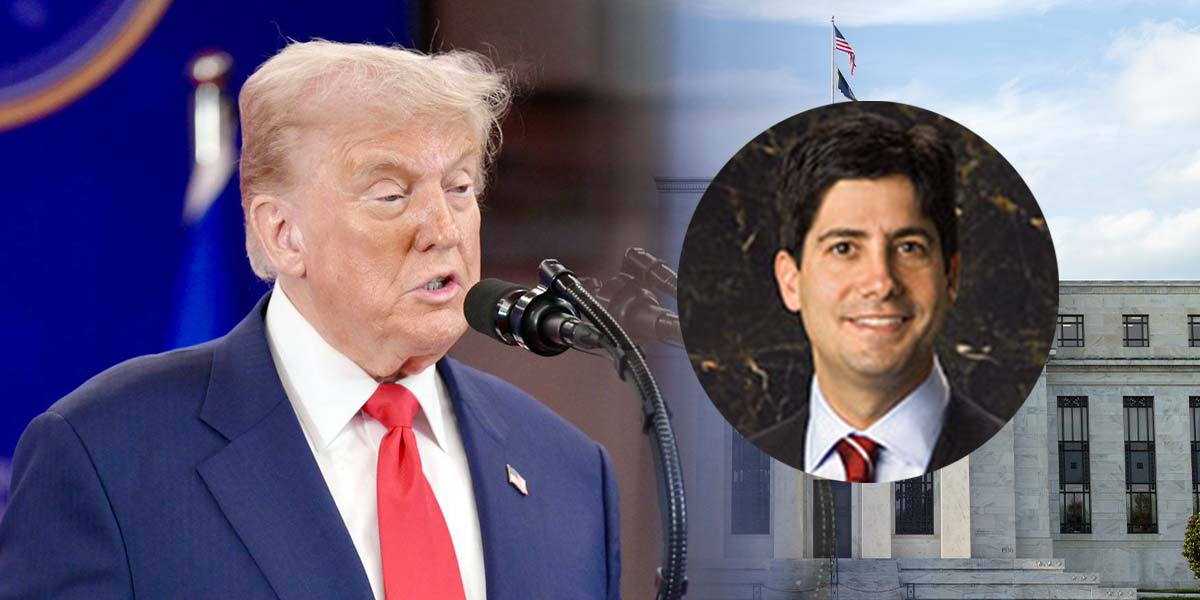
Washington, D.C. — U.S. President Donald Trump announced on Friday that he intends to nominate Kevin Warsh, a former Federal Reserve governor, to serve as the next chair of the Federal Reserve — a choice that signals a possible shift in the central bank’s leadership during a period of economic uncertainty.
Trump made the announcement on social media, calling Warsh one of the “best” candidates for the role and saying he would “never let you down.” When speaking to reporters later, the president said Warsh was the “perfect candidate,” highlighting his academic credentials and experience.
If confirmed by the Senate, Warsh would replace Jerome Powell, whose current term as Fed chair is set to expire in May. The nomination must still be approved by lawmakers before Warsh can formally assume the post.
Warsh, 55, has a long history with the central bank and national economic policy. He was appointed to the Federal Reserve Board of Governors in 2006 at just 35 years old, making him one of the youngest governors in the institution’s history. He served through the global financial crisis and was involved in high-level policy discussions during that tumultuous period.
Before his time at the Fed, Warsh worked as a special assistant for economic policy under President George W. Bush beginning in 2002. After leaving the Federal Reserve, he held senior roles in the private sector, including at Morgan Stanley, and later became a distinguished visiting fellow at Stanford University’s Hoover Institution. He also holds a law degree from Harvard Law School.
Read Also: BREAKING: Iran Calls EU Armies Terrorist Groups Over IRGC Listing
In recent months, Warsh has expressed a more positive view on the possibility of interest rate cuts, a stance that aligns with Trump’s public pressure on the Federal Reserve to ease monetary policy to support economic growth. However, the central bank’s decisions are made by a committee of policymakers, and it remains unclear whether Warsh’s views will secure majority support among his future colleagues.
Warsh’s potential leadership comes at a critical time for the U.S. economy, as officials weigh inflation concerns, labor market strength, and global economic risks. His confirmation process is expected to draw close attention from both lawmakers and financial markets.