
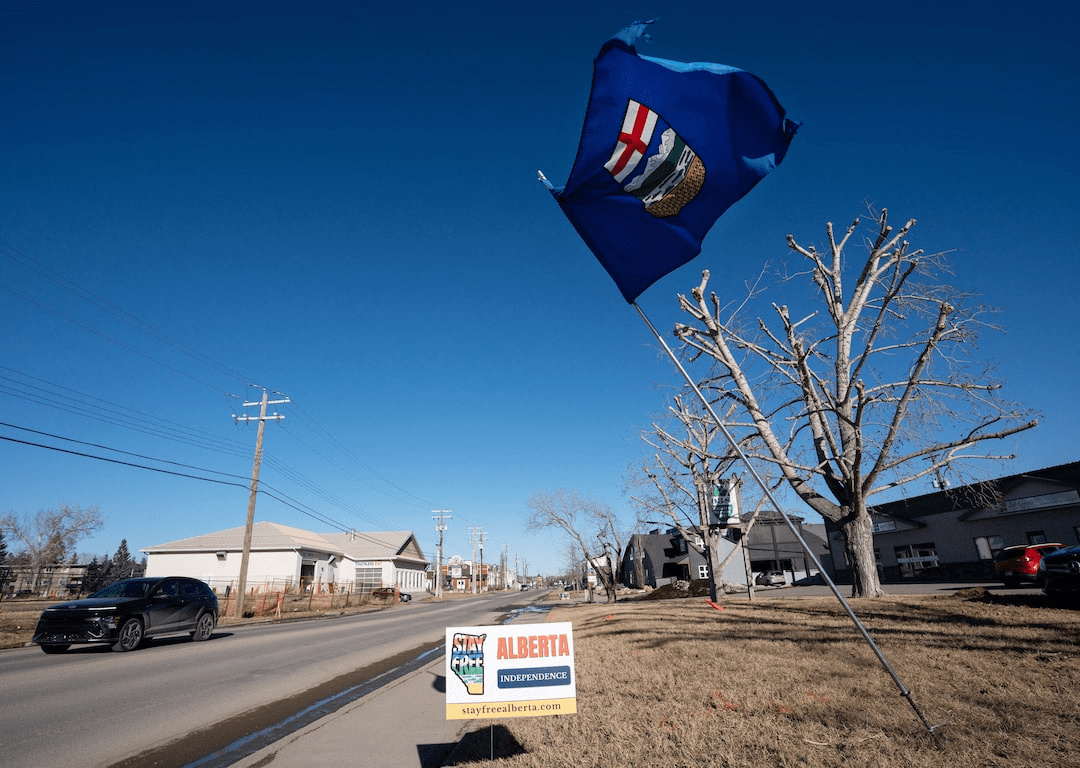
Separatists in Alberta are collecting signatures to force a referendum on independence from Canada, a campaign that has gained momentum as the oil-rich western province’s grievances with Ottawa deepen amid U.S. President Donald Trump’s trade threats and annexation rhetoric.
Organizers aim to gather roughly 177,000 signatures by May 2, equivalent to 10 percent of Alberta’s registered voters, the threshold needed under provincial law to trigger a citizen-initiated referendum. Volunteer canvassers have set up tables in towns across the province, drawing residents who say they want Alberta to chart its own course as a sovereign nation rather than join the United States.
The drive presents a complication for Prime Minister Mark Carney, who has sought to project national unity while navigating Trump’s tariff policies and repeated suggestions that Canada should become part of the United States. Alberta, a politically conservative province that generates the bulk of Canada’s oil and gas output, has long harbored resentment toward federal Liberal governments it accuses of strangling the energy sector with restrictive environmental policies.
Jeff Rath, spokesman for the Alberta Prosperity Project, which backs independence, said the separatist cause is building support. He confirmed that he and other activists traveled to Washington in January to meet with U.S. State Department officials, seeking to gauge how the administration would view an independent Alberta.
During the meetings, Rath said he raised the possibility of constructing a new pipeline to carry Alberta oil to American markets. He described the response as positive, noting U.S. concerns about Ottawa’s plans to expand energy sales to China. “The only thing we’re interested in is a free and independent Alberta, not statehood,” Rath said.
A White House official said American officials routinely meet civil society groups and that no support or commitments were made. A State Department official confirmed staff-level discussions took place without senior officials present, adding that no further meetings were planned.
Carney, asked about reports of contact between Trump administration officials and Alberta separatists, said he expected Washington “to respect Canadian sovereignty.”
Canada ranks as the world’s fourth-largest oil producer, with petroleum and natural gas accounting for the country’s most valuable export category. Nearly all Canadian oil and gas comes from Alberta, where the industry employs tens of thousands and tax revenue from energy companies forms a significant portion of the provincial budget.
In High River, a town in the foothills of the Rocky Mountains, residents stopping at a strip mall to sign the petition described Alberta as culturally and economically distinct from the rest of Canada. Darell Seib, a local resident, cited the province’s conservative politics and cowboy heritage as markers of difference. “People are independent, people are entrepreneurial, we work hard,” he said. “We’re different. We need to have more of our governance closer to home.”
Read also: House Passes Measure To Overturn Trump’s Canada Tariffs
Other supporters of the campaign voiced frustration that Alberta’s economic contributions go unrecognized nationally. Government data show the province accounted for nearly as much economic growth in 2024 as Ontario, Canada’s most populous province, despite having one-third the population. Several people Reuters interviewed asked not to be identified, citing concerns about backlash in their communities.
Polling suggests separatist sentiment remains a minority view. A survey conducted this month by Leger found 71 percent of Albertans want to remain part of Canada, while nearly one in five support independence. Rath declined to disclose how many signatures have been collected but said a referendum could occur as early as October if the petition succeeds.
Alberta Premier Danielle Smith’s government enacted legislative changes last year that lowered barriers to citizen-led referendums, including halving the signature requirement. Smith said in a statement her government supports “a strong and sovereign Alberta within a united Canada” but that citizen-initiated referendums allow residents to express differing views. She said she has been working with Carney to reduce tensions between the province and federal authorities.
Electoral officials in Alberta have also certified a competing petition, submitted by a former deputy premier, that calls for Alberta to remain a Canadian province. A referendum on that question could also be held this fall.
Duane Bratt, a political science professor at Mount Royal University in Calgary, called the situation “absolutely bonkers.” He said Smith has repeatedly taken steps to ease the path for a separatist vote, despite her stated opposition to independence.
Adrienne Davidson, an assistant professor of political science at McMaster University, said multiple obstacles stand in the way of Alberta secession, including the absence of a defined threshold for the share of voters needed to compel the federal government to enter secession negotiations.
Read further: FDA Rejects Moderna Flu Shot Review Amid Policy Reversal
A long-standing separatist movement in Quebec, the French-speaking province where independence referendums were held in 1980 and 1995, could further complicate matters. The Parti Quebecois, which leads in polls ahead of an October provincial election, has pledged to hold a third referendum by 2030 if it wins power. Academics said a Quebec independence vote could accelerate sovereignty demands in Alberta.
Carney has attempted to address Alberta’s concerns by offering policy concessions. In November, he signed an agreement with Smith to scale back certain climate regulations and support construction of a new oil pipeline to Canada’s West Coast.
Gabriel Brunet, a spokesman for Dominic LeBlanc, Canada’s minister for intergovernmental affairs, described Alberta as “an essential partner” for Ottawa. “Canada’s new government is engaged in renewing the Canada-Alberta relationship based on common objectives and respect,” Brunet said.