
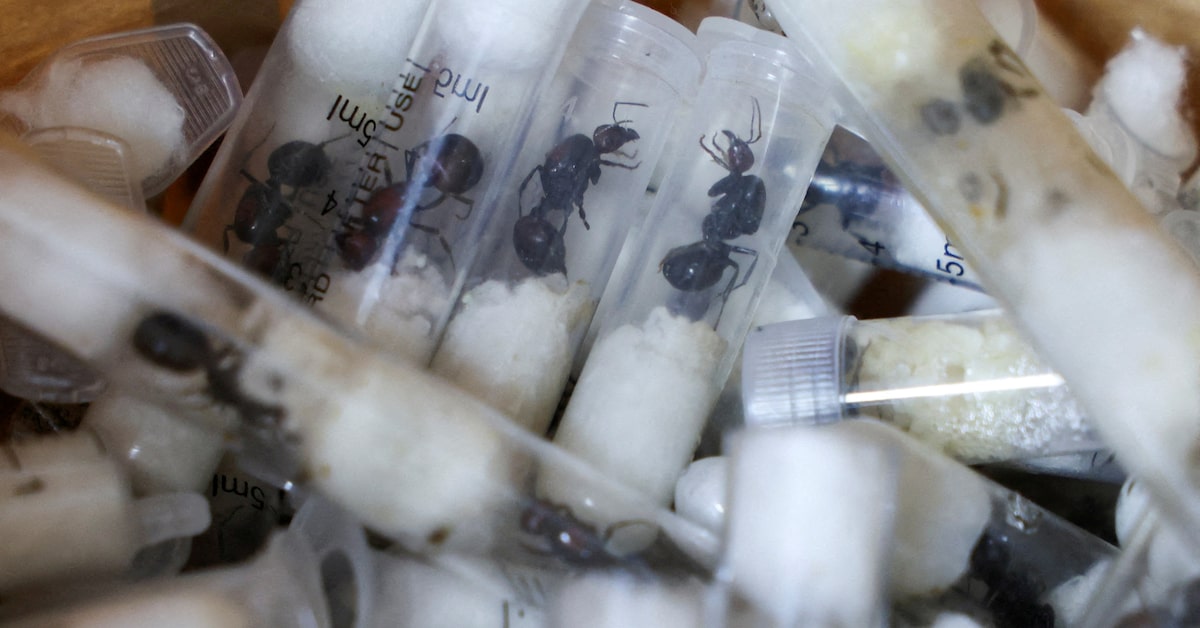
A Chinese national identified as the suspected ringleader of an international garden ant trafficking syndicate was arrested at Nairobi’s Jomo Kenyatta International Airport after authorities discovered more than 2,200 live queen ants concealed in specialised test tubes and tissue paper rolls inside his luggage, court documents filed at the JKIA Law Court showed on Wednesday.
Zhang Kequn, 27, was intercepted in the early hours of Tuesday as he prepared to board a flight out of Kenya. Kenya Wildlife Service investigators said Zhang was caught as he attempted to smuggle close to 2,000 queen garden ants sealed for shipment to China, with part of the consignment packed in test tubes and approximately 300 more concealed inside tissue paper rolls hidden within his luggage. JKIA Law Court prosecutor Allen Mulama told the presiding magistrate that a personal search of Zhang’s baggage had recovered 1,948 ants stored in specialised test tubes — a refinement, Mulama noted, from the syringes used in a comparable case in 2025. The remaining 290 ants were found inside three separate rolls of soft tissue paper.
Zhang had not left Kenya voluntarily. Investigators said Zhang was the mastermind behind the trafficking ring broken up last year in Kenya but had apparently escaped the country at that time using a different passport. Immigration officials had placed a stop order on his current travel document following his evasion of arrest, and it was that flagged entry on his passport that led security personnel to intercept him before he could board on Tuesday.
He had been in Kenya for approximately two weeks before his arrest, according to court documents, and had identified three accomplices to investigators who he said had supplied him with the ants.
The KWS told the court it required five days to complete its investigation, including forensic examination of an iPhone and a MacBook seized from Zhang at the time of his arrest. Detectives have extended their field inquiries beyond Nairobi to Nakuru, Naivasha, and other towns in the Rift Valley where ant harvesting operations are suspected to be ongoing. Senior Principal Magistrate Njeri Thuku granted the detention request and ordered Zhang held at Lang’ata Police Station pending the outcome of the forensic work. The case is listed for mention on March 17.
The significance of the Bangkok connection disclosed to the court adds a distinctly international dimension to what might otherwise appear a localised law enforcement matter. The KWS told the court that a similar consignment of ants originating from Kenya had been seized in Bangkok on the same Tuesday, indicating the existence of a widespread and organised ant-smuggling network with multiple exit routes. The parallel seizure suggests the syndicate is not solely dependent on direct Kenya-to-China routing, and that intermediary markets in Southeast Asia may be functioning as transshipment hubs for the trade.
The ants at the centre of the case belong to the species Messor cephalotes — the giant African harvester ant — a genus native to East Africa and described by the KWS as ecologically significant. The KWS has noted that giant African harvester ants are important to Kenya’s ecosystem, with their removal potentially disrupting soil health and biodiversity through the loss of their seed-dispersal and soil-aeration functions.
The species has become highly sought after in the exotic pet markets of Europe and Asia, where collectors maintain them in large glass or acrylic enclosures known as formicariums — transparent habitats that allow owners to observe the colony’s internal architecture, foraging behaviour, and caste hierarchies in real time. Individual queen ants can command prices of several hundred dollars in specialist markets, and established colonies in premium formicariums sell for considerably more.
Read Also: Kenya’s Slimming Surge Sparks Debate On Beauty And Health
Under Kenyan law, insects are classified as wildlife and are subject to the same protective framework that covers more conventionally recognised fauna. The Kenya Wildlife Service has confirmed that no person is permitted to collect, possess, transport, import, or export insects without a permit from the authority, a provision that carries the same legal weight as equivalent restrictions on mammals, birds, or reptiles. Zhang has not entered a plea.
The case is the second major ant-smuggling prosecution at JKIA in less than twelve months. Last year, four individuals were convicted and fined $7,700 each, approximately 1 million Kenyan shillings, after being arrested at the same airport with a consignment of approximately 5,000 insects, including Messor cephalotes specimens.
The KWS described that ruling as a “landmark case,” marking the first time the courts had treated insects as protected wildlife worthy of prosecution under the same framework applied to elephant ivory or rhino horn. Conservation experts said the prosecutions reflected a significant shift in the profile of wildlife trafficking in Kenya — away from high-value megafauna, which have long attracted enforcement attention and international treaty protections, and toward smaller, less visible species that slip through regulatory frameworks with considerably greater ease.
Read Also: Nairobi Floods Kill Ten, Trap 71 Vehicles As Airport Diverts Flights
The phenomenon has been characterised by researchers as a form of biopiracy — the extraction of a country’s biological resources for commercial exploitation abroad without consent, benefit-sharing arrangements, or legal authorisation. Unlike ivory, which requires the death of a protected animal and generates obvious physical evidence, live insect smuggling is difficult to detect through standard baggage screening and has historically attracted lighter penalties when discovered. The KWS said last year that demand for garden ants from Kenya had been growing in Europe and Asia, with collectors drawn specifically to the harvester ant’s distinctive size, social complexity, and adaptability to captive environments.
Biologists have raised particular concern about the removal of queen ants, which Zhang was specifically carrying. A queen is the reproductive core of a harvester ant colony and can live for fifteen to twenty years, laying eggs continuously throughout her lifespan. Without her, a colony collapses. The removal of breeding queens from wild populations therefore imposes a compounding long-term impact on local ant populations that goes well beyond the number of individual insects in any single seizure.
The KWS’s forensic examination of Zhang’s electronic devices and the extension of the investigation to Nakuru and Naivasha are expected to determine the full scope of the supply network before the case returns to the JKIA Law Court on March 17 for a compliance mention.