
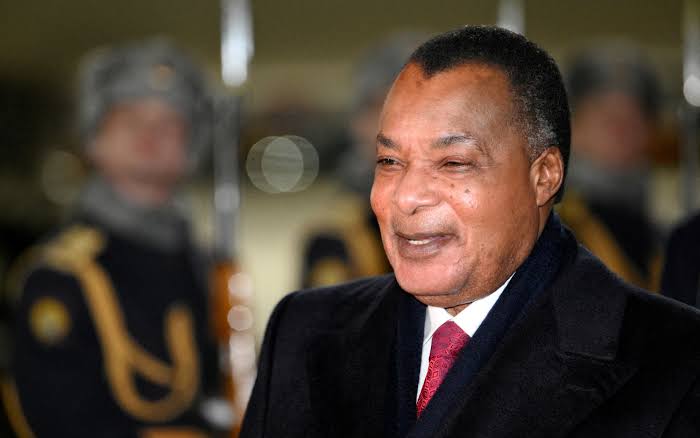
Denis Sassou Nguesso was declared re-elected as president of the Republic of Congo on Tuesday with 94.82 percent of the vote, according to provisional results announced by Interior Minister Raymond Zephirin Mboulou on state television — an outcome that extends the 82-year-old’s cumulative 42-year hold on power for a fifth consecutive term, in an election whose reported turnout directly contradicted the empty polling stations witnessed by journalists in Brazzaville on election day.
The official count placed 2,681,587 voters out of 3,167,909 registered as having cast ballots, with 2,644,013 votes recorded as valid and 37,574 as invalid, producing the official turnout figure of 84.65 percent.
Sassou Nguesso’s closest challenger, Mabio Mavoungou Zinga of the Alliance party — a 69-year-old retired customs inspector and former member of parliament — received 1.48 percent. Independent candidate Uphrem Dave Mafoula received 1.03 percent. The remaining four candidates each received less than one percent of the vote.
Speaking at his party’s headquarters in Brazzaville after the results were announced, Sassou Nguesso told reporters: “By reelecting me by a landslide, the people have kept their word. Now it is up to us to keep ours. We promise to commit ourselves fully to doing everything possible.” He described the turnout as reflecting the Congolese people’s “civic-mindedness” and “patriotism” — a characterization at odds with the scenes that Western correspondents and domestic observers had documented throughout election day, when polling stations across the capital displayed persistently sparse queues.
Residents who declined to vote were unambiguous in their explanations.
“Like many of my friends I didn’t vote simply because everything was rigged to ensure that President Denis Sassou N’Guesso continues to govern us,” said Christian Sondou, 52, a carpenter. “Having been in power for over 40 years, Denis Sassou N’Guesso has failed to lift the country out of poverty. He should have stepped down and handed power over to the young people.” Elise Sonia, a vendor at the Makelekele market, said: “There’s no need to lament, we must be patient as he won’t be around forever. Nature will take care of this generation that clings to power without making the slightest effort to build and develop the country.”
The African Union observer mission described the election in markedly different terms. The mission, led by former Ghanaian President Nana Addo Dankwa Akufo-Addo, said at a press conference on Tuesday: “The mission is pleased with the calm and secure atmosphere that prevailed throughout the ballot, which took place in an environment of order, peace, and transparency. Thirteen out of the 15 departments were covered by observers. The mission expresses its full gratitude to the competent authorities and to the population of the Republic of Congo for the political maturity demonstrated in the electoral process.”
The provisional results must still be validated by the Constitutional Court. Defeated candidates have five days to file a challenge, and the court has fifteen days from the close of that window to publish final certified results.
Read Also: Congo Election Set to Extend Sassou Nguesso’s 42-Year Rule
The election was conducted under conditions that rights groups and opposition figures had described in detail before Sunday’s vote. Human rights activists were arrested during the run-up, several opposition parties were suspended, and public gatherings were monitored. A nationwide internet blackout was imposed from the morning of election day and remained in effect through the announcement of results on Tuesday, a practice NetBlocks confirmed was technically consistent with the blackout deployed during the 2021 election. Movement within parts of Brazzaville was restricted on polling day, and shops were ordered to close. The internet remains cut.
The two political figures who would most credibly have challenged Sassou Nguesso in a competitive race were not on the ballot. General Jean-Marie Michel Mokoko, former army chief of staff who ran in the 2016 election, and former interior minister Andre Okombi Salissa have each been in prison for nearly a decade after being convicted on state security charges following that contest. The main established opposition parties declined to field candidates, citing what they characterized as a process designed to produce a predetermined outcome. The six challengers who did appear on Sunday’s ballot were universally described by independent analysts as non-competitive.
Sassou Nguesso first assumed power in a military coup in 1979 and governed under a one-party system until 1992, when he organized Congo’s first multiparty elections. He lost that contest to Pascal Lissouba and spent five years out of power before returning as a militia commander following a four-month civil war in 1997, displacing the elected government. He has won every subsequent election: in 2002, 2009, 2016, 2021, and now 2026. A constitutional referendum in 2015 removed presidential age limits and reset the term count, enabling three additional five-year terms. The current term, which begins when he is sworn in following Constitutional Court certification, is constitutionally designated as his last.
Read Also: Congo’s 82-Year-Old Ruler Seeks Final Term In Foregone Vote
The country is struggling with high international debt, which stands at 94.5 percent of GDP, and skyrocketing youth unemployment. More than half the country’s 5.7 million population lives in poverty, and 47 percent of the population is under 18. Oil and gas provide most state revenue, generating growth estimated at 2.9 percent for 2025 after a decade-long economic downturn following the oil price collapse of 2014. Congo successfully completed a three-year IMF stabilization program last year. Critics argue that the improvement in macroeconomic indicators has not translated into material improvements in living standards for ordinary Congolese, and that oil revenues have historically been concentrated in the hands of a small political and commercial elite.
Sassou Nguesso is Africa’s third-longest-serving head of state, behind Cameroon’s Paul Biya and Equatorial Guinea’s Teodoro Obiang Nguema Mbasogo. He told the AFP news agency before the election that he would not remain “in power forever” and that a new generation would eventually take over, while declining to name any preferred successor — a silence that has sharpened speculation within the ruling Congolese Labour Party about whether his son Denis-Christel Sassou Nguesso, currently a cabinet minister, or another figure from the inner circle will eventually lead the country.
No challenge to the provisional results had been filed publicly as of Tuesday evening. Sworn in following Constitutional Court certification, Sassou Nguesso’s new term will run until 2031.