
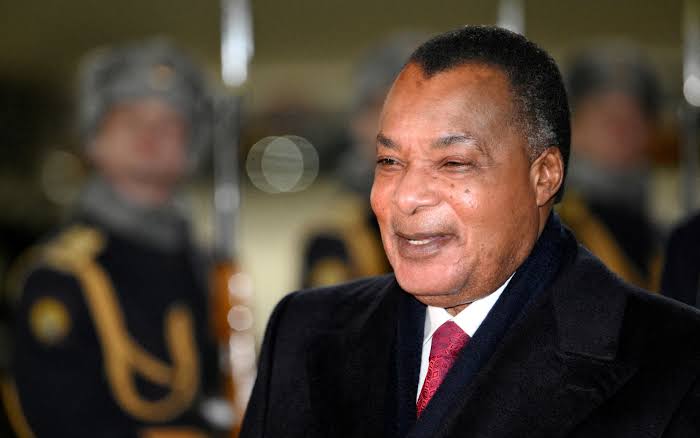
The Republic of Congo votes on Sunday in a presidential election that is widely expected to extend Denis Sassou Nguesso’s combined 42-year hold on power, with six little-known challengers facing an incumbent who controls the state broadcaster, commands the loyalty of security forces that cast ballots two days early, and presides over an electoral commission whose members were selected by his ruling party’s parliamentary majority.
Sassou Nguesso, 82, first seized power in a coup in 1979, governed until losing the country’s first multiparty election to Pascal Lissouba in 1992, and returned to the presidency in 1997 after overthrowing Lissouba during a civil war.
He is Africa’s third-longest-serving leader after Equatorial Guinea’s Teodoro Obiang and Cameroon’s Paul Biya, and has held power for all but five years of the period since Jimmy Carter occupied the White House.
A 2015 constitutional reform, passed despite opposition street protests, removed the presidential age limit of 70 and reset the term count, enabling Sassou Nguesso to contest elections in 2016 and 2021 and to stand again on Sunday. The same constitution limits presidents to three five-year mandates, which would, barring another revision, make Sunday’s contest his last.
The seven candidates validated by the Constitutional Court on February 20 are Sassou Nguesso of the ruling Congolese Labour Party and six challengers, Nganguia Engambé Anguios, Joseph Kignoumbi Kia Mboungou, Uphrem Dave Mafoula, Mavoungou Zinga Mabio, Manangou Vivien Romain, and Gavet Elengo Melaine Destin. Members of Congo’s national independent electoral commission, CENI, are selected by the National Assembly, giving the ruling party a structural advantage in shaping the process. In June 2025, the Ministry of Interior suspended fifteen opposition parties, several of which had been in the process of forming a coalition called the Rassemblement des forces du changement to contest the election collectively. Two of the most prominent opposition figures from the 2016 cycle — former army chief of staff General Jean-Marie Michel Mokoko and former interior minister André Okombi Salissa — remain in detention after being convicted on internal security charges following that election.
Lassy Mbouity, leader of Les Socialistes Congolais and a declared presidential candidate, was kidnapped in May 2025 and his whereabouts remain unknown. The Alliance for Democratic Alternation, formed in 2023 by three opposition parties in preparation for this election, ultimately did not field a candidate, leaving the ballot without any representative of the most organised anti-Sassou opposition bloc.
The political atmosphere in Brazzaville and Pointe-Noire in the days before the vote has been shaped partly by the government’s violent crackdown on youth gangs known locally as “bébés noirs,” a campaign that rights groups say extended beyond gang members into the broader youth population, producing arrests, beatings, and detentions that chilled public expression. Human rights activist Joe Washington Ebina said the crackdown had “created a climate where people no longer feel safe leaving their homes and expressing themselves.” Throughout the capital, opposition campaign materials were confined to occasional handbill distribution at markets. Sassou Nguesso’s imagery dominated every major road and roundabout.
“Everywhere I look, I see only the president’s face, as if the others weren’t even in the race,” Rosalie Tsianko, a communications professional in Brazzaville, told Reuters. At Brazzaville’s Moukondo Market, Fortune, a 27-year-old unemployed university graduate who declined to give his surname, said he expected nothing from the poll. “When you see how money is spent during the campaign, you wonder if those in power really care about the living conditions of the population,” he said.
Security forces voted on Thursday, a practice that Maja Bovcon, an independent consultant focused on Central and West Africa, said had proven effective in previous election cycles.
“Intimidation and repression by state security forces will once again play a key role in sustaining Sassou Nguesso’s rule. The tactic of having security forces vote before election day — freeing them to patrol polling stations — proved effective in 2021,” Bovcon said. In the 2021 election, official results credited Sassou Nguesso with more than 88 percent of the votes cast at a reported turnout of 67 percent. The main opposition parties boycotted that contest.
Read Also: Congo’s 82-Year-Old Ruler Seeks Final Term In Foregone Vote
Prime Minister Anatole Collinet Makosso, who also serves as government spokesperson, rejected characterisations of the process as neither free nor fair.
“No election is won in advance. Congo is equipped with oversight bodies to ensure transparency, fairness and the vitality of our democracy,” he told Reuters. He said the presence of foreign journalists in Brazzaville was proof of the country’s openness. Freedom House gave Congo a score of two out of forty for political rights in its most recent assessment.
Sassou Nguesso’s campaign has framed the election around continuity and stability — a frame that carries genuine resonance for some citizens given the violent upheaval in Gabon following its 2023 coup, the post-electoral instability in Cameroon in 2025, and the ongoing conflict in the neighbouring Democratic Republic of Congo.
“I support him because he is a man of peace,” businessman Roger Ennel Ahoue said. Against that, opposition candidate Uphrem Dave Mafoula told a small Brazzaville rally that “forty years of suffering is enough,” describing Sassou Nguesso’s economic and social record as a failure. More than 52 percent of Congo’s 6.1 million people live below the poverty line — a rate unchanged since 2021 — while youth unemployment stands at approximately 42 percent in a country where nearly half the population is under 18.
Sassou Nguesso has maintained close ties with both China and Russia throughout his tenure. China has provided financing for major infrastructure projects in exchange for oil and timber concessions, leaving Congo with an estimated $3.2 billion in Chinese debt. Russia holds a 90 percent stake in the Pointe-Noire-Makoulou-Pichot pipeline. French and US prosecutors have launched investigations into assets held abroad by members of Sassou Nguesso’s family, a series of inquiries the family has consistently denied are warranted.
Read Also: Eastern Congo Mass Graves Discovered Following Rebel Exit
The intraparty succession dynamic adds an unusual secondary narrative to an election whose outcome is not in doubt. The most prominent candidate to succeed the president is his son Denis-Christel Sassou Nguesso, currently Minister of International Cooperation, though analysts have noted that he lacks his father’s authority within the ruling party and is described as widely unpopular beyond the inner circle. Other contenders for eventual succession include the president’s nephew Jean-Dominique Okemba, Secretary-General of the National Security Council, and his cousin Jean-Jacques Bouya, Minister of State for Regional Development.
Frédéric Nkou, a jobless voter in Brazzaville, captured the dominant mood when he told Reuters: “We need better health care and education. But with this new term, we will experience more of the same.”
Over 3.2 million Congolese are registered to vote on Sunday. If no candidate secures an absolute majority of valid ballots in the first round, the constitution requires a second round within twenty-one days of the Constitutional Court’s official announcement of results. No independent international election observation mission has been accredited for the vote.