
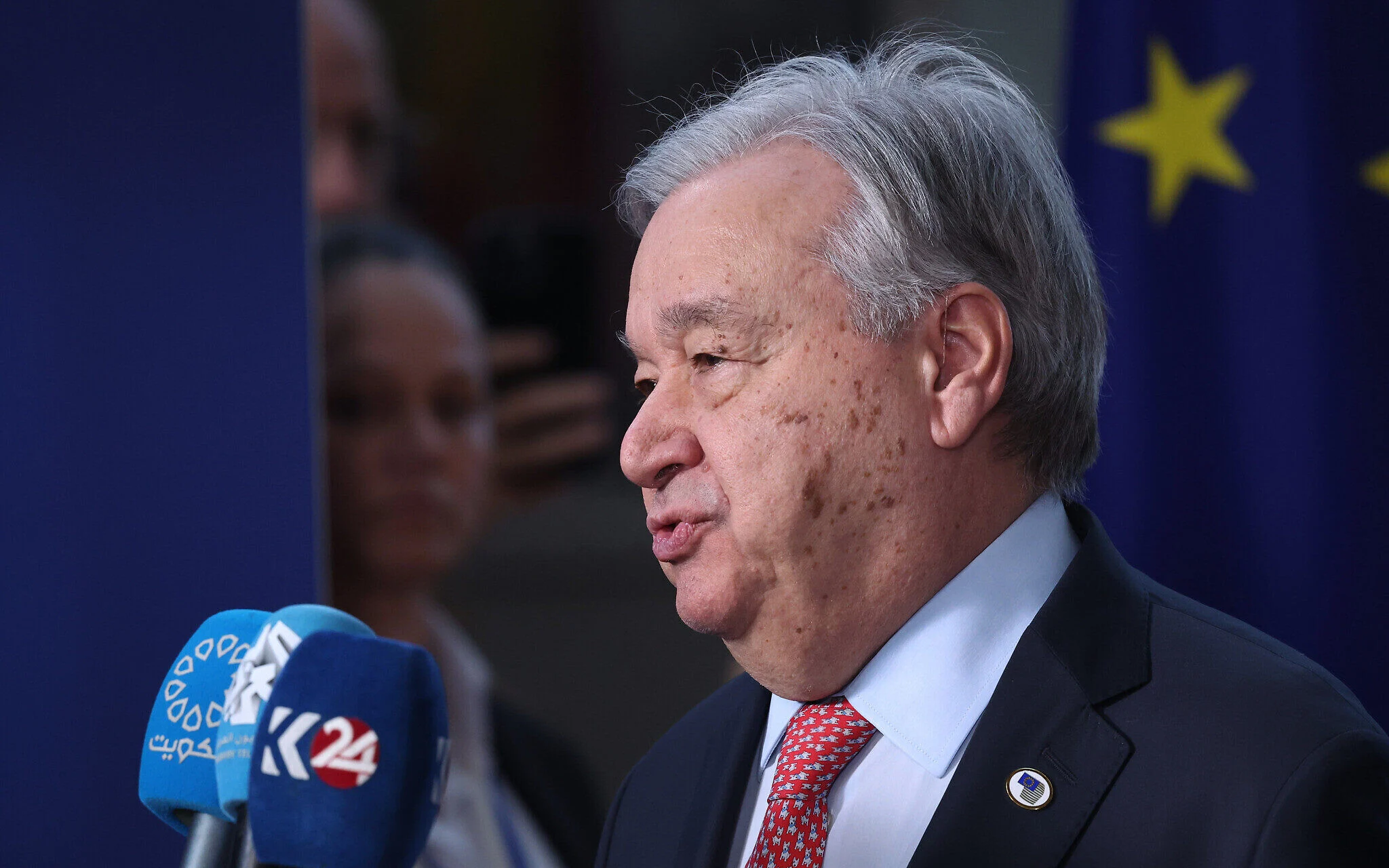
UN Secretary-General António Guterres has acknowledged cooperating with Donald Trump’s rival international body on Gaza reconstruction while dismissing the broader organisation as a personal vanity project that bypasses the multilateral principles the United Nations was built on — as the world’s foremost diplomat pushes to insert the UN into efforts to defuse the Hormuz crisis without direct access to the American president driving it.
In an exclusive interview with Politico conducted during a visit to Brussels, where European leaders were meeting largely to address the Iran war, Guterres confirmed he has not spoken with Trump since the conflict began.
Asked directly whether the two had been in contact, the secretary-general replied, “No, no, no.” He said he communicates with others in the administration but declined to identify them.
The admission underscores the degree to which the United Nations has been sidelined from the defining international crisis of the moment — a war that has killed more than 1,400 people in Iran, sent oil prices above $110 a barrel, effectively closed the Strait of Hormuz to commercial shipping, and triggered the largest emergency release of strategic oil reserves in the agency’s history. The body whose founding purpose is managing exactly this kind of global emergency is, by its own secretary-general’s account, working the phones with Gulf states and European councils while the US president who launched the war takes no calls from Turtle Bay.
Read also: Elon Musk Found Guilty Of Misleading Twitter Shareholders
Guterres nonetheless made a pointed case that the UN has something to offer that no bilateral arrangement or American-led initiative can replicate, citing its brokerage of the 2022 Black Sea Initiative that created a humanitarian shipping corridor for Ukrainian grain and fertiliser following Russia’s invasion. The initiative functioned for a year before Moscow withdrew. He said he was exploring whether a comparable framework could be applied to the Hormuz Strait.
“My main objective is to see if it is possible to create conditions in the Strait of Hormuz similar to what existed in the past,” Guterres said. “It would be a different solution. But we would like to be useful and we are prepared to manage the system. We have task forces created to be able to do it.”
He was careful to frame the UN’s preferred role as complementary rather than independent. “We prefer to work directly with the U.S. and other states,” he added — the language of an institution that recognises the limits of its own leverage when the world’s most powerful military is the primary actor in the crisis it is trying to address.
On Trump’s Board of Peace, launched in September 2025 as what the president described as an alternative to “failed” international institutions, Guterres drew a distinction between the Gaza reconstruction objective and everything else the body purports to do.
He said the UN is cooperating with structures the Board has created to fund and deliver reconstruction of Palestinian homes and infrastructure — a goal Guterres said had been defined and approved by the Security Council and therefore falls within legitimate multilateral frameworks. “We are cooperating actively with structures created by the Board of Peace,” he confirmed.
Beyond that specific function, his assessment was withering. “Everything else now is a personal project of President Trump, in which he has full control of everything,” Guterres said. “This is not the effective way to address the dramatic problems that we have now. We need to be clear about international law, to be clear about the values of the Charter of the United Nations. That is essential in any peace initiative.”
Read more: War-Hit Gulf Nations Secure $16bn In US Military Hardware
The board’s membership tells much of the story Guterres was diplomatically declining to tell directly. Permanent membership requires a $1 billion contribution — a threshold that has kept away key democracies including the United Kingdom, Canada, France and Germany, while Russia and China have also declined to join. The resulting membership roster includes Belarus and Azerbaijan, among others. Trump withdrew Canada’s invitation in January following a bilateral dispute with Ottawa. Trump declared himself chairman for life of what he asserted could “prove to be the most consequential international body in history.”
The contrast with the United Nations — 193 member states, a Security Council, international law, and seven decades of institutional precedent — is stark, and Guterres was not subtle about drawing it.
His acknowledgement that he cooperates with the Board on Gaza while dismissing the rest of its ambitions as a Trump personal project is a careful balancing act: refusing to validate the institution while engaging with the one concrete objective it shares with the UN system.