
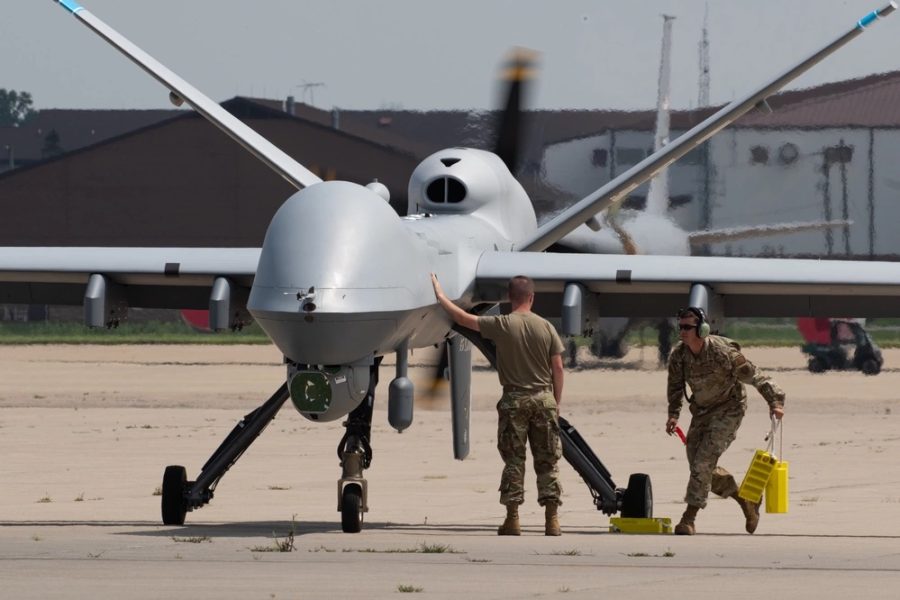
The United States military is operating multiple MQ-9 Reaper surveillance drones and approximately 200 troops inside Nigeria, conducting intelligence collection and military training operations in support of the Nigerian armed forces’ campaigns against Islamic State West Africa Province, Boko Haram, and al-Qaeda-linked militant groups spreading across the country’s north — a deployment confirmed jointly by American and Nigerian officials on Saturday that marks Washington’s most significant counterterrorism footprint in West Africa since it was expelled from neighboring Niger two years ago.
Major General Samaila Uba, director of defense information at Nigeria’s Defense Headquarters, confirmed that U.S. assets were being operated out of Bauchi airfield in the country’s northeast.
“This support builds on the newly established U.S.-Nigeria intelligence fusion cell, which continues to deliver actionable intelligence to our field commanders,” Uba told Reuters. “Our U.S. partners remain in a strictly non-combat role, enabling operations led by Nigerian authorities.” A U.S. defense official, speaking on condition of anonymity, said the deployment had been requested by Nigeria and characterized the security situation as a shared concern. “We see this as a shared security threat,” the official said.
The troops are not embedded within Nigerian military units operating on the front line, and both governments stated that the MQ-9 drones are being used for intelligence, surveillance, and reconnaissance rather than airstrikes.
Neither Uba nor the U.S. official would comment on specific cases in which American intelligence had directly supported Nigerian targeting decisions. Uba said U.S. forces were helping Nigeria “identify, track and respond to terrorist threats,” and that the timeline for the deployment’s duration would be agreed upon by both sides.
The disclosure arrives against a backdrop of renewed insurgent intensity. The confirmation of American troops on Nigerian soil comes less than two years after the United States completed its withdrawal from Air Base 201 in Agadez, Niger — a $100 million facility built to house approximately 1,000 troops and conduct drone surveillance and strikes across the Sahel — following the 2023 coup in that country and the subsequent junta government’s demand that all U.S. military personnel depart. That expulsion, part of a broader regional rejection of Western military engagement that also affected French forces across the Sahel, left the United States without a fixed surveillance and strike platform in a geographic zone where Islamic State affiliates and al-Qaeda-linked groups have expanded their operations into new territories, including into northern Nigeria’s northwest — a region historically affected by banditry but now showing signs of organized Islamist infiltration.
The Bauchi airfield deployment appears to represent Washington’s answer to that capability gap. Reports have also indicated that the United States has requested Nigerian authorization to establish a drone refueling station on Nigerian soil, a facility that would support MQ-9 operations currently conducted partly out of Accra, Ghana, and would extend the operational range and endurance of American ISR flights over Nigerian territory and the broader Lake Chad basin region.
Those discussions were described as advanced but not concluded. No Nigerian official has publicly confirmed or denied the refueling station request.
The U.S. deployment follows an episode that significantly raised the political temperature of American military engagement in Nigeria. In late 2025, U.S. forces conducted airstrikes targeting militants in northwestern Nigeria — a set of operations that the Trump administration framed in terms of protecting Christian communities in the region, a characterization the Nigerian government publicly rejected as inaccurate and as an unwelcome intrusion into the country’s domestic security framing.
Read Also: U.S. Military Strikes Over 30 Islamic State Targets in Syria
That episode fed into a broader diplomatic tension that accompanied President Bola Tinubu’s state visit to Washington later the same year, and it established a pattern in which American officials and Nigerian officials publicly presented the bilateral security relationship in notably different terms.
The current deployment does not appear to have generated the same friction. Tinubu’s government has accepted the presence of U.S. troops and drones on Nigerian territory, framing it as a capacity-building partnership rather than a foreign military intervention — a distinction that the operational parameters of the arrangement, with U.S. personnel confined to advisory and intelligence roles rather than combat functions, is designed to sustain.
The intelligence fusion cell cited by Uba represents the most institutionalized element of that arrangement, creating a formal channel through which American signals intelligence, drone imagery, and targeting data are converted into actionable information for Nigerian field commanders.
The scale and nature of the threat driving the partnership has been underscored by events in the days before the deployment became public. On Wednesday, a coordinated assault by Boko Haram and ISWAP fighters on a Nigerian military base in Mallam Fatori, near the Niger border in Borno State, killed multiple insurgents and wounded four soldiers before being repelled with air support — a pre-dawn attack that deployed armed drones and demonstrated the insurgency’s sustained capacity to mount complex operations against military positions.
Days earlier, triple suicide bombings in Maiduguri — the Borno State capital and the most heavily defended city in northeastern Nigeria — killed at least 23 people and wounded more than 100. The combination of urban bombing and direct military assault within a 72-hour window illustrated the multi-front pressure that Nigerian security forces are under and the operational rationale for seeking external intelligence support.
The northwest adds a qualitatively different dimension of concern. For most of the past decade, Nigeria’s northwest was characterized primarily by banditry — criminally motivated violence by armed groups targeting rural communities for livestock theft, kidnapping-for-ransom, and extortion.
That framework has been eroding. Intelligence assessments shared between Nigerian and American officials have pointed to increasing ideological framing by bandit leaders in Zamfara, Katsina, and Sokoto states, a growing willingness to attack symbols of state authority, and evidence of logistical contact between northwestern armed groups and Islamist affiliates operating across the border in Niger. The U.S. military’s engagement in Nigeria — publicly framed as advisory and intelligence-focused — reflects a strategic determination that if the northwest mutates into a third major operating zone for organized Islamist insurgency in Nigeria, alongside the northeast and the Middle Belt, the consequences for regional stability across the Gulf of Guinea and Lake Chad basin would be severe and would arrive in a security environment already substantially degraded by the loss of the Niger base and the withdrawal of French forces from Mali, Burkina Faso, and Chad.
Read Also: U.S. To Deploy 200 Troops To Train Nigeria’s Military
The MQ-9 Reaper drone at the center of the Nigeria deployment is a platform with a dual-use character that the deployment’s non-combat framing does not fully resolve. Capable of loitering at high altitude for more than 27 hours, the MQ-9 can carry up to eight Hellfire missiles alongside its sensor suite, and the same aircraft used for ISR in Nigeria today could, under a different authorization framework, be reconfigured for strike operations — as was the case with U.S. drones in Niger before 2024 and in Somalia, where an ongoing advisory and strike mission has been in place since 2017. The U.S. defense official confirmed that the current authorization covers intelligence collection only, and Uba was explicit that U.S. partners remain in a non-combat role. Whether that authorization remains in place if the security environment deteriorates significantly, or if specific high-value targets are identified, was not addressed by either official.
The duration of the deployment has not been established. Uba said the timeline would be “determined in agreement by both sides,” suggesting an open-ended arrangement subject to periodic bilateral review rather than a fixed-term commitment.
No formal Status of Forces Agreement governing the legal basis for U.S. military personnel in Nigeria has been publicly announced, and neither government confirmed whether existing bilateral defense cooperation frameworks are sufficient to cover the current footprint.