
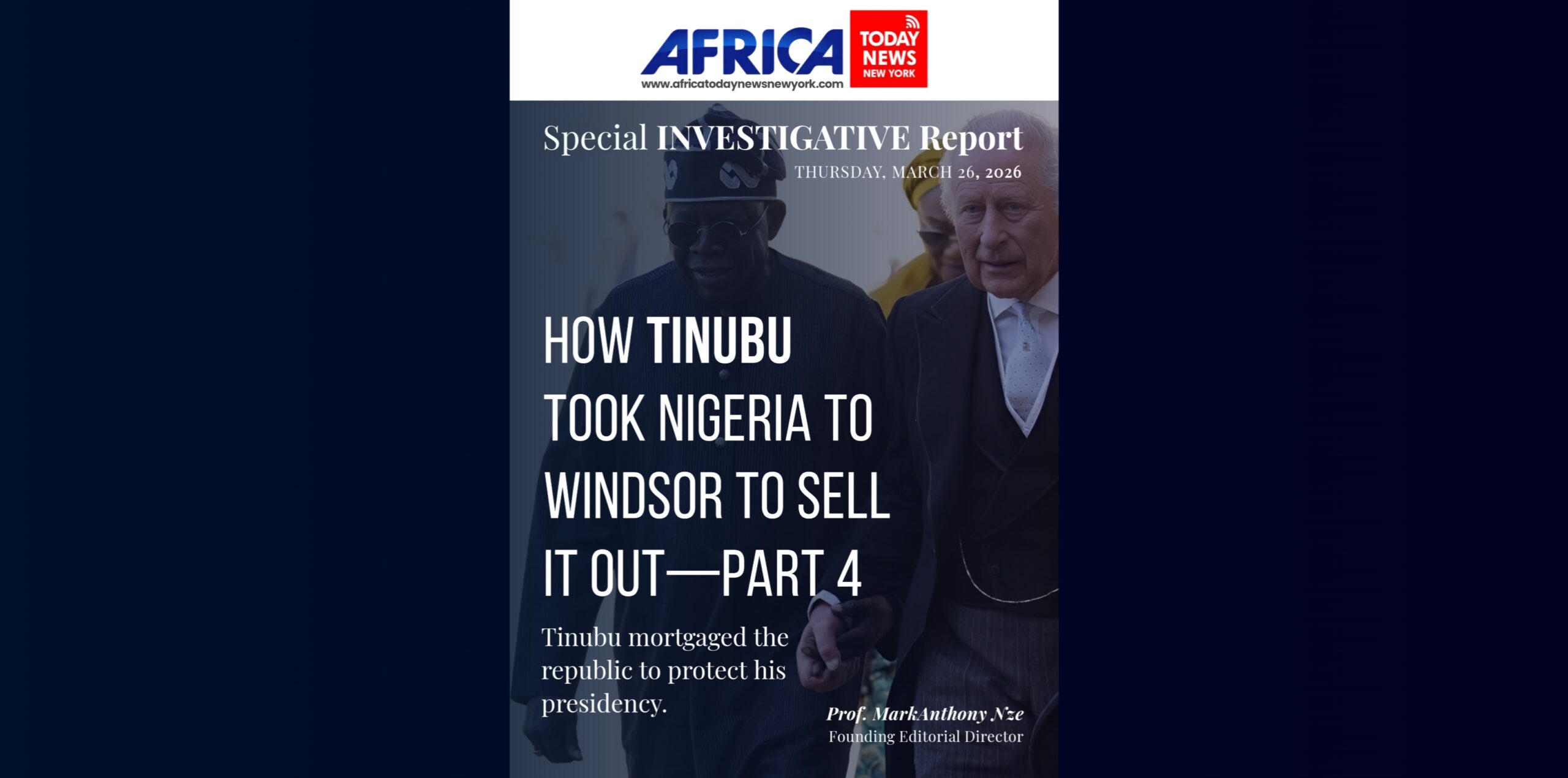
Tinubu mortgaged the republic to protect his presidency.
By Prof. MarkAnthony Nze
The real scandal of Windsor is not that Bola Tinubu went to Britain. Presidents travel. States court investors. Former colonial powers pursue advantage. None of that, by itself, is extraordinary. The scandal is something colder and more consequential: Tinubu now appears to govern Nigeria as though the country itself were collateral. That is the deeper meaning of the visit, the deals around it, and the pattern they reveal. What was presented to the public as diplomacy increasingly resembles something more ruthless—a presidency under strain seeking external ballast by making the republic more available to those positioned to reward that openness. Britain provided the ceremony. Tinubu provided the urgency. Nigeria provided the stake.
That is why the proper subject of this final installment is not a state banquet, a port deal, or a communiqué. It is Tinubu’s governing method. He has not protected Nigeria’s future; he has commodified it. He has handled the republic not as a trust to be guarded, but as a distressed asset to be leveraged, partitioned, and marketed for political survival. Nasarawa’s buried wealth and Lagos’s strategic gate are no longer being treated as instruments of national transformation. They are being repositioned as bargaining chips in a presidency’s struggle to remain afloat. Beneath the choreography, beneath the banquet, beneath the polished language of partnership, what emerges is not diplomacy but disposal: a country’s long-term leverage being quietly converted into short-term political oxygen.
A serious government under pressure would move in the opposite direction. It would tighten its stewardship of strategic assets. It would become more transparent, not less. It would explain the terms of major commitments in painful detail because it would understand that when public trust is thinning, opacity becomes its own political poison. Tinubu’s instinct appears different. He seems drawn not merely to projects, but to endorsement-bearing projects—transactions that can be displayed as proof that powerful actors abroad still consider him bankable. That is the thread connecting Windsor to the ports, the ports to the trade framework, and the trade framework to the broader performance of investor-friendliness now surrounding strategic sectors. This is not just policy. It is image management with sovereign consequences.
What Nigerians were told was renewal now bears the architecture of extraction. The ports are presented as progress, but they increasingly resemble the rebuilt plumbing of outward transfer. The mineral future is described as investment-ready, but that phrase now sounds less like development than preparation: preparation for access, for priority, for external capture dressed in the vocabulary of reform. The public is being asked to celebrate the engineering of its own exposure. It is being instructed to mistake vulnerability for sophistication and surrender for strategy. This is how the language of national advancement gets repurposed into a mechanism for anesthetizing public scrutiny.
Read also: How Tinubu Took Nigeria To Windsor To Sell It Out—Part 3
This is not governance in any honorable sense. It is the political economy of desperation. It is what happens when a presidency under pressure starts treating foreign approval as a substitute for domestic legitimacy, and ceremonial embrace abroad as compensation for eroding trust at home. The result is always the same: the language grows cleaner as the substance grows dirtier. “Partnership” begins to mean leverage for others. “Modernization” begins to mean dependency with better branding. “Reform” begins to mean the managed opening of national assets to interests that did not build them, do not belong to them, and will not bear the social cost when the transaction turns sour. Tinubu’s defenders may call that realism. History tends to call it something else.
And history is merciless with leaders who make this mistake. It does not remember the chandeliers kindly. It does not preserve the flattery of state banquets. It asks a colder question: when the pressure came, what did the leader protect first? In Tinubu’s case, the answer is becoming harder to evade. Faced with the choice between rebuilding legitimacy through sacrifice, transparency, and national discipline, or seeking ballast through foreign validation and high-value transactions, he appears to have chosen the second path. That is why the scandal of Windsor is larger than one visit, one ports deal, or one season of diplomacy. It revealed a governing philosophy: survival first, sovereignty later.
That philosophy is the real indictment. It says the republic can be made negotiable if the incumbent gains stability from the bargain. It says strategic assets can be made available if the political return is sufficient. It says future generations may be asked to inherit the exposure so that the present ruler may enjoy the insulation. That is not statesmanship. That is a government consuming tomorrow in order to prolong today. And this is precisely why the mineral question matters so much. In a world where critical minerals anchor industrial power, battery systems, advanced manufacturing, and geopolitical leverage, no serious state should treat such assets casually. Yet Tinubu’s administration has spent much of its time advertising inflows and openness while failing to demonstrate, with equal force, how national advantage will be protected over the long run. Nigeria’s problem is no longer a lack of rhetoric. It is a crisis of guardianship.
The most dangerous part is that this method does not always look violent while it is happening. It looks elegant. It arrives with official language, foreign smiles, technical documents, investment terms, and staged photographs. It flatters the public while emptying the state. It converts access into applause and dependency into prestige. By the time the consequences become obvious, the deal has already been normalized, the rhetoric has already been repeated, and the people have already been told that resistance is ignorance. This is how political classes train nations to participate in their own diminishment: not by forcing surrender openly, but by packaging it as modernity.
Read more: How Tinubu Took Nigeria To Windsor To Sell It Out—Part 2
So the Windsor story does not end with the flight home. It begins there. Its consequences will be written not in headlines but in structures: who controls the gate, who benefits from the corridor, who prices the minerals, who bears the liabilities, who is excluded from the wealth beneath their own soil, and who is told to call this arrangement progress. What is now at stake is not merely policy, but national memory. Because the final triumph of a politics like this is not only material extraction. It is the teaching of a people to describe their own weakening as wisdom. If that lesson takes hold, then the republic suffers a deeper wound than any bad contract can capture: it begins to lose the instinct to recognize a sellout when it is staged as sophistication.
Tinubu’s supporters will insist this is too severe. They will say the world is interconnected, that Nigeria needs capital, that ports must be rebuilt, that reforms are painful but necessary, and that critics are mistaking complexity for betrayal. Some of that is true as far as it goes. Nigeria does need capital. Ports do need upgrading. States do need partners. But none of that answers the question at the center of this story: why does this presidency so often seem more fluent in the language of external reassurance than in the discipline of domestic explanation? Why are foreign actors clearer about what they are gaining than Nigerians are about what they are giving up? Why does Tinubu look so eager to appear acceptable abroad while the burdens of his policy choices remain so heavily socialized at home? Those are not partisan questions. They are republican ones.
The answer, or at least the outline of it, lies in 2027. The APC’s formal endorsement of Tinubu for reelection did more than settle a party matter. It turned the whole presidency into a project of preservation. Once that happened, everything else became legible differently. Diplomacy ceased to be just diplomacy. Major financing ceased to be just development. Investor confidence ceased to be merely economic. All of it became politically useful. A royal welcome tells elites not to panic. A British-backed deal tells markets that doors remain open. A trade framework tells foreign capital that the administration is aligned with its expectations. To an incumbent with a reelection horizon and a legitimacy problem, those are not side benefits. They are the point.
That is why this series ends not with outrage, but with a verdict. Tinubu did not merely seek cover abroad; he taught the republic to pay for it. He did not merely pursue diplomatic prestige; he made prestige politically functional in a way that appears to leave Nigeria more exposed. He did not merely accept Britain’s interest; he made that interest easier to satisfy while asking Nigerians to trust that exposure would eventually look like progress. In the end, the most brutal truth about Windsor is also the simplest: the crown supplied the pageant, Britain secured the leverage, Tinubu took the optics—and Nigeria was left to absorb the cost.
Selected Sources (APA 7th Edition)
Reuters. (2025, May 22). Nigeria’s ruling party endorses President Tinubu for 2027 re-election. Reuters.
Reuters. (2026, March 16). Nigeria inflation eases marginally in February after central bank trims rates. Reuters.
Reuters. (2026, March 18). King Charles welcomes Nigerian president to UK for state visit. Reuters.
Reuters. (2026, March 19). UK and Nigeria agree billion-dollar export finance deal to refurbish ports. Reuters.