
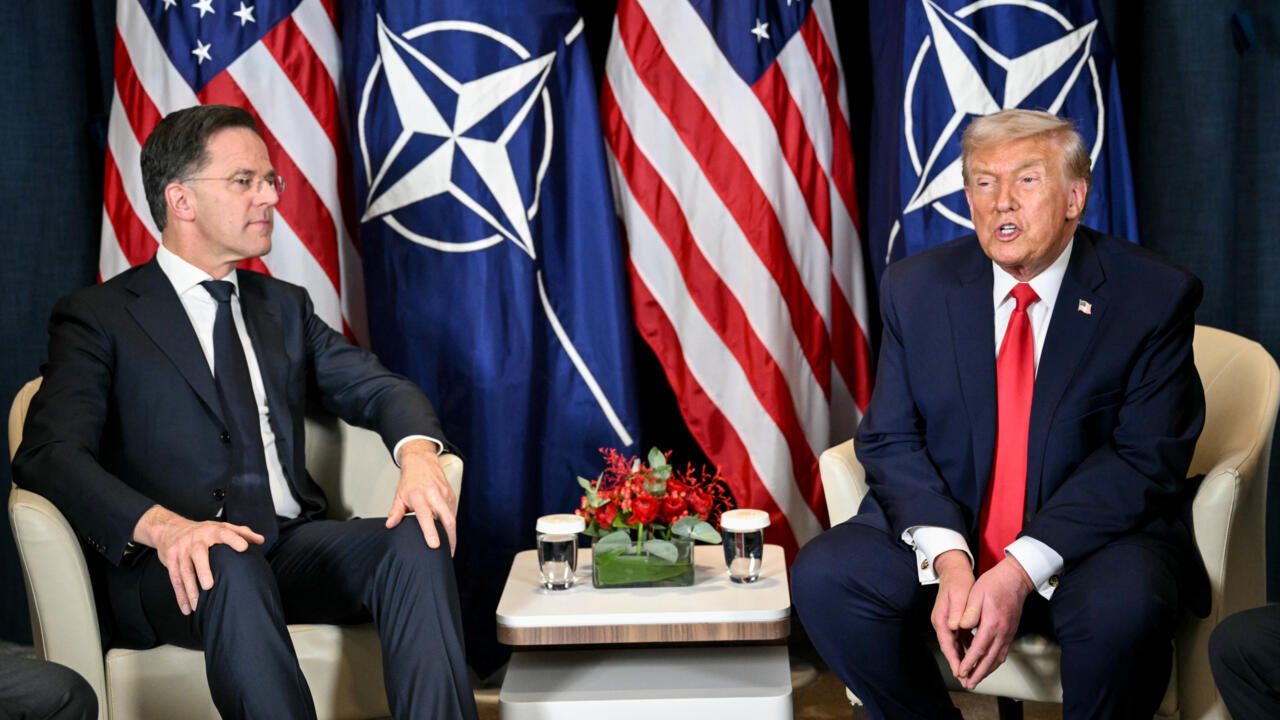
Donald Trump emerged from a closed-door meeting with NATO Secretary General Mark Rutte on Wednesday without announcing America’s withdrawal from the alliance — but left little doubt that his fury at partners who refused to join his war on Iran had not subsided, reviving his threats over Greenland and declaring that NATO had failed the United States when it mattered.
“NATO WASN’T THERE WHEN WE NEEDED THEM, AND THEY WON’T BE THERE IF WE NEED THEM AGAIN,” Trump posted on Truth Social after the meeting. “REMEMBER GREENLAND, THAT BIG, POORLY RUN, PIECE OF ICE!!!” The reference to Denmark’s Arctic territory — which had temporarily receded from headlines once the Iran war consumed Washington’s attention — landed without explanation, as if the president intended the ambiguity itself as the message.
The meeting had been called against a backdrop of genuine alarm within the alliance. Trump’s public rage at NATO members for refusing to join the Iran campaign, limiting US forces from using bases on their territory, and what he described as a collective failure to help reopen the Strait of Hormuz had prompted fears he might formally move to pull the United States out of an alliance it has anchored since 1949. White House Press Secretary Karoline Leavitt told reporters before the meeting that withdrawal was “something the president has discussed, and I think it’s something the president will be discussing in a couple of hours with Secretary General Rutte” — a framing that set expectations for a confrontation.
What followed was conducted entirely behind closed doors. Rutte, the former Dutch prime minister whose reputation as the “Trump whisperer” rests on a cultivated ability to flatter and redirect the American president, entered the West Wing through a side gate. When he emerged, he described the conversation as “very frank” and “very open.” Asked repeatedly whether Trump had indicated he would leave NATO, Rutte declined to answer directly — a non-answer that said something while confirming nothing.
Read aslo: Hormuz Reopens Under Trump-Iran Two-Week Truce Deal
The Wall Street Journal reported that Trump was also considering a more targeted punishment: moving US troops out of specific NATO countries he deemed unhelpful during the Iran conflict, rather than pursuing a full withdrawal that would require congressional approval he is unlikely to receive. The approach would allow Trump to apply pressure and signal displeasure without triggering the legislative battle a formal exit would demand.
Trump has been cutting in his assessments of individual allies. He called British Prime Minister Keir Starmer “no Winston Churchill” and dismissed Britain’s aircraft carriers as “toys.” He branded NATO itself a “paper tiger” for its refusal to lead the Hormuz effort and for the restrictions allied governments placed on basing rights during the campaign. The criticism reflects a genuine strategic rupture: an American president who launched a war expecting partners to follow, and partners who decided — individually and collectively — that they would not.
Rutte has spent months threading that needle. He called US efforts to degrade Iran’s military capability something to “applaud” — a formulation that praised the campaign without endorsing it, supported the president without committing forces, and preserved enough allied goodwill to keep his lines to Washington open. At a NATO summit last year he called Trump “daddy,” a gesture of performative deference that became widely noted and apparently served its purpose.
Read more: Trump Threatens ‘Hell’ If Iran Blocks Strait, Eyes Deal
Ahead of the White House visit, Rutte met Secretary of State Marco Rubio to discuss Iran, Ukraine and NATO burden-sharing. The State Department said the two leaders also discussed Operation Epic Fury, the US-led effort to reach a negotiated end to the Russia-Ukraine war, and “increasing coordination and burden shifting with NATO allies” — language that frames European defence spending as a precondition for continued American engagement rather than a voluntary contribution to collective security.
Rutte was also scheduled to meet Pentagon chief Pete Hegseth during his Washington visit.
The meeting came one day after the US and Iran agreed to a fragile two-week ceasefire following five weeks of war. The pause has reduced the immediate pressure on allied relationships — there is no live bombing campaign to either join or refuse — but the grievances Trump aired publicly during the conflict have not been withdrawn. Russia and China have been watching the alliance’s internal turbulence with what officials in multiple European capitals have described as undisguised satisfaction.