
Four days after Peruvians cast their votes, the question of who will govern them has migrated from the counting room to the legal system — and may not be resolved for weeks.
With 97.9% of ballots tallied, leftist Roberto Sanchez holds a lead of 50.025% against conservative Keiko Fujimori’s 49.975%, a margin so thin that the remaining uncounted votes cannot mathematically settle the race on their own. Of the 2.1% of polling stations still pending, only a fifth contain straightforward ballots yet to be tabulated.
The other 80% — representing roughly 400,000 votes — are contested, and will proceed directly to judicial review by Peru’s Special Electoral Jury.
Read also: Peru Considers Ousting President Jeri After Four Months
Omar Awapara, secretary general of the Peruvian election monitoring group Transparencia, said plainly that the count itself is unlikely to produce a winner.
“We’ll get to a point when the difference between the candidates is greater than the contested votes left to be counted, and then it will be clearer,” he told reporters. The whole process, he added, could take a few weeks.
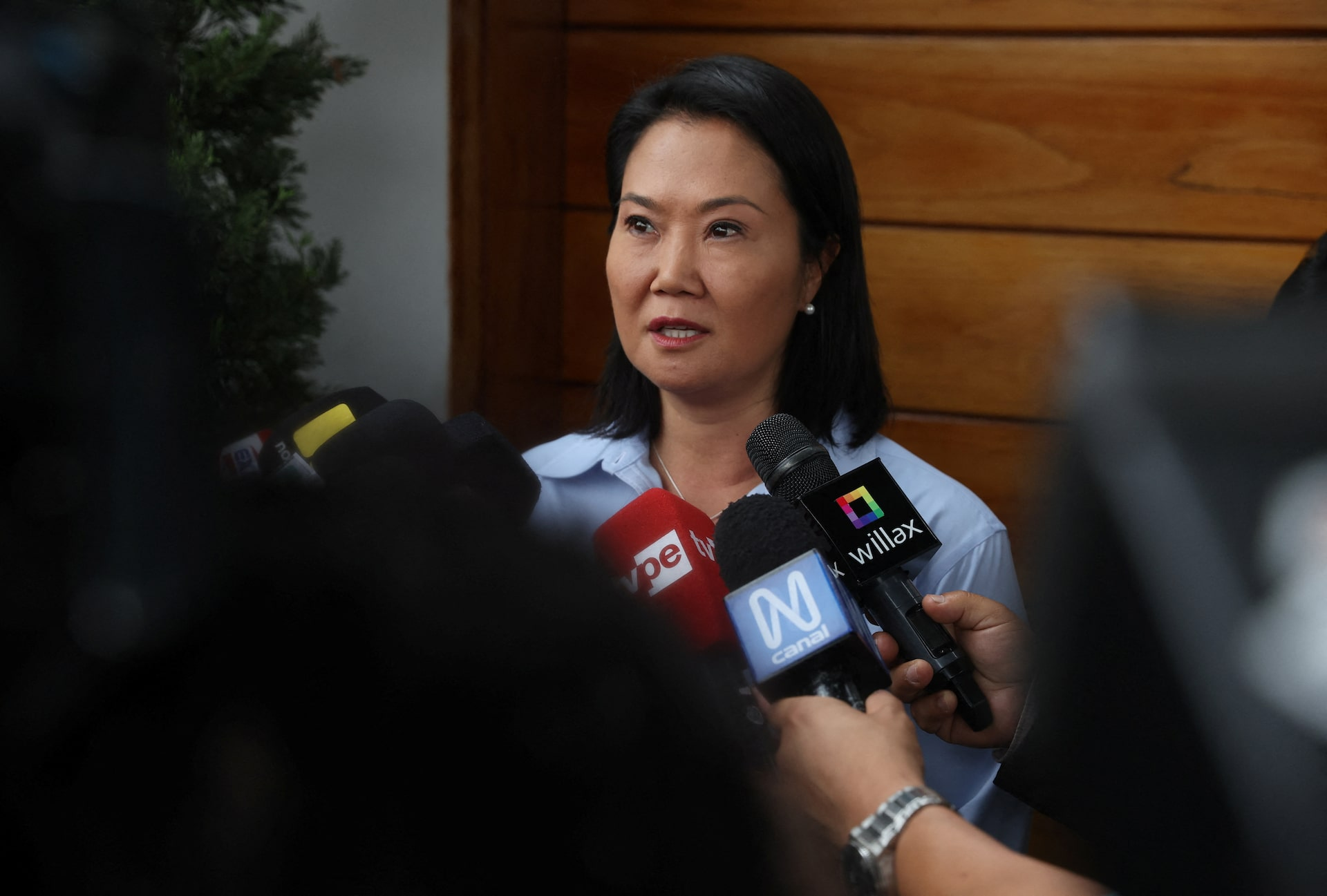
Fujimori spent Wednesday cutting into what was once a 50,000-vote gap. The engine driving her recovery is the overseas vote: among Peruvians abroad, she currently commands roughly 63% support, and that pool of ballots has been arriving in volume while domestic tallies wind down. But the math of what remains means her momentum runs up against a ceiling — the foreign ballots account for only a fraction of the pending total. Everything else is contested, and contested means contested.
Read also: Interim Peru President Ousted After Four-Month Tenure
Sanchez, who led the Ipsos quick count on election Sunday — a survey with an accurate record in previous Peruvian races — has begun signaling that his campaign is watching the process with something more than patience. On Wednesday he told reporters that democracy must be defended, and said his team had requested meetings with international observers to discuss what he described as “strange, unusual, and questionable developments.” He stopped short of specific allegations.
International observers did not share his unease, at least not publicly. Delegations from the Organization of American States and the European Union each said Wednesday that the vote had been conducted normally, and that a drawn-out final count was simply a procedural consequence of the margin — not an indication of irregularities.
Both campaigns have spent the week urging their supporters toward patience, a posture that has held but grown visibly strained.
Financial markets, meanwhile, are conducting their own running verdict on the outcome. Peru’s main stock index closed up 0.68% Wednesday, continuing a partial recovery from a sharp Friday selloff that followed survey data showing Sanchez — who has pledged sweeping economic reforms — ascending in the polls. The sol slipped 0.53% against the dollar to close at 3.40, reflecting lingering unease.
Eileen Gavin, principal Americas analyst at risk intelligence firm Verisk Maplecroft, said the market’s relative calm reflects a specific bet: that Fujimori will eventually pull ahead on expatriate votes, and that even if she does not, a conservative-leaning legislature will serve as a brake on whichever executive takes office. Peru’s lower house and its newly restored Senate both skew right, a structural check that investors appear to be pricing in regardless of who wins the top seat.
That calculation has kept capital relatively stable — but it is a calculation premised on institutional resilience holding through what is likely to be a grinding, contentious legal process.
The contested ballots heading to the Electoral Jury span disputes ranging from challenged signatures to procedural irregularities at individual polling stations. Each must be adjudicated separately. At 400,000 votes, the volume is large enough to flip a result measured in fractions of a percentage point, which is precisely why the Jury’s review carries the weight it does — and why both campaigns are already positioning themselves for that arena.
Peru has been here before. Fujimori herself lost a disputed 2021 race against leftist Pedro Castillo after a prolonged legal fight that consumed weeks and tested the country’s democratic institutions. Castillo was later removed from office and imprisoned after an abortive self-coup attempt. The nation’s political memory is short on stable outcomes, which gives the current standoff a weight beyond its arithmetic.