
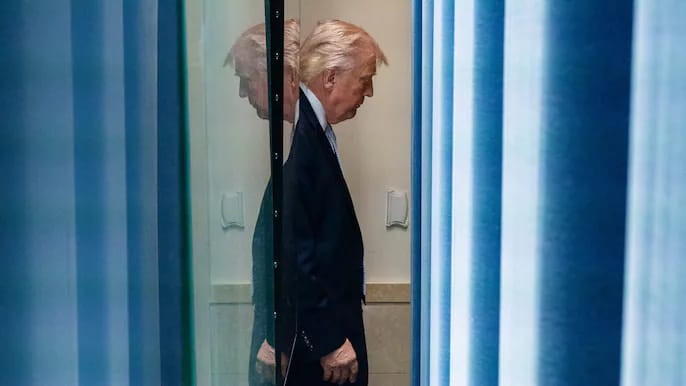
Six weeks of war ended — or paused, or stumbled toward something resembling quiet — on Tuesday night, when Donald Trump announced a two-week ceasefire with Iran less than two hours before his own deadline for destroying the country’s civilian infrastructure.
The timing was either masterful or accidental, and in Washington those two things are often the same.
Pakistan brokered the deal. Field Marshal Asim Munir and Prime Minister Shehbaz Sharif had been working the back channels between Washington and Tehran, and on Tuesday their work produced something concrete: both sides agreed to stop shooting, Iran agreed to reopen the Strait of Hormuz to oil traffic, and Sharif announced he had invited delegations from both countries to Islamabad on Friday for formal negotiations.
Trump posted on Truth Social that it was “a double sided CEASEFIRE” and said Iran had submitted a 10-point proposal he considered a workable foundation for a permanent deal. He expected the agreement to be “finalised and consummated” within the two-week window. Iran’s Supreme National Security Council said Trump had accepted Iranian conditions. Trump told AFP it was a “total and complete victory. 100 percent. No question about it.”
Read more: Weakened Hormuz Resolution Faces UN Vote Tuesday
Both sides claiming victory simultaneously is either diplomatic theatre or the definition of a successful negotiation. Possibly both.
What nobody disputed was the toll. More than 5,000 people dead across nearly a dozen countries in six weeks. Over 1,600 Iranian civilians among them. A global economy absorbing oil prices 50 percent above where they started, a strait through which a fifth of the world’s energy supply normally flows sitting largely closed, and a US president whose approval ratings had sunk to their lowest point ever as petrol crossed $4 a gallon and showed no sign of retreating.
The day itself was one of the conflict’s most harrowing. Trump had spent Tuesday threatening annihilation. “A whole civilisation will die tonight,” he posted, warning Iran that bridges and power plants would be obliterated if the strait was not reopened by 8 p.m. Eastern. The UN Secretary-General condemned it. Pope Leo condemned it. International law experts warned the threatened strikes on civilian infrastructure could constitute war crimes. Markets shuddered. US and Israeli aircraft intensified strikes on Kharg Island, railway bridges, an airport and a petrochemical plant as the clock ran down.
Then, with roughly 90 minutes to spare, the ceasefire landed.
Markets responded immediately when the announcement broke in Asian trading hours — oil dropped, stocks surged, the dollar softened. The US Energy Information Administration issued a sobering qualifier: fuel prices could keep rising for months even after the strait reopened, because six weeks of disruption does not reverse itself because a document was signed.
Read also: Trump Threatens ‘Hell’ If Iran Blocks Strait, Eyes Deal
The ground did not immediately cooperate with the document. More than an hour after Trump’s announcement, Israeli military radar tracked missiles launched from Iran. Explosions from interceptions lit up the sky over Tel Aviv. Kuwait, Bahrain, Saudi Arabia and the UAE activated air defences in near-simultaneous alerts. Israeli media reported strikes on launch sites inside Iran. Netanyahu’s office confirmed Israel supported the ceasefire — then specified it did not apply to Lebanon, apparently contradicting Pakistan’s Sharif, who had said Lebanon was included. Southern Lebanon’s state news agency reported continued Israeli shelling and an air strike near a hospital that killed four people.
Iraq’s Islamic Resistance said it would suspend regional operations for two weeks.
A source briefed on the negotiations said the American side did not fully trust the arrangement, describing it as a “trust-building exercise” and warning that Iran might be buying time. The phrasing acknowledged what the ceasefire actually is: not an end, but a wager.
The politics behind the timing are not difficult to read. Trump’s approval ratings were at historic lows. Polls showed majorities of Americans opposed to the war and angry about petrol prices. The midterm campaign was accelerating. “We’ve seen President Trump wanting to find a route towards a way that the US military can back out of the war with Iran, but also frame that as a kind of victory,” said Jessica Genauer, academic director of the Public Policy Institute at the University of New South Wales.
He found one. Whether it holds is the question that Islamabad on Friday begins — but does not answer.
The strait is supposed to reopen. The talks are supposed to produce a deal. The missiles were still flying an hour after the ceasefire was announced.
This is where six weeks of war has brought the world: a pause, a prayer, and a Friday meeting in Pakistan to figure out if any of it is real.