
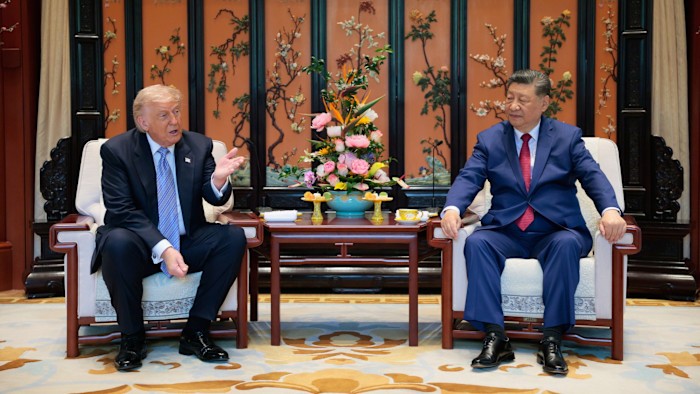
Donald Trump left Beijing without saying publicly what he told Xi Jinping about Taiwan — and what he did say publicly raised questions in Taipei that his administration spent the weekend trying to contain.
The silence was the first signal. Xi’s official readout of the summit included a stark warning that mishandling Taiwan would put the US-China relationship in “great jeopardy.” The White House’s initial readout mentioned Taiwan not at all. Secretary of State Marco Rubio told NBC News the topic “did not feature primarily” in the first day’s discussions. More than 24 hours passed after Xi’s warning before Trump addressed the subject directly — and when he did, what he said was not reassuring to an island that has been watching the Beijing summit with considerable anxiety.
“Taiwan would be very smart to cool it a little bit. China would be very smart to cool it a little bit. They ought to both cool it,” Trump told Fox News in an interview that aired Friday afternoon, placing Taipei and Beijing in the same sentence as roughly equivalent sources of regional tension. He said he was not looking for Taiwan to pursue independence, and framed American military commitment to the island’s defense in terms that stopped well short of the guarantees Taipei has historically relied upon. “I’m not looking to have somebody go independent, and you know, we’re supposed to travel 9,500 miles to fight a war,” Trump said. “I’m not looking for that.”
He also confirmed he had declined to answer Xi directly when the Chinese leader asked whether the United States would defend Taiwan against a Chinese attack — a deliberate non-answer consistent with the long-standing American doctrine of strategic ambiguity, which leaves Beijing uncertain about Washington’s intentions precisely to deter military action. But the manner of the non-answer, combined with the “cool it” framing, gave observers more to work with than the doctrine alone typically provides.
Read also: Trump Says He & Xi Have Agreed To Bar Iran’s Nuclear Path
On the pending arms sale, Trump was equally noncommittal. A potential large weapons package for Taiwan — separate from the record $11 billion sale announced in December — remains unapproved. “I may do it, I may not do it,” Trump said, a formulation that converts a statutory obligation into a personal discretionary decision in a way that Taipei’s government cannot ignore.
Taiwan’s presidential spokesperson Karen Kuo responded with the careful language of an administration that needs to project stability without escalating. “It is a clear fact that President Lai Ching-te has consistently advocated for continuing to contribute to regional peace and stability and remaining committed to maintaining the status quo across the Taiwan Strait,” Kuo said. She added that “China’s escalating military threat is the sole destabilizing factor within the Indo-Pacific region, including the Taiwan Strait” — a rebuttal to the equivalence Trump’s “cool it” framing implied, directed as much at Washington as at Beijing.
Treasury Secretary Scott Bessent told CNBC he expected Trump would say more on Taiwan in the coming days. Whether that elaboration clarifies or complicates the picture Taipei is trying to read remains to be seen.
Analysts watching the summit’s Taiwan dimension noted a pattern that predates this week. “If you look at the readouts of all Trump-Xi meetings before this, just the last several that have occurred since maybe April of last year, you see the US readouts have a much smaller portion focused on Taiwan,” said Rush Doshi of the Council on Foreign Relations. “There’s really no sign that there’s been a significant change in US Taiwan policy, at least not yet from the summit.” Wendy Cutler, former acting deputy US trade representative, read Xi’s warning differently — as a deliberate linking of economic cooperation to Taiwan stability, a signal that Beijing intends the two tracks to run together rather than separately.
The 1979 Taiwan Relations Act legally requires Washington to provide the island with sufficient defense articles to maintain self-defense capabilities. Trump’s “I may do it, I may not do it” on the pending arms package does not override that law. What it does is introduce a degree of personal unpredictability into a commitment that Taiwan has spent decades treating as structural rather than situational — and that distinction, in the current environment, is not a small thing.