

JURISDICTIONAL NOTICE
STATUS: U.S. First Amendment Protected.
Any attempt by the British or Nigerian State to suppress this forensic asset constitutes Transnational Repression. All interference will be tracked and submitted to the FBI for Global Magnitsky Sanctions.
♦♦♦♦♦♦♦♦♦♦♦♦♦♦♦♦♦♦♦♦♦♦♦♦♦♦♦♦♦♦♦♦♦♦♦♦♦♦♦♦♦♦♦♦♦
How Britain Violated International Law to Create and Keep Ripping Nigeria Off
| Britain did not hand Nigeria a repaired republic. It transferred an imperial machine, left the wiring inside the walls, and called the ceremony freedom. |
By Prof. MarkAnthony Nze
The Independence Trap — Flag Without Freedom
October 1, 1960, is usually told as a sunrise. The flag changed. The anthem changed. The colonial governor’s world began to recede from public view. Nigerians celebrated, and they were right to celebrate. No colonized people owe an apology for rejoicing when the flag of occupation comes down. But celebration is not the same as a cure. Beneath the ceremony, Britain had not handed over a country freshly authored by its peoples. It handed over a state it had assembled for rule, disciplined through bureaucracy, fed through export, and balanced through constitutional arithmetic. Nigeria received sovereignty, yes. It also received the machine that sovereignty was expected to operate.
The Legal Door Was Opened from London
The legal record is colder than the independence speeches. Nigeria’s formal independence came through the Nigeria Independence Act 1960, an Act of the British Parliament. That fact alone should disturb the romance. The colonizer wrote the legal instrument by which it claimed to release the colonized. Even more revealing, the Act did not erase the old legal order. Section 1 provided that from October 1, 1960, the United Kingdom Parliament would no longer legislate for Nigeria, but it also preserved the operation of existing laws and legal instruments already in force before that date. In plain language, Britain withdrew without wiping clean the legal architecture of empire. The governor’s authority faded; the legal habits of colonial rule survived.
No serious attorney would confuse that with a clean founding. A transfer of power is not a transfer of authorship. Nigeria did not sit in a sovereign national convention of all its peoples and rewrite the colonial bargain from the ground up. Britain handed over control of a constitutional structure Britain had already shaped, supervised and legitimized. The country became formally independent before it became structurally free from the deepest assumptions of its maker. The keys changed hands, but the locks were British.
Read also: Britain’s Imperial Fraud: Part 5
Federalism by Imperial Procedure
Britain’s final constitutional act was not a modest footnote. The Nigeria (Constitution) Order in Council 1960 did not simply recognize independence; it promulgated the Constitution of the Federation and the constitutions of the regions. Even in departure, Britain was still arranging the furniture of Nigerian political life. A federation was handed over, but not one born from a fully sovereign Nigerian constitutional moment. The legal form arrived through imperial procedure, and imperial procedure has a talent for making command look like order.
The symbolic break was also incomplete. Nigeria became independent in 1960, but it did not become a republic until 1963. For the first three years, the British monarch remained Nigeria’s head of state, represented locally by a Governor-General. That detail is not decorative. It exposes the careful half-light in which British decolonization often operated: enough freedom to stage a celebration, enough imperial residue to remind everyone who had written the script. The old empire did not vanish in a single morning. It stepped backward, left its frame standing, and allowed the newly independent state to inhabit it.
The Political Arithmetic of Suspicion
Then came the political arithmetic, and the arithmetic was explosive. At independence, the House of Representatives contained 312 seats: 174 for the Northern Region, 73 for the Eastern Region, 62 for the Western Region, and 3 for Lagos. One region held more seats than the two other major regions combined. Whatever language Britain used to describe balance, the numbers created leverage. Power was not merely distributed; it was weighted. The center was not merely a federal meeting point; it became the prize through which survival, patronage, security and national direction could be controlled.
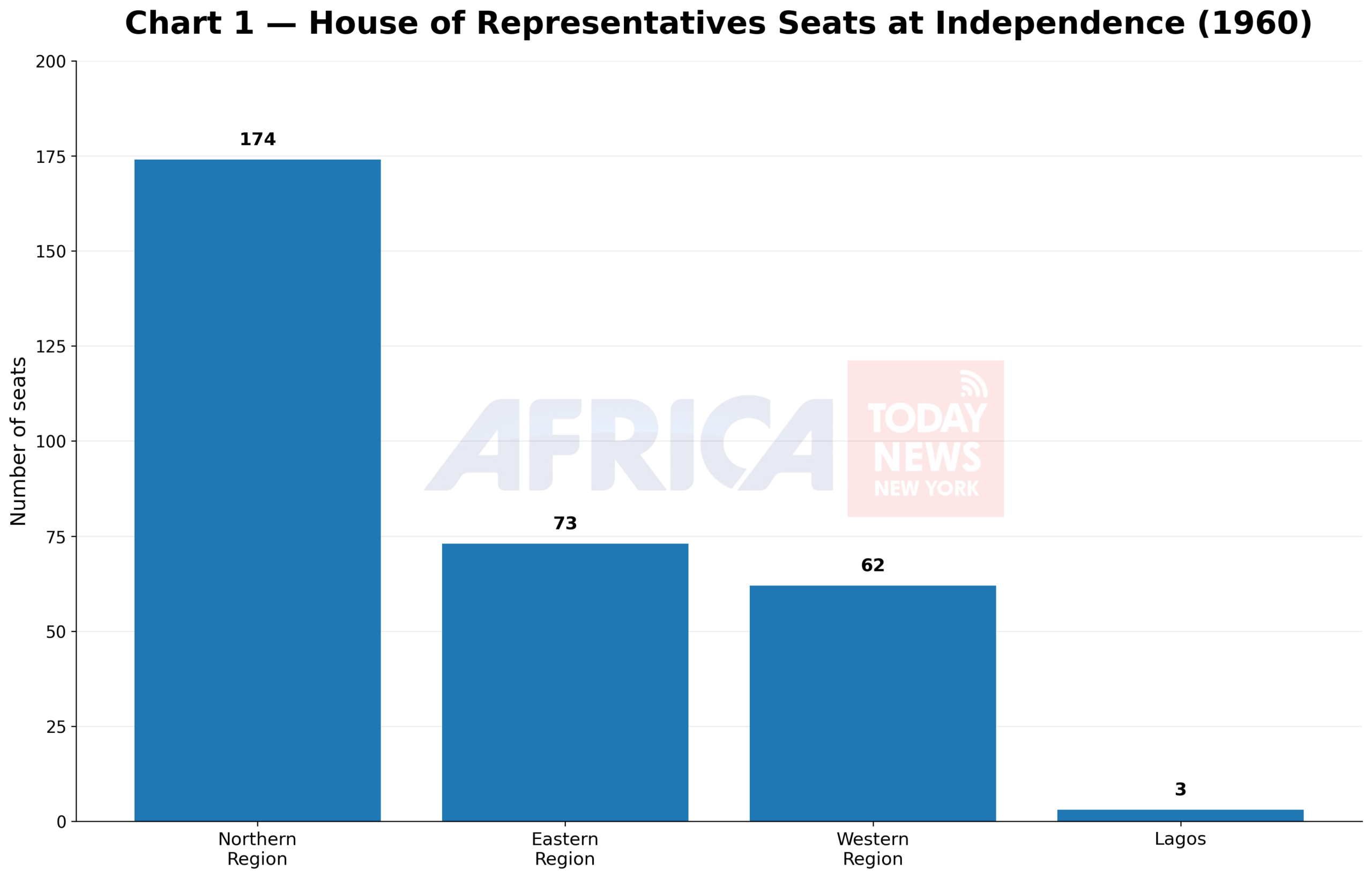
What the Numbers Expose
The chart makes the imbalance visible without argument. The Northern Region entered independence with 174 seats; the Eastern and Western Regions together had 135; Lagos had 3. That was not neutral arithmetic. It told every political actor what the center would mean before the country had even learned how to trust itself. Britain left behind a federation in which the struggle for federal power was already loaded with suspicion. The problem was not diversity. Diversity does not destroy countries by itself. The problem was diversity placed inside a state whose original terms had been arranged by a ruler that never intended to live under the consequences.
Federalism can protect plural societies when it grows from trust, negotiation and enforceable restraint. Nigeria’s federalism arrived carrying colonial fingerprints. Britain had governed regions differently, empowered intermediaries selectively, strengthened some forms of authority and weakened others, and trained political communities to see the center not as a shared civic instrument but as a strategic battlefield. By 1960, the state was not entering freedom as a mature covenant among equal peoples. It was entering freedom as a colonial assembly whose internal anxieties had already been sharpened by the method of rule.
Read also: Britain’s Imperial Fraud: Part 4
The Ghosts of Indirect Rule
Indirect rule did some of the dirtiest work. In textbooks, it is often presented as administrative genius, a practical accommodation to local realities. In practice, it often meant domination through intermediaries. Britain ruled through chiefs, emirs, native authorities and selected local structures that answered upward before they answered outward. The people were not made sovereign in their own local worlds; they were processed through authority Britain could manage. Scholarship on colonial legacies has shown that stronger forms of indirect rule were associated with weaker postcolonial outcomes in areas such as state effectiveness, rule of law, political stability and corruption control.
That legacy mattered because institutions remember how they were trained. A bureaucracy trained to command does not become humble because independence has arrived. A police system trained to secure order does not automatically become a guardian of citizens. A local authority trained to report upward does not suddenly become accountable downward. The faces changed, the flag changed, the anthem changed, but too much of the state’s instinct remained colonial: file first, citizen later; order first, justice later; command first, consent later.
Economic Freedom with British Arteries
Economic dependence completed the ambush. Long before independence, Nigeria’s economy had been turned outward. Railways, ports, roads, customs houses and administrative priorities were built around the movement of value, not the balanced development of Nigerian life. Cocoa, cotton, groundnuts and palm produce mattered because they fed imperial commerce. The World Bank’s study of agricultural incentives in Nigeria records that, as late as 1955, 70 percent of Nigeria’s exports went to Britain, while 47 percent of its imports came from Britain. Those figures are not background information. They are evidence of a country approaching independence with its commercial arteries still tied to the former ruler.
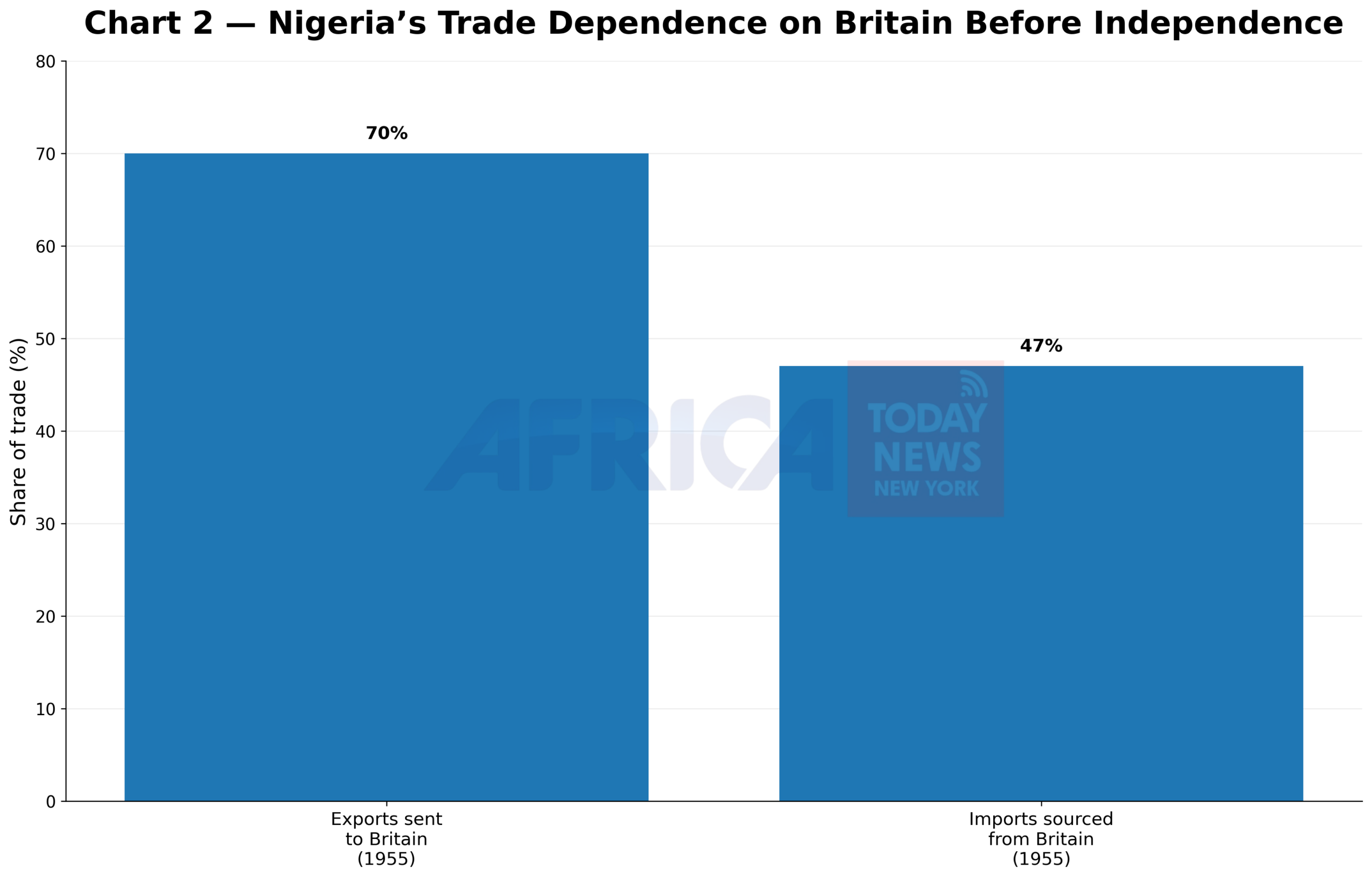
Commercial Freedom with a Colonial Artery
The chart exposes the fraud beneath the handover language. A country being prepared for independence was still sending most of its export life into the economy of the power that had ruled it. Seventy percent of exports going to Britain was not a casual market preference; it was the afterlife of colonial routing. Forty-seven percent of imports coming from Britain shows the other side of the same dependency. Nigeria was being declared politically free while its commercial bloodstream still ran through British channels. Britain did not need to occupy every office when the economy had already been trained to move through British doors.
This is why “flag independence” is not a slogan. It is a diagnosis. Political sovereignty can arrive before economic autonomy. A country can own its anthem while its export routes, trade habits, elite education, legal imagination and commercial dependency still point outward. Britain did not have to keep the Union Jack above Lagos to preserve influence. Once the economy, law, bureaucracy and political structure had been bent in the right direction, imperial presence could become less visible and still remain powerful.
Timeline of a Managed Exit
The timeline makes the case even harder. In 1900, Britain took direct control after the Royal Niger Company’s charter was revoked. In 1914, it amalgamated the Northern and Southern Protectorates. In 1954, it entrenched the federal constitutional framework. In 1960, it declared Nigeria independent. That sequence matters. Britain spent decades constructing the state on imperial terms, then presented the final years as constitutional preparation for self-government. It built first for control and transferred later under pressure.
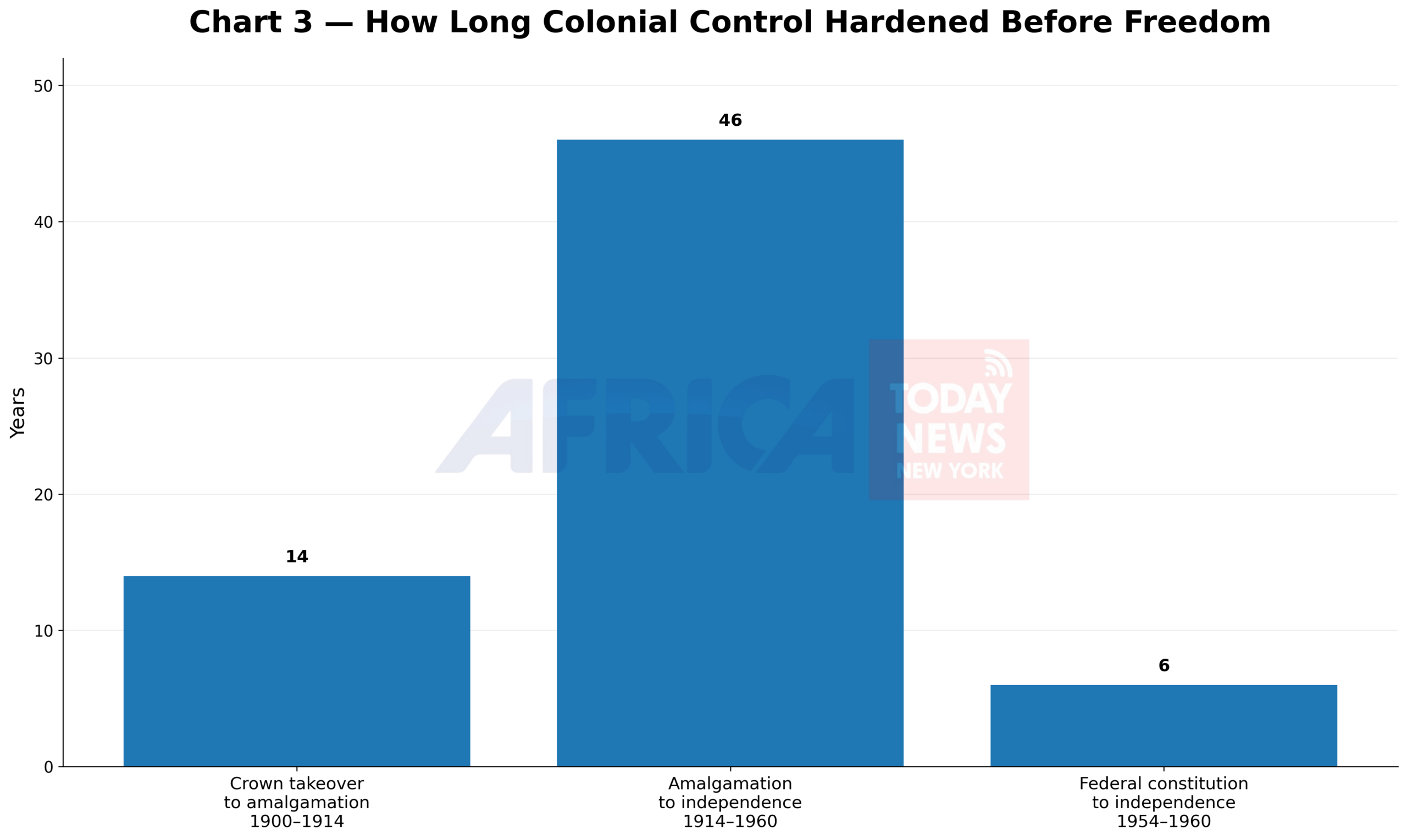
Time as Evidence
The chart shows how long the trap had been hardening before Britain called the handover freedom. Fourteen years separated Crown takeover from amalgamation. Forty-six years separated amalgamation from independence. Only six years separated the 1954 federal constitutional framework from the 1960 transfer. Nigeria was not allowed to grow slowly into a self-authored republic. The colonial structure matured first; constitutional freedom came later. By the time independence arrived, the map, the regions, the center, the legal habits and the economic channels had already been set. Britain did not leave behind an unfinished sketch. It left behind a machine.
The False Innocence of Departure
Nothing in this absolves Nigeria’s postcolonial ruling class. Too many local elites inherited a wounded state and then treated it like an estate. They deepened the damage through corruption, coups, electoral manipulation, ethnic bargaining, patronage, impunity, resource theft and cowardice before justice. Their crimes are their own. But domestic betrayal does not erase imperial design. One lazy argument blames Britain for everything. Another equally dishonest argument blames Britain for nothing. The truth is harsher and more useful: Nigerian elites committed many later crimes inside a structure whose deepest defects had been designed before they took possession of it.
Britain’s most effective trick was to make exit look like repair. It was not. What happened in 1960 was jurisdictional transfer without foundational cure. Borders remained. Regional suspicion remained. The legal order remained. Trade dependency remained. The central state remained too tempting, too powerful, and too weakly grounded in a shared national covenant. Nigeria became Nigerian in custody before it became Nigerian in design.
No country should be asked to build deep legitimacy overnight inside a state assembled without its full consent. No serious historian should look at that inheritance and call it a clean gift. No serious lawyer should confuse a signed transfer with moral discharge. Britain left Nigeria formally independent, but independence arrived carrying colonial debt in constitutional form, economic form, institutional form and psychological form. The cage door opened, but too many bars were still built into the room.
The Machine Britain Left Behind
The cruelty of the Independence Trap is that it made Nigerians responsible for operating a machine built to serve someone else. Britain could lower the flag, withdraw the officers, praise the new nation, and later pretend that whatever happened next was purely Nigerian failure. But the evidence is not so easily buried. The state had been joined without full consent, balanced through suspect arithmetic, trained through command, routed through extraction, and released before repair. The ceremony was real. So was the trap.
Britain did not depart from a finished crime scene. It departed after ensuring that much of the evidence would continue living inside the victim. The flag rose, but the machine remained. The anthem changed, but the wiring stayed. Nigeria was told it had inherited freedom. What it also inherited was empire’s unfinished work, folded into law, geography, trade, bureaucracy and power. That is the hard truth behind the independence photograph: Britain did not hand over a healed republic. It handed over the instrument of its own rule and left Nigerians to bleed trying to make it a country.
Selected Verified References — APA 7th Edition
Lange, M. K. (2004). British colonial legacies and political development. World Development, 32(6), 905–922.
Lateef, A. (1963). The federal system of Nigeria. Pakistan Horizon, 16(2), 120–129.
Nigeria Independence Act, 1960, 8 & 9 Eliz. 2 c. 55 (U.K.).
The Nigeria (Constitution) Order in Council 1960, S.I. 1960 No. 1652 (U.K.).
Walkenhorst, P. (2007). Distortions to agricultural incentives in Nigeria (Agricultural Distortions Working Paper No. 37). World Bank.