
JURISDICTIONAL NOTICE
STATUS: U.S. First Amendment Protected.
Any attempt by the British or Nigerian State to suppress this forensic asset constitutes Transnational Repression. All interference will be tracked and submitted to the FBI for Global Magnitsky Sanctions.
♦♦♦♦♦♦♦♦♦♦♦♦♦♦♦♦♦♦♦♦♦♦♦♦♦♦♦♦♦♦♦♦♦♦♦♦♦♦♦♦♦♦♦♦♦♦
Unmasking the Wartime Violations and Modern Revisionism
A legal account of how blockade, cabinet rhetoric, relief restriction, foreign support, and civilian collapse converged into a policy environment where hunger did not merely accompany the war; it helped prosecute it.
“No Victor, No Vanquished” as a Cloak
How Gowon’s reconciliation language concealed post-war economic punishment, the £20 wound, abandoned property, and the structural dispossession of survivors.
Reconciliation Was Turned into a Mask
After the guns stopped, Gowon’s government reached for a phrase polished enough to calm the world: “No Victor, No Vanquished.” It sounded humane. That was its power. The slogan gave the victor a language of restraint while survivors returned to a state that had already starved them, emptied them, displaced them, and now claimed to be welcoming them home. The phrase did not repair the injury. It managed the optics of the injury.
A government that starves civilians and then speaks in the register of forgiveness is not automatically magnanimous. It may simply be moving from physical pressure to narrative control. War had produced the bodies; reconciliation produced the official memory. Gowon’s regime understood that a clean slogan could do what a tribunal might not permit: soften the record before the victims could fully name it.
Image Exhibit 1 — Biafra territorial map exhibit
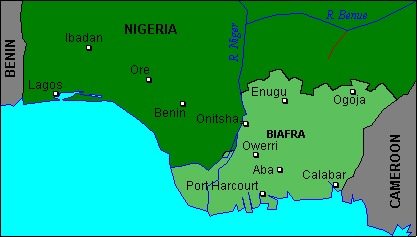
Credit: Wikimedia Commons. Public domain. Source page: https://commons.wikimedia.org/wiki/File:Biafra_map.PNG
The £20 Policy and the Economics of Defeat
The cruelty of the post-war settlement was not hidden. It was financial, administrative, and deliberate. The commonly cited £20 policy—through which many former Biafrans with bank deposits were effectively returned to economic life with a flat sum regardless of prior balances—became the symbol of a deeper post-war dispossession. Even where the legal mechanics are debated, the political meaning remains severe: survivors were reabsorbed into Nigeria under conditions that made recovery structurally unequal.
Money is not a small matter after famine. A population emerging from blockade needs capital for food, shelter, transport, school fees, tools, medicine, trade, and the rebuilding of broken households. To restrict monetary recovery after a war of starvation is to extend the injury. It converts surrender into economic dependency. It tells survivors that the war may be over, but the terms of life remain under federal control.
Image Exhibit 2 — Refugee shelter/interior relief setting, Nigeria/Biafra context, 1968

Credit: CDC/Public Health Image Library (PHIL) / Wikimedia Commons public-domain relief-camp image set. Public domain.
Awolowo’s Shadow
Awolowo’s place in this section is unavoidable because his wartime financial authority and the reported logic surrounding starvation as pressure belong to the same moral file as the post-war economic order. A policy environment that treats hunger as strategy during the war and constrains recovery after the war cannot be cleaned by a slogan. The continuity is too hard to ignore. First the body is weakened. Then the wallet is emptied. Then the state announces reconciliation.
That is not national healing. It is discipline after surrender. It is the language of unity placed over a defeated population whose biological, economic, and social means of recovery had already been damaged. The moral obscenity is not only that survivors were poor. It is that the victorious state helped decide the conditions under which their poverty would begin again.
Read also: Yakubu Gowon And The Starvation Of Biafra: Part 9
Abandoned Property and the Geography of Loss
The post-war injury did not stop at bank accounts. The abandoned property question, especially in places such as Port Harcourt, left many returning Easterners facing the loss of homes, businesses, shops, and urban footholds. Property is memory, security, credit, inheritance, location, and future. Once it is stripped away, the citizen returns to the nation as a guest inside what used to be his own life.
Gowon’s reconciliation narrative cannot survive a hard reading of this geography of loss. If no one was vanquished, why did so many return to find assets gone, savings constrained, communities disrupted, and recovery left to private endurance? A state serious about reconciliation builds restitution into law. A state interested in closure builds slogans.
Britain and the Comfort of the Slogan
Britain had every reason to welcome the language of “No Victor, No Vanquished.” It allowed London to treat the war as closed without confronting the full moral cost of the federal victory it had helped sustain. Once Gowon spoke reconciliation, British policy could retreat behind the claim that Nigeria had chosen healing. The suffering became past tense. The famine became tragedy. The post-war settlement became internal administration.
But history does not permit that escape. Britain’s complicity did not end when the shooting stopped, because the political outcome Britain supported created the conditions under which post-war economic punishment could be administered. The federal state survived. The federal narrative prevailed. The defeated population returned to life under the authority that had controlled the siege. Britain cannot help preserve the victor’s advantage and then hide behind the victor’s slogan.
Read also: Yakubu Gowon And The Starvation Of Biafra: Part 8
The False Peace
A false peace is not the absence of bullets. It is the conversion of defeat into silence. Gowon’s post-war language asked Biafrans to re-enter Nigeria without the truth having been tried, without the famine having been judged, without restitution matching the scale of injury, and without the state admitting that starvation had been made useful. The survivors were expected to perform citizenship inside a republic that had not performed justice.
That expectation was not peace. It was obedience after trauma. It was a demand that the people buried the evidence because the state was ready to move on. No society heals by making the wounded audition for national belonging.
Image Exhibit 3 — Relief supplies moved by aircraft in the Nigeria/Biafra relief operation, 1968
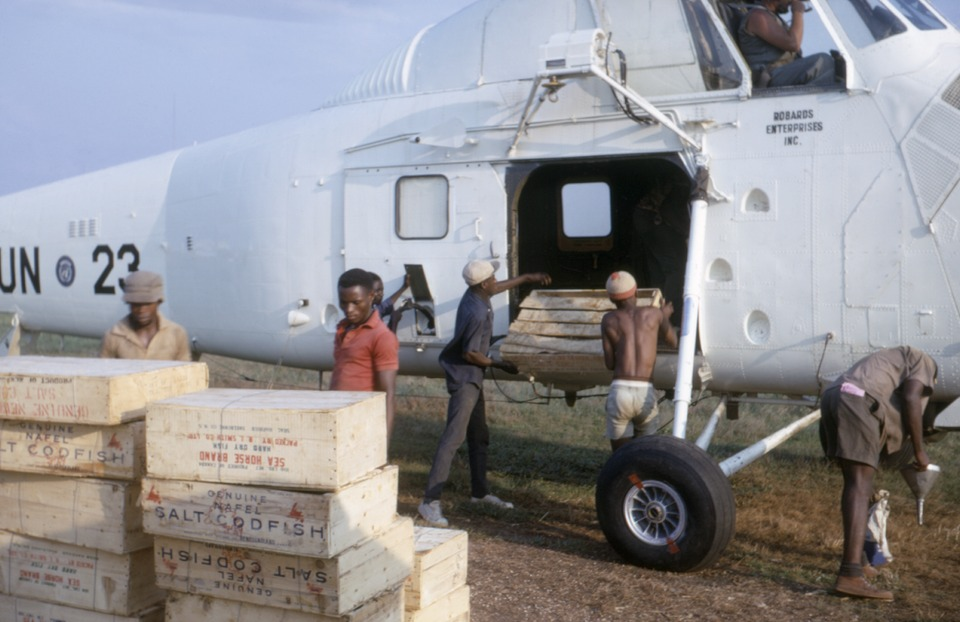
Credit: CDC/Public Health Image Library (PHIL), public-domain Nigeria/Biafra relief logistics image. Source archive: https://wwwn.cdc.gov/phil/
Closing Charge
Part 10 proves that “No Victor, No Vanquished” was not a settlement. It was a cloak. Behind it stood the £20 wound, property loss, broken families, flattened capital, and a population told to return to the country under conditions arranged by the victors. Gowon’s regime did not merely win the war; it attempted to control the meaning of the war after winning it.
The phrase was meant to sound generous. Under cross-examination it sounds like a confession. A government that must announce there was no vanquished while imposing terms that kept survivors economically wounded has already revealed the truth: victory continued after surrender, only now it wore the language of reconciliation.
Forensic Charts — Part 10
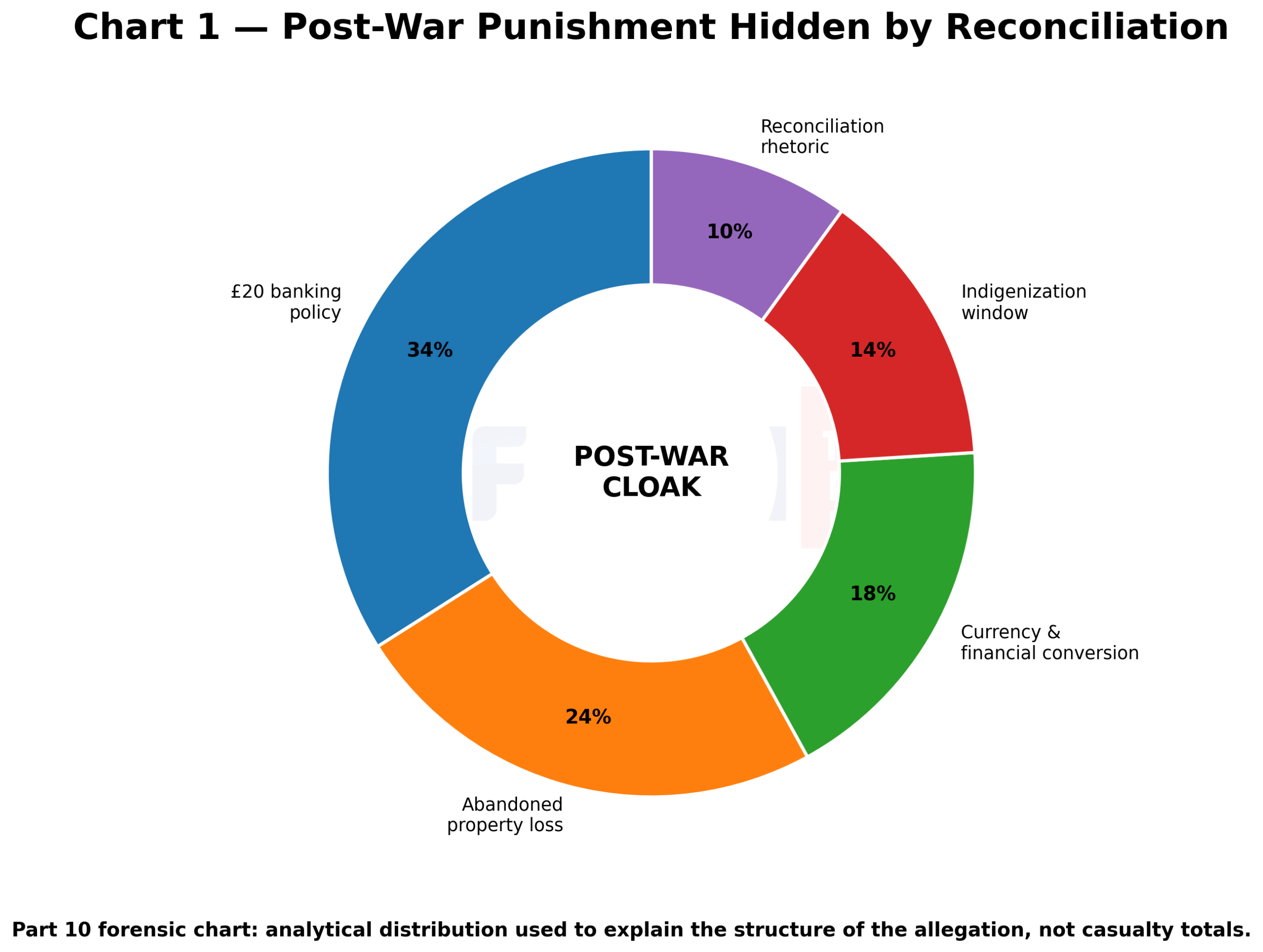
This chart breaks down the major components of post-war punishment concealed behind reconciliation language: the £20 banking policy, abandoned property losses, currency conversion, the timing of indigenization, and the public slogan itself.
Chart 2 — Rhetoric Versus Material Consequence
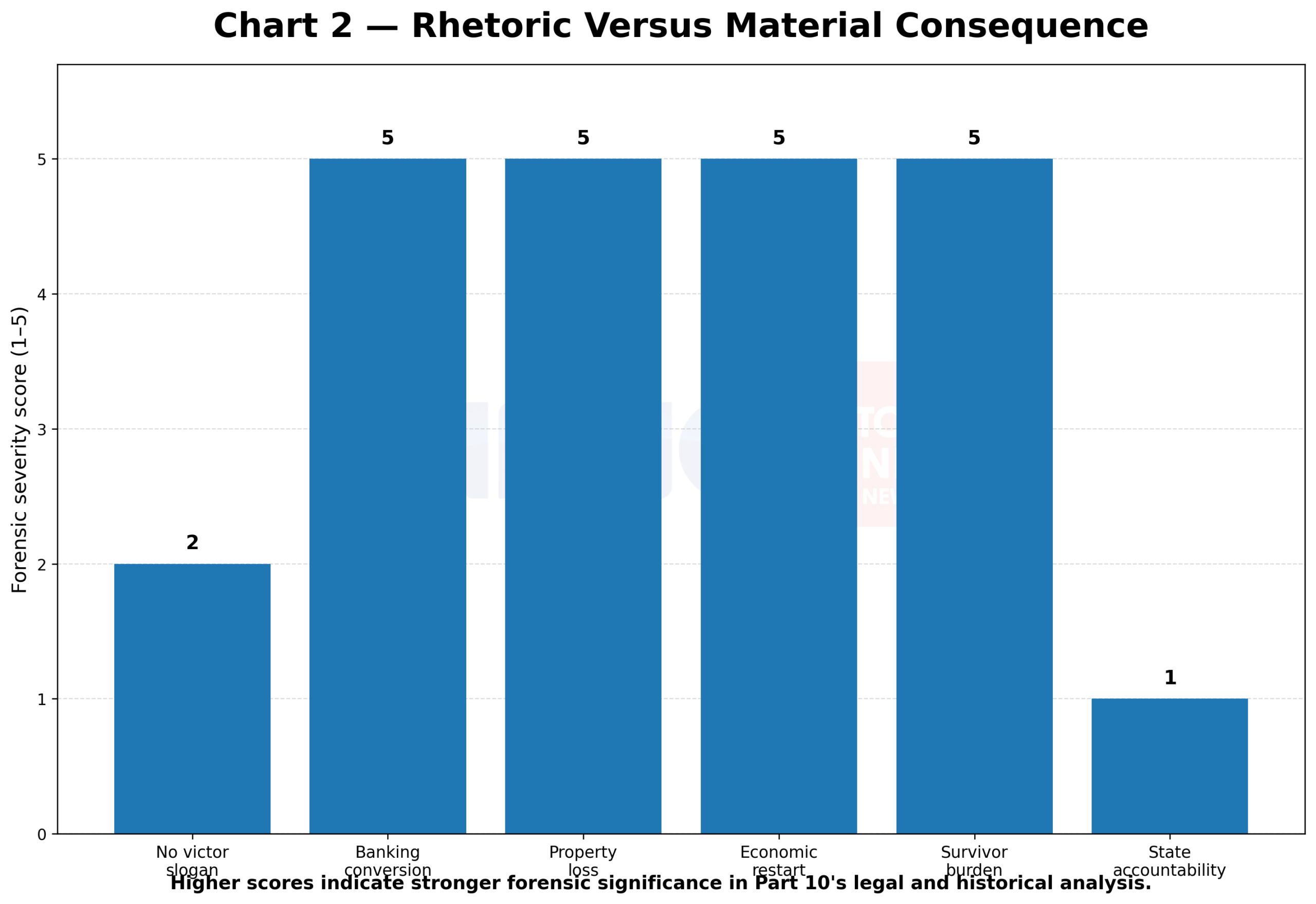
This chart contrasts the soft public language of ‘No Victor, No Vanquished’ with the hard economic consequences imposed on survivors. The highest scores belong to banking, property loss, survivor burden and economic restart because those measures shaped the post-war reality.
Chart 3 — From Surrender to Economic Enclosure
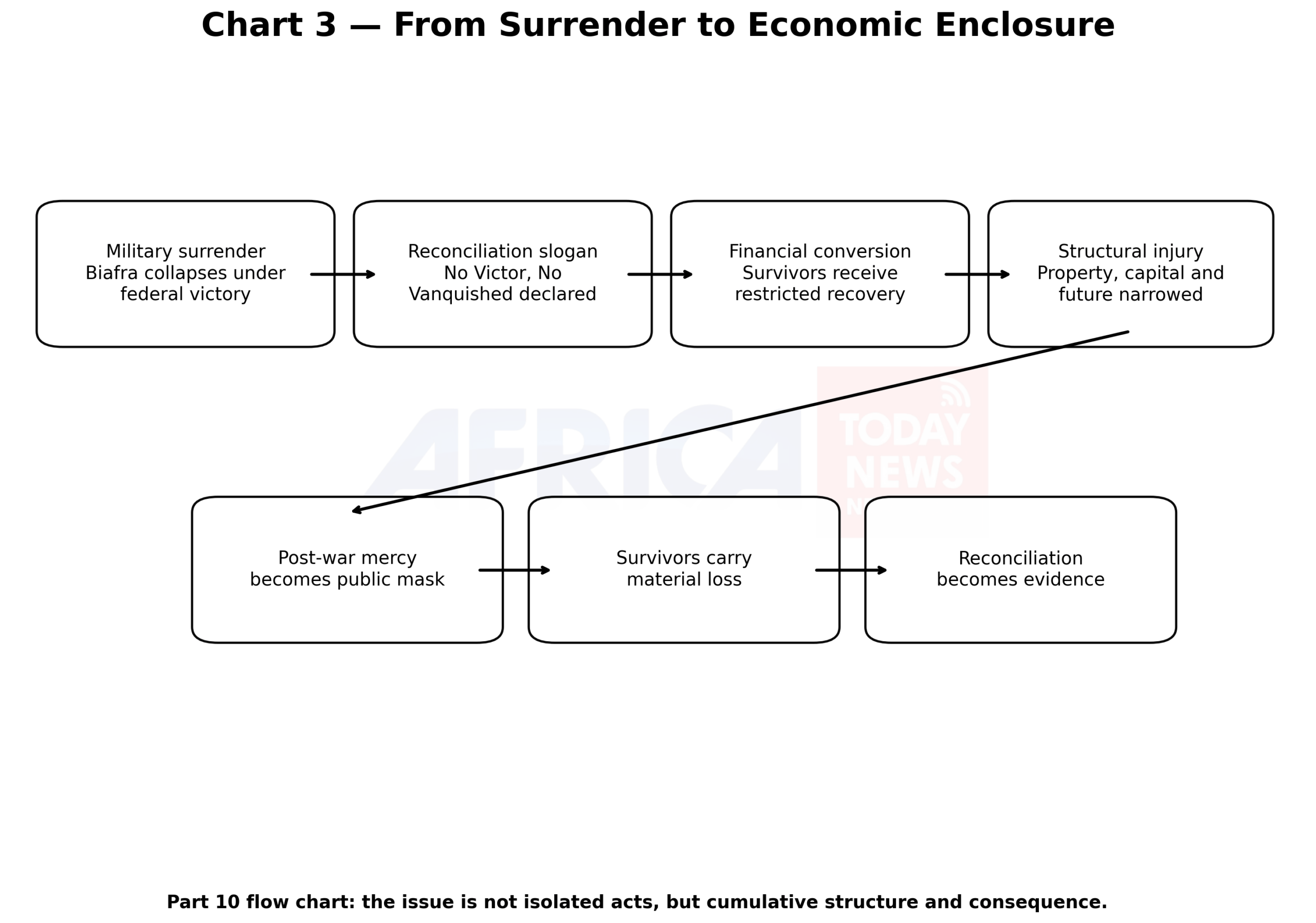
The flow chart shows the transition from military surrender into financial enclosure. Gowon’s government announced reconciliation, then survivors met the material reality: restricted funds, property disputes, weakened capital, and a tilted post-war economy.
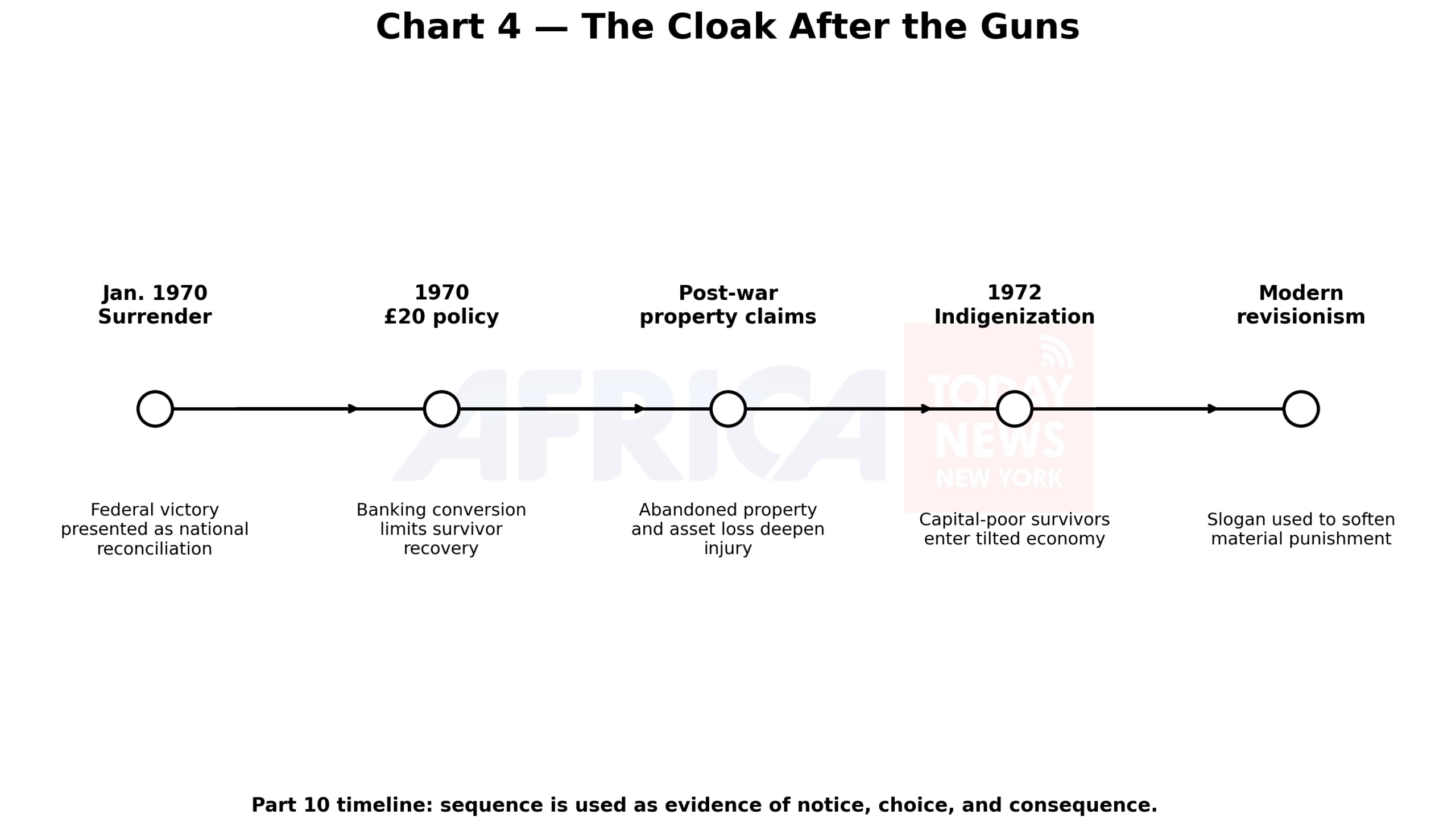
The timeline shows how quickly the slogan of mercy separated from the economics of punishment. The guns stopped in 1970, but banking limits, property losses, and later economic restructuring shaped the terms under which survivors re-entered the federation.
Historical Sources, Legal Authorities, and Evidentiary Record — APA 7th Edition
Akresh, R., Bhalotra, S., Leone, M., & Osili, U. O. (2017). First and second generation impacts of the Biafran War. NBER Working Paper No. 23721.
Heerten, L. (2017). The Biafran War and postcolonial humanitarianism: Spectacles of suffering. Cambridge University Press.
Okwuosa, L. N. (2021). The post-war era in Nigeria and the resilience of Igbo communal life. African Identities, 19(4), 1–18.
Stremlau, J. J. (1977). The international politics of the Nigerian Civil War, 1967–1970. Princeton University Press.
Uche, C. (2008). Oil, British interests and the Nigerian Civil War. The Journal of African History, 49(1), 111–135.