
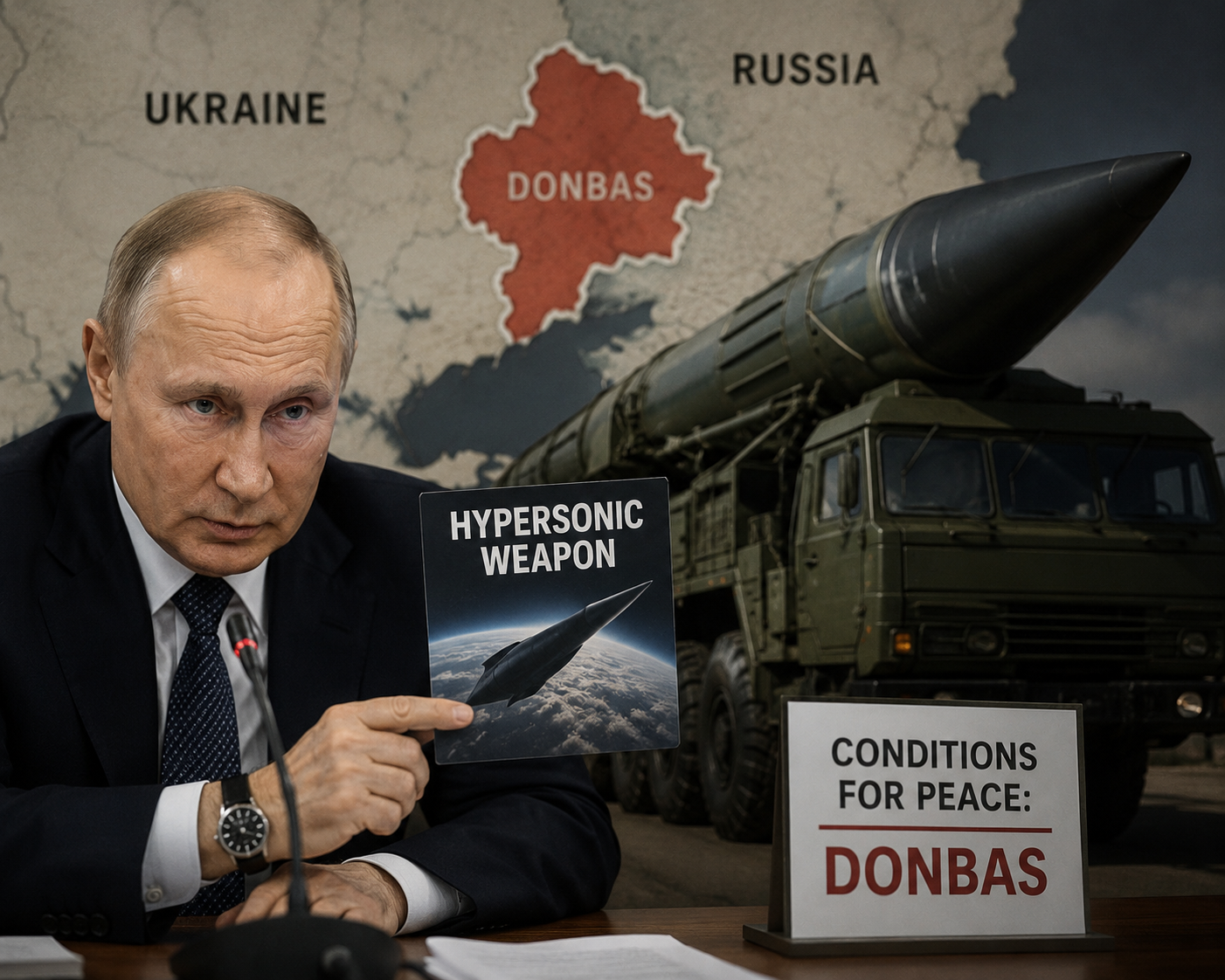
Vladimir Putin used a marquee international stage on Thursday to simultaneously project battlefield confidence, issue a veiled nuclear-capable missile threat against Ukrainian cities, and insist that any peace deal must be built on terms Kyiv has consistently said would leave what remains of Ukraine exposed and indefensible — all while his home city was still smoking from Ukrainian drone strikes the night before.
The Russian president spoke to foreign media editors on the sidelines of the St. Petersburg International Economic Forum, Russia’s annual showcase economic gathering, hours after Ukrainian President Volodymyr Zelenskyy published an open letter calling for a direct face-to-face meeting and warning that Ukraine would fight on if Putin refused to engage. Putin’s spokesman confirmed the Russian leader was aware of the letter but had not yet reviewed it in detail.
He had other things on his mind.
Read also: Zelensky Appeals Directly To Putin For Meeting, Truce
Putin said Russia had “recently” seized full control of Luhansk and now held more than 85 percent of Donetsk and 80 percent of Zaporizhzhia — three of the four Ukrainian regions Moscow unilaterally declared as its own in 2022 in a move Kyiv and the overwhelming majority of the international community rejected as illegal annexation. His forces, he said, were advancing every day.
Western and Ukrainian military analysts have disputed the pace and sustainability of that advance, arguing that Russian momentum has slowed substantially and that Moscow remains far from achieving its own declared war aims.
Putin’s numbers do not change because analysts disagree with them.
The core of his peace position, once stripped of diplomatic language, was what it has always been: Ukraine must surrender the remainder of the Donbas. He dressed the demand in a reference to the Anchorage summit he held with Donald Trump last August, saying Russia accepted the compromises discussed there and that Kyiv must do the same before the conflict can reach what he called “a natural conclusion.” What those compromises entailed was not specified. Zelenskyy has said repeatedly that yielding the Donbas would place hundreds of thousands of Ukrainians under Russian control and strip the country of the strategic depth needed to resist future aggression.
Then came the Oreshnik. Putin disclosed that Russia has not yet deployed its Oreshnik hypersonic missile in active combat against Ukraine — only test-fired it to evaluate results in preparation for potential full-scale use, including against urban targets.
Read also: Russia Accuses US Of Blocking UN Attendance With Visa Refusal
The Oreshnik, first fired into Ukraine in 2024, is nuclear-capable, carries a stated range of more than 5,000 kilometers, and Putin has previously claimed it cannot be intercepted — an assertion Western defense experts have challenged. Raising it in the context of a peace discussion, in front of foreign media editors at an economic forum while Zelenskyy’s ceasefire letter was circulating, was not incidental. It was a calibrated reminder of what Russia has chosen not to use yet.
Putin struck a tone throughout that blended grudging openness to diplomacy with an insistence that the battlefield entitled Russia to dictate the terms. He acknowledged Trump’s peace efforts, praised what he described as the American president’s readiness to broker compromise, and noted — with apparent patience rather than frustration — that Trump was preoccupied with the Iran war for now. The European Union, he suggested, might usefully deploy its influence to bring Kyiv around to the necessary concessions. That framing — in which Europe persuades Ukraine to accept Russian terms rather than Russia moderating its demands — reflects Moscow’s negotiating posture precisely.
Zelenskyy’s letter offered a different framing entirely.
The Ukrainian president wrote that ordinary Russians had grown exhausted by drone and missile attacks on their cities, fuel shortages, and inflation — conditions, he argued, that made Russian society ready for peace even if the Kremlin was not. He warned Putin that his own political future depended on making the right decision. Putin, asked Thursday about his plans beyond the end of his current term in 2030, declined to engage.
His health was in God’s hands, he said. The Russian constitution permitted him to run again and serve until 2036 if he won. Whether he intended to was not a question for now. Russia faced pressing problems. Those needed solving first.
He did not say what the pressing problems were. His air defenses, he conceded, needed improvement — an acknowledgment extracted by the reality of Ukrainian drones reaching St. Petersburg oil terminals and naval facilities on the eve of the forum. “Russia has an air defence system. Yes, we must improve it. Yes, we must strengthen it,” Putin said. The concession, however carefully worded, came from a leader who rarely admits to defensive gaps in public, and it landed in the middle of a week in which Zelenskyy had deliberately demonstrated how far Ukrainian reach now extends.
Now in the fifth year of Europe’s bloodiest land conflict since the Second World War — a war Russia expected to conclude in days — Putin remains the indispensable figure in any negotiated end to the fighting and the principal obstacle to one. He says he is ready for a deal. He has named his price. And he has reminded everyone within range of a microphone that he still has weapons he has not yet chosen to fire.