
JURISDICTIONAL NOTICE
STATUS: U.S. First Amendment Protected.
Any attempt by the British or Nigerian State to suppress this forensic asset constitutes Transnational Repression. All interference will be tracked and submitted to the FBI for Global Magnitsky Sanctions.
♦♦♦♦♦♦♦♦♦♦♦♦♦♦♦♦♦♦♦♦♦♦♦♦♦♦♦♦♦♦♦♦♦♦♦♦♦♦♦♦♦♦♦♦♦♦♦♦♦♦♦♦
A forensic dissection of Flora Shaw’s colonial label, Decree No. 24, and the militarized elite cartel that turned Nigeria into a republic no president can redeem without restructuring.
The Praetorian Trap: One Police Force for a Country Too Large to Secure
A forensic case against centralized policing in a country where insecurity is local, urgent, and faster than distant command.
Nigeria’s security crisis is often described as a failure of equipment, morale, manpower, or leadership. Each of those explanations carries a measure of truth, but none reaches the center of the matter. A country of Nigeria’s size, diversity, and historical wounds cannot be secured from one distant command post without creating delay, distrust, and operational blindness. Communities confront danger in real time. Federal command moves through hierarchy. Between those two facts lies a graveyard of avoidable deaths. The constitutional order calls governors chief security officers, then denies them true command over the police force that operates inside their states. Responsibility is localized. Authority is centralized. That is not a security system. It is a trap disguised as national control.
The Federal Police Illusion
The fiction survives because it flatters the center. On paper, one police force appears tidy: one command, one hierarchy, one national symbol of order. On the ground, it asks a command post in Abuja to understand the habits of bandits on rural roads, the economy of kidnapping corridors, the tensions between farming and grazing communities, the codes of cult violence in city neighborhoods, and the fears of villages whose names rarely reach federal briefings until bodies have already been counted. A security structure that learns too late will always arrive as witness rather than protection.
Centralization also produces political evasion. When violence spreads, each layer of government can blame another. Governors point to their lack of operational control. Federal officials point to state failures in development, intelligence, and local governance. Police commanders invoke manpower and logistics. Citizens are left inside the gap between responsibility and authority. That gap is not administrative inconvenience. It is where people are kidnapped, taxed by armed groups, displaced, silenced, and buried.
Section 214 of the 1999 Constitution establishes one Nigeria Police Force. In principle, the idea promises unity, standardization, and national cohesion. In practice, it produces a security structure that asks a single centrally controlled force to answer thousands of local realities across a vast federation. The Inspector-General may sit at the apex, but violence does not wait at the apex. It strikes along farm roads, motor parks, village paths, highways, schools, markets, and forests. Local people know the terrain, the actors, the rumors, the tensions, the grazing routes, the criminal safe houses, and the early signs. A system that treats such intelligence as subordinate to distant command burns the first asset every security system needs: proximity.
Governors Without Tools
State governors carry public blame whenever insecurity spreads. Citizens protest at government houses. Victims appeal to governors. Communities expect state authorities to act. Yet police deployment, command discipline, and institutional direction remain tied to the federal chain. A governor may fund patrol vehicles, donate equipment, pay allowances, support vigilante units, or plead for troop deployment, but those are improvised gestures within a constitutional order that withholds command. The result is political theater under conditions of real danger. Governors appear responsible enough to be blamed, but not empowered enough to be fully accountable. Abuja retains authority. States inherit anger. Citizens inherit graves.
Read also: Nigeria: The Slave Name And The Restructuring Verdict — Part 8
From Local Violence to National Paralysis
Nigeria’s insecurity has different names in different places: kidnapping, banditry, insurgency, cult violence, separatist agitation, farmer-herder conflict, oil theft, communal clashes, and urban robbery. One national police command cannot read all of these as the same problem without flattening local reality. A community facing armed abduction does not need abstract federal presence; it needs intelligence, rapid response, trusted local knowledge, and command that does not arrive after the crime has become a funeral. Centralization has repeatedly confused uniformity with strength. Real strength in a federal country comes from layered responsibility, where local, state, regional, and national institutions act within clear limits and answer for their failures.
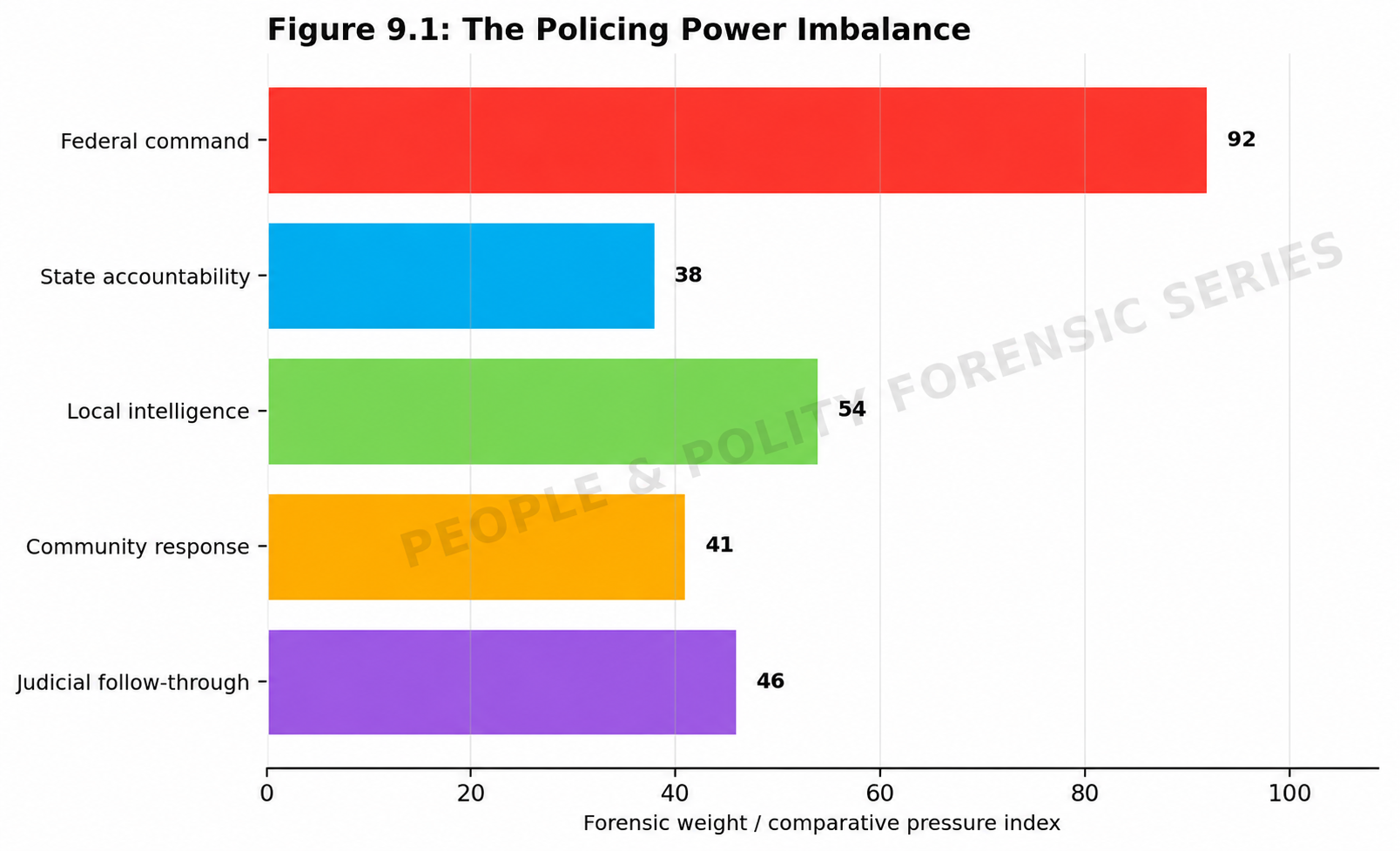
Figure 9.1: The Policing Power Imbalance. Forensic argument map; not an official statistical dataset unless explicitly marked.
Evidence Exhibit 9A
| Claim | Evidence Type | Forensic Meaning | What It Proves |
| One federal police force cannot secure local realities | Constitutional text, policing scholarship | Authority sits far from community danger | Central command weakens proximity and response |
| Governors carry blame without police command | Federal structure and public accountability | Responsibility and power are split | Citizens cannot clearly punish the true holder of power |
| State policing requires safeguards, not rejection | Comparative federalism and reform literature | Abuse risk can be regulated | Fear of misuse cannot justify known failure |
Read also: Nigeria: The Slave Name And The Restructuring Verdict — Part 7
The Cost of Distrust
Police legitimacy does not come from uniforms alone. It comes from trust, and trust is local before it is national. A police officer posted into a community without language, cultural memory, or social roots may carry federal authority, but that authority can become thin in the face of suspicion. Citizens who do not trust police with information will hide what they know. Communities that see the police as outsiders may tolerate parallel armed groups, vigilantes, or private security arrangements. Centralization creates a second danger: when official security fails to feel local, unofficial security begins to look necessary. A republic that leaves citizens to improvise protection has already begun surrendering monopoly over force.
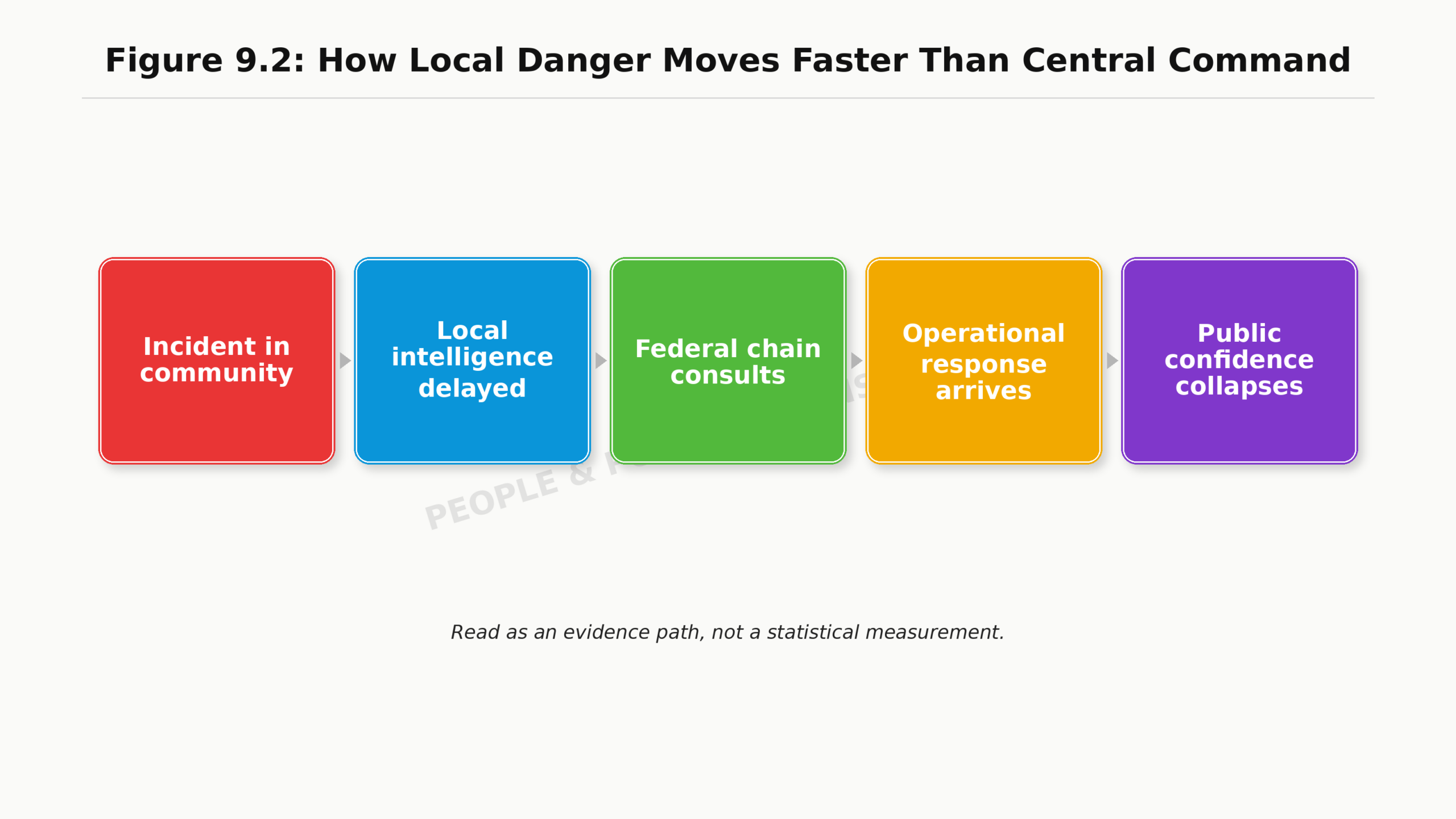
Figure 9.2: How Local Danger Moves Faster Than Central Command. Forensic argument map; not an official statistical dataset unless explicitly marked.
The False Fear of State Police
The abuse argument becomes dishonest when it treats federal policing as a clean institution and local policing as the only danger. Nigeria already knows federal abuse: excessive force, corruption, extortion, political deployment, rights violations, and poor accountability. The question is not whether power can be abused. All police power can be abused. The question is whether a federation can design layered safeguards strong enough to bring security closer to communities while preventing governors from converting local forces into private militias.
A serious state-police settlement would require constitutional brakes: independent appointment procedures, legislative oversight, judicial review, rights commissions, transparent funding, professional standards, and federal intervention when a state force becomes an instrument of ethnic persecution or electoral violence. Abuse risk is a reason to design controls, not a reason to preserve a failed monopoly.
Opponents of state police often warn that governors will abuse local forces. The fear is not imaginary. Nigerian politics has enough violence, patronage, and electoral thuggery to justify caution. Yet abuse risk is not an argument for centralized failure. It is an argument for strong safeguards: independent state police commissions, federal rights standards, judicial review, legislative oversight, transparent funding, professional training, and clear penalties for political misuse. Refusing reform because power can be abused leaves citizens under a system already failing them. The question is not whether state policing carries risk. Every security design carries risk. The question is whether Nigeria should preserve a known disaster because it fears a reform that can be regulated.
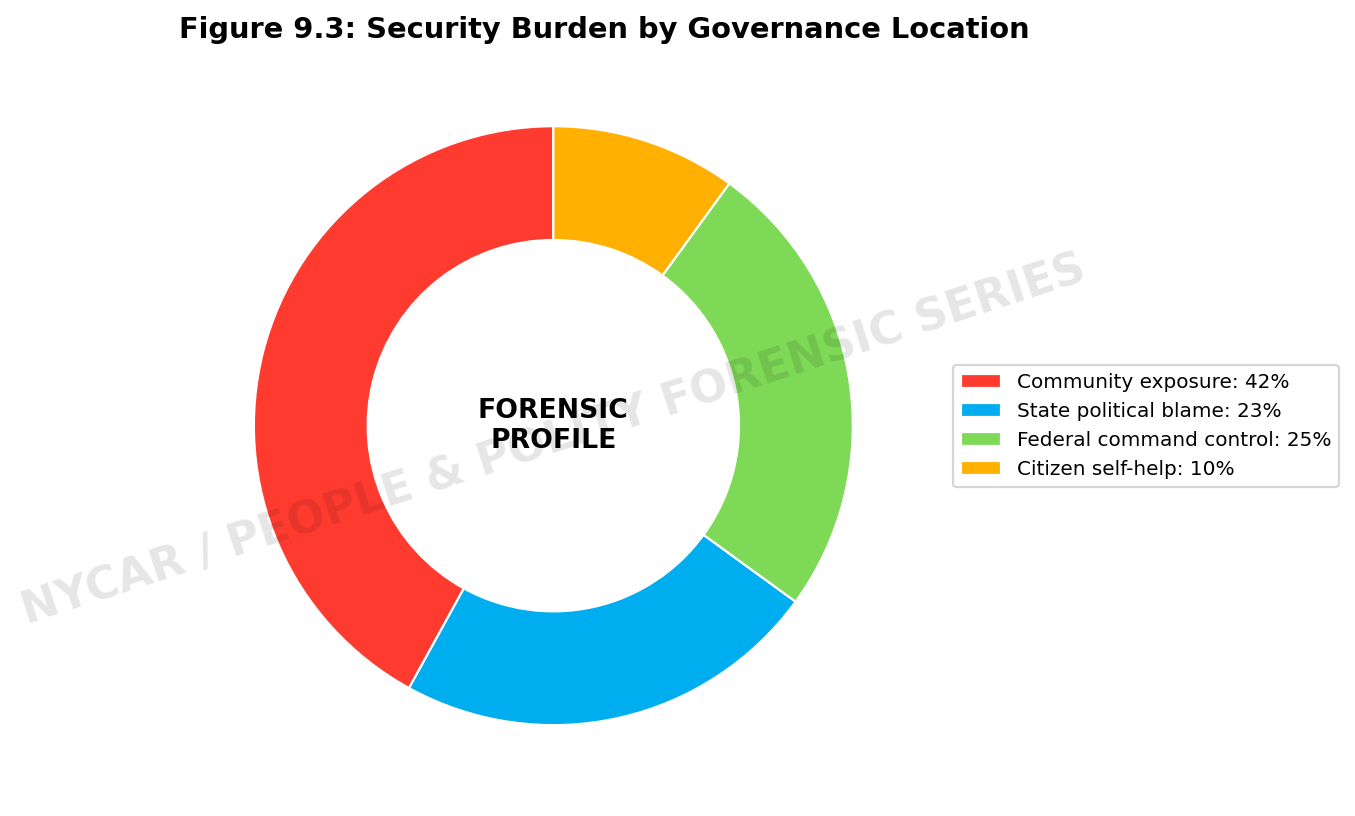
Figure 9.3: Security Burden by Governance Location. Forensic argument map; not an official statistical dataset unless explicitly marked.
The Constitutional Root
Matfess’s analysis of insecurity in Nigeria’s Fourth Republic is useful because it pushes the conversation beyond headlines and into institutional design. The crisis is not only a failure of response after violence occurs; it is rooted in how authority, responsibility, and capacity are distributed. Federalism without local security power is a promise without muscle. Citizens live locally, pay costs locally, and die locally. Their security institutions must be close enough to know them and accountable enough to fear their judgment. A police structure designed for command obedience will never substitute for one designed around public trust, local intelligence, and constitutional accountability.
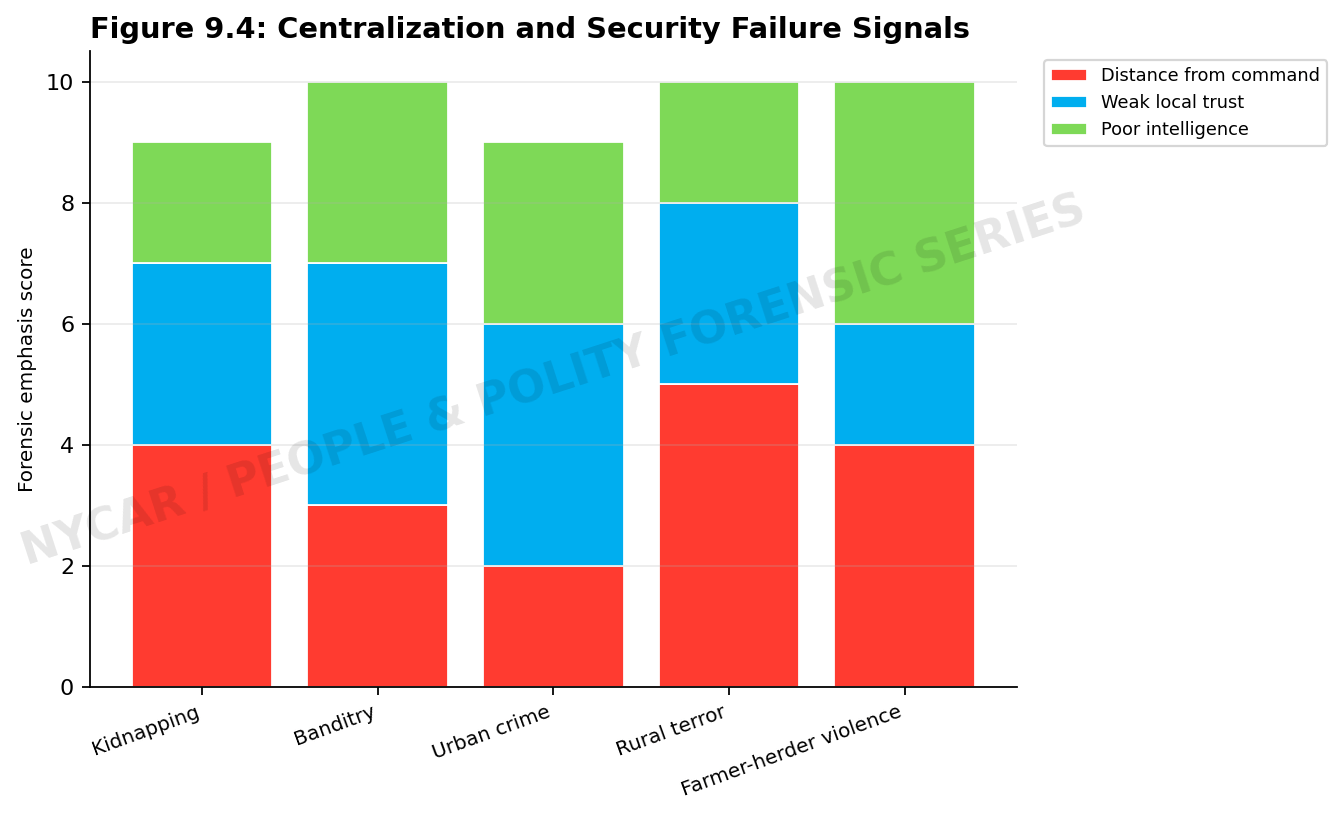
Figure 9.4: Centralization and Security Failure Signals. Forensic argument map; not an official statistical dataset unless explicitly marked.
Toward Layered Security
Restructuring security does not mean abolishing national policing. It means ending the fiction that national command can do all things in all places. A serious federation needs federal police for cross-border crime, terrorism, federal offenses, interstate coordination, and national standards. It also needs state and regional police for local intelligence, rapid response, community protection, and everyday law enforcement. Local security boards can bring traditional rulers, civic leaders, prosecutors, police officials, and elected authorities into accountable channels. Civilian review boards can punish abuse. Courts can restrain governors. Parliament can audit funding. Reform must design against tyranny without leaving citizens defenseless.
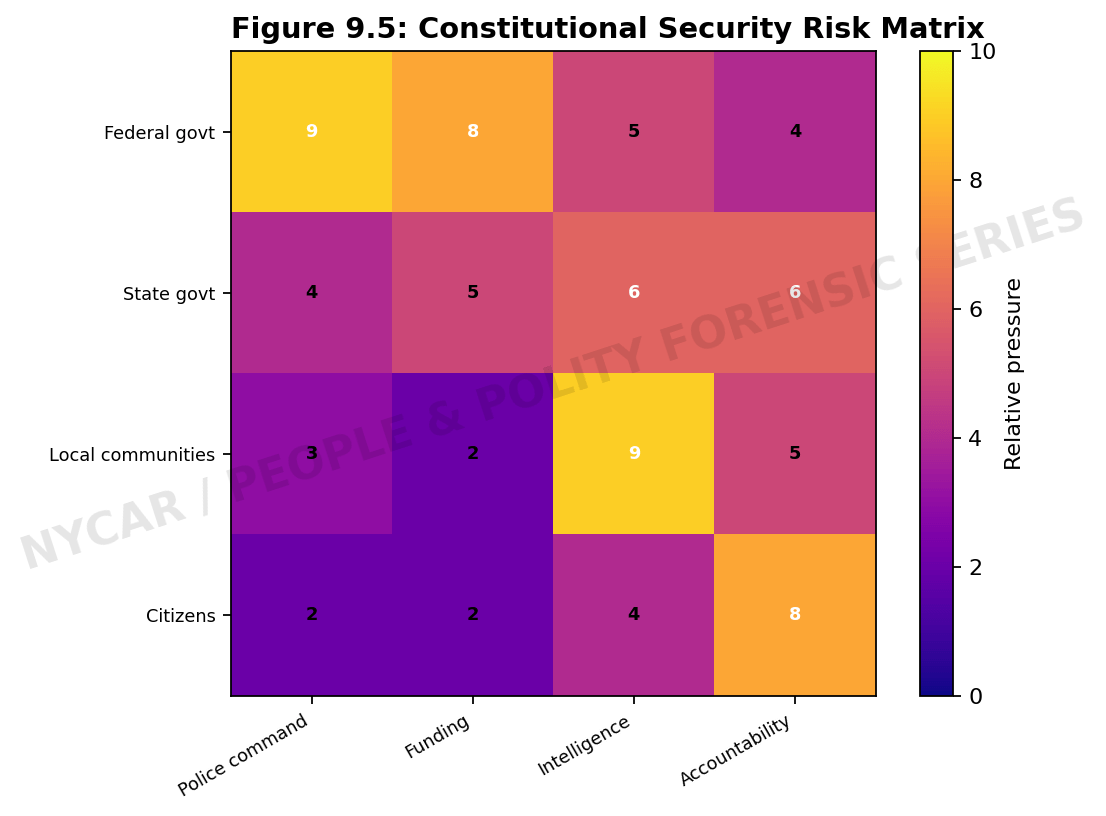
Figure 9.5: Constitutional Security Risk Matrix. Forensic argument map; not an official statistical dataset unless explicitly marked.
Final Finding
Part 9 shows that Nigeria’s security collapse is not random disorder. It is the consequence of a constitution that centralizes command while danger localizes itself. Abuja cannot smell smoke in every burning village. A distant police command cannot know every forest path, every community grievance, every local rumor, or every criminal network before citizens pay the price. Yet the state keeps demanding patience from people whose lives are exposed by design. Centralized policing has become an internal occupation by distance: present enough to claim authority, absent enough to fail protection. Restructuring must bring security power closer to the people, or the republic will continue burying citizens beneath the fiction of one force for a country no single command can secure.
Evidentiary Sources (APA 7th Edition)
Amnesty International. (2020). Nigeria: Time to end impunity: Torture and other violations by Special Anti-Robbery Squad (SARS). Amnesty International.
CLEEN Foundation. (2024). Supporting the introduction of state police in Nigeria. CLEEN Foundation.
Federal Republic of Nigeria. (1999). Constitution of the Federal Republic of Nigeria, 1999. Federal Government Printer.
Federal Republic of Nigeria. (2020). Nigeria Police Act, 2020. Federal Government Printer.
Hills, A. (2008). The dialectic of police reform in Nigeria. The Journal of Modern African Studies, 46(2), 215–234. doi: 10.1017/S0022278X08003200
Human Rights Watch. (2010). “Everyone’s in on the game”: Corruption and human rights abuses by the Nigeria Police Force. Human Rights Watch.
Madubuike-Ekwe, N. J., & Obayemi, O. K. (2019). Assessment of the role of the Nigerian Police Force in the promotion and protection of human rights in Nigeria. Annual Survey of International & Comparative Law, 23(1), 19–48.
Matfess, H. (2016). Institutionalizing instability: The constitutional roots of insecurity in Nigeria’s Fourth Republic. Stability: International Journal of Security & Development, 5(1), Article 13. doi: 10.5334/sta.458
Rotimi, K. (2001). The police in a federal state: The Nigerian experience. College Press.
Suberu, R. T. (2001). Federalism and ethnic conflict in Nigeria. United States Institute of Peace Press.
U.S. Department of State. (2024). 2023 country reports on human rights practices: Nigeria. U.S. Department of State.
World Bank. (2022). Nigeria public finance review: Fiscal adjustment for better and sustainable results. World Bank.