
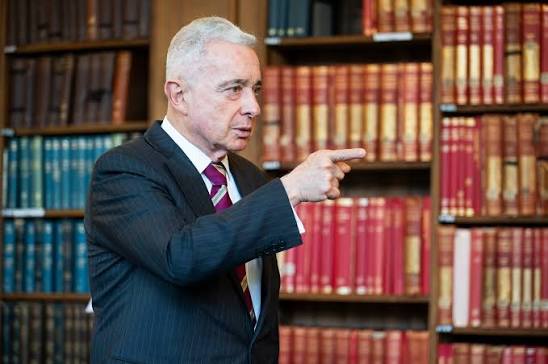
Colombia’s Attorney General’s Office has launched a criminal investigation into former President Álvaro Uribe over the founding of a paramilitary organization, two massacres, and the killing of a human rights defender — a probe that lands on the calendar just 48 hours before voters decide a presidential runoff in which Uribe’s own legal history has become a campaign issue.
News of the investigation surfaced Thursday through a Reuters source inside the prosecutor’s office and through Uribe himself, who posted about it on social media before details were confirmed. A spokesperson told Reuters that Uribe has been summoned for questioning, though no date has been set.
Uribe, 73, governed Colombia for two terms between 2002 and 2010 and remains the dominant figure of the country’s political right. He is also Colombia’s only former president ever criminally convicted — a fraud and bribery verdict last year tied to allegations he ordered a lawyer to pay jailed paramilitary fighters to retract claims linking him to their network. That conviction was overturned on appeal. It now sits before the country’s Supreme Court, unresolved.
The senator at the center of that earlier case is on the ballot Sunday.
Iván Cepeda, the leftist lawmaker whose original complaint triggered the witness-tampering prosecution, is formally classified as a victim in that proceeding. He now faces right-wing lawyer Abelardo De La Espriella in the presidential runoff — a candidate who has Uribe’s explicit backing and has campaigned on a hardline approach toward armed rebel groups. Uribe did not let the timing pass without comment.
Read also: Colombian Hopeful Shot, In Critical State After Attack
“This is a clear case of political pressure and injustice,” he said, alleging a connection between Cepeda and the prosecutor who issued the summons.
His lawyers, he added, had identified four well-documented sites of paramilitary massacres and violence that will form the basis of the coming questioning.
The new investigation reaches into territory far older and bloodier than the bribery case that made Uribe a convicted felon. Colombia’s paramilitary movement emerged from financing supplied by cattle ranchers, landowners and merchants seeking protection from leftist guerrilla groups during the country’s internal conflict. A national truth commission has attributed nearly half of the more than 450,000 deaths recorded in that conflict between 1985 and 2018 to paramilitary violence. Uribe’s connection to that network — denied for decades, investigated intermittently, never previously prosecuted at this level — is now the direct subject of a criminal inquiry rather than a peripheral allegation in someone else’s case.
The family precedent is not encouraging for Uribe. His brother, Santiago Uribe, was convicted last year on charges tied to the same paramilitary apparatus and sentenced to 25 years in prison.
Read also: Colombian Military Plane Crash Kills 66
Uribe has built his political identity around denial of that connection for most of his public life, casting every legal challenge as persecution by opponents unable to defeat him at the ballot box. The framing has worked before. Whether it holds depends partly on who is left to make the opposite case once Sunday’s vote is counted.
Cepeda’s campaign has not directly tied his candidacy to the prosecutor’s timeline, and there is no public evidence connecting his campaign to the office’s decision to act now. But the optics are unavoidable: a sitting presidential candidate, classified as a victim in one Uribe prosecution, watching a new and far more serious one open against the man backing his opponent, days before voters decide between them.
De La Espriella has staked his campaign on toughness toward FARC remnants and other armed groups still operating in Colombia’s periphery — a position that places him, implicitly, on the side of the security establishment Uribe built during his presidency and that critics say was never fully separated from the paramilitary structures the truth commission has now quantified in the hundreds of thousands of deaths.
No court has found Uribe guilty of founding a paramilitary group, ordering a massacre, or killing a human rights defender. Those are now allegations under formal investigation, not settled findings. The Supreme Court has not yet ruled on his existing conviction. The runoff happens Sunday regardless of what either court eventually decides — leaving Colombia to elect its next president while the legal status of one of its most consequential former leaders remains, as it has for years, unresolved.