
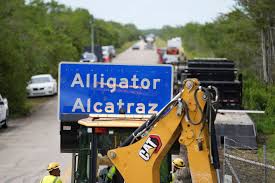
A Florida immigration facility conceived as a punishment by geography — where alligators and python-infested wetlands would do the work of walls — has been cleared of all detainees, the Department of Homeland Security confirmed Wednesday, drained of its population just as the Atlantic hurricane season opened its first named storm.
The timing was not incidental. DHS cited the arrival of hurricane season as the operational justification for transferring every detainee held at the facility known as Alligator Alcatraz to other detention sites, though spokesperson Lauren Bis declined to say how many people were moved or where they were sent. The statement offered no indication the closure was permanent. But the combination of forces that accumulated over the facility’s year of operation — sustained legal challenges, documented abuse complaints, whisper campaigns from within the administration about unsustainable costs, and now a named storm churning through the Gulf of Mexico — suggest the site’s effective lifespan as an active detention hub may already be over.
Anonymous officials told The New York Times in May that the remote camp had grown too expensive to justify.
Alligator Alcatraz opened in July 2025 on an abandoned airstrip carved into Big Cypress Natural Preserve, northwest of Miami. Its existence was announced on June 19 of that year. The facility was never presented as a conventional detention center. Florida Attorney General James Uthmeier put the premise plainly at launch: if detainees escaped, there was nowhere to go and nothing waiting for them outside the fence except the Everglades’ more dangerous residents. Donald Trump toured it personally alongside Florida Governor Ron DeSantis the week it opened, the spectacle functioning as both a political event and a statement of intent. DeSantis, Trump’s former rival in the 2024 Republican primary, had committed state resources to supporting the administration’s mass deportation agenda, and Alligator Alcatraz was the most visible embodiment of that partnership.
The facility was designed to hold up to 3,000 people. Officials maintained that its aluminum-frame structure could withstand winds equivalent to a Category 2 hurricane. That assurance did not survive contact with scrutiny from lawyers, rights organizations, and the detainees themselves — who described denied access to legal counsel, chronic medical neglect, and food contaminated with insects. The remote location, civil rights advocates argued, was not incidental to those conditions but integral to them: isolation was the tool, the Everglades its enforcer.
Read also: Court Rules ‘Alligator Alcatraz’ Immigration Center Stays Open
The American Civil Liberties Union led one of several lawsuits filed against both the state of Florida and the federal government, alleging the facility’s design systematically denied detainees the legal services they were entitled to. ACLU attorney Amy Godshall, who helped bring that case, acknowledged Wednesday’s transfers as a necessary step while pressing the administration on what she described as the larger unresolved question. The harm done over the past year, she said, could not be undone by clearing the population out. Her organization’s demand was categorical: permanent closure, with a binding commitment never to detain people at the site again.
Beyond the legal system, the facility generated opposition from an older constituency. Indigenous leaders of the Miccosukee and Seminole nations pushed back against the construction from the beginning, arguing that the installation damaged both their territories and the ceremonial sites that hold meaning within the broader Everglades ecosystem. Their objections were noted and largely set aside.
The broader context for Alligator Alcatraz was the Trump administration’s domestic detention expansion during his second term — a network of facilities that has drawn protests across the country and triggered a sustained national argument about conditions inside federal and state-run immigration lockups. Alligator Alcatraz drew an outsized share of attention partly because of its name and its theater, partly because of the sustained documentation of conditions inside.
Tropical Storm Arthur, the first named storm of the 2026 Atlantic hurricane season, was moving through the Gulf of Mexico toward Louisiana as the DHS announcement was made Wednesday. The hurricane season runs June through November. Whether Arthur was sufficient meteorological cover for an exit that may have already been decided on cost grounds, DHS did not address. The fate of the detainees transferred out — their numbers, their destinations, their legal status — remained unspecified in the agency’s statement.
The government opened the facility in one news cycle and emptied it in another. Between those two moments, roughly a year passed, and the people held there have now been moved somewhere else.