
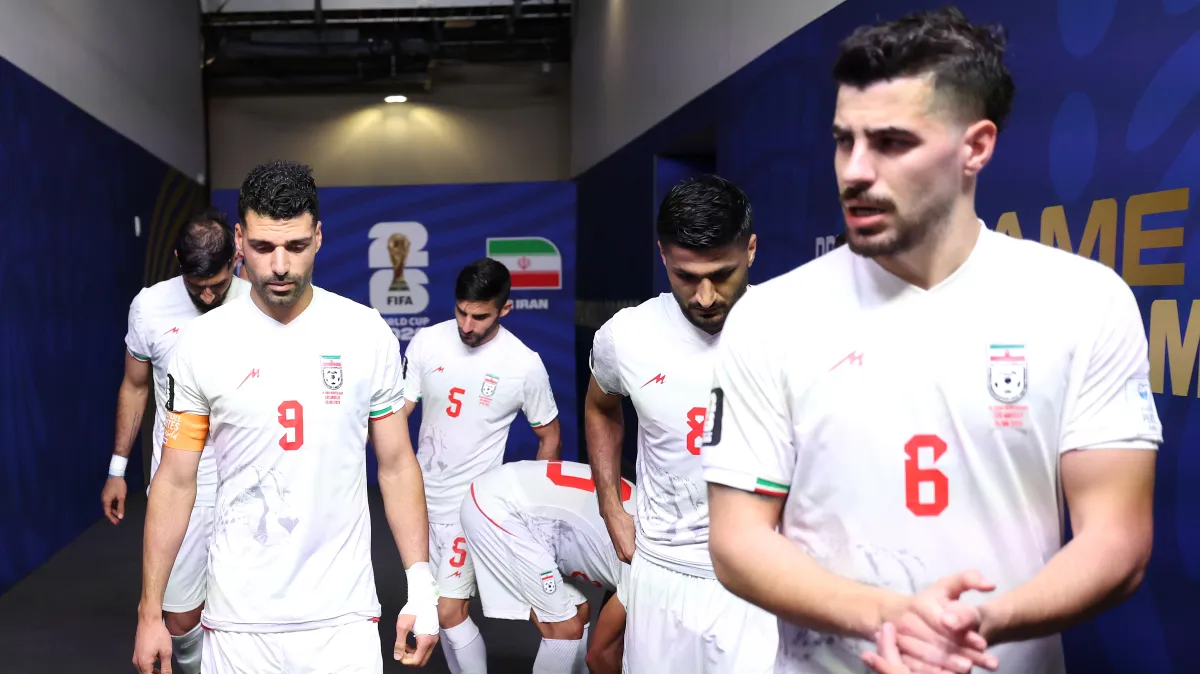
U.S. intelligence agencies have identified no credible threat tied to Iran’s World Cup delegation. The team still cannot spend a single night in any American city where it plays.
That contradiction sat at the center of Saturday’s confirmation from Andrew Giuliani, executive director of the White House Task Force for the tournament, that the travel restrictions binding Iran’s squad will not change, regardless of the team’s plan to file a formal complaint with FIFA. Giuliani told Reuters the existing protocol stays in place for now, with reviews to follow as the tournament progresses.
The mechanics are rigid: Iranian players may enter the United States only within 24 hours of a scheduled match and must leave for their training base in Tijuana, Mexico, immediately after the final whistle.
Read also: Syria’s Kurds Warn Iran’s Kurds: Don’t Trust Washington
That rule produced its first real test after Iran’s Group G opener against New Zealand, a match that ended around 8 p.m. local time. Within hours of the final whistle, the delegation was airborne back to Mexico, bypassing the overnight stay in Los Angeles that coach Amir Ghalenoei said his team had counted on for recovery. Ghalenoei did not hide his frustration afterward, calling his squad “the most oppressed team in the whole World Cup.”
A visa complication compounded the strain. Winger Mehdi Torabi’s entry document expired once the New Zealand match ended, and team officials said Tuesday afternoon that a new multiple-entry visa had since been issued, clearing him to travel for future games. The State Department’s response was brief: “This issue has been resolved.”
Buried inside Giuliani’s broader comments Saturday was a detail that has drawn less attention than the overnight-stay dispute: some members of Iran’s traveling delegation have been denied U.S. visas altogether. Every player and every coach has received one, Giuliani said. Certain team officials have not, a gap he attributed to derogatory information the U.S. has gathered on those individuals. He offered no further detail on what that information contains or how many officials it affects.
Iran arrived in Los Angeles on Saturday evening for Sunday’s match against Belgium, roughly 24 hours ahead of kickoff, in line with the unchanged protocol. Giuliani said the team will fly back to Tijuana on a 27-minute charter Sunday afternoon, with discussions over the rules for Iran’s third match — against Egypt in Seattle on Friday — set to begin the day after.
Read also: US And Israel Strike Iran In Operation Shield Of Judah
Some of the friction predates the tournament’s opening kick. Iran’s training base was relocated from Tucson, Arizona, to Tijuana before the World Cup began, a switch Giuliani defended as beneficial to all sides. He said the change cut roughly an hour off the team’s flight time to Los Angeles compared with the original arrangement, and he described himself as satisfied with how the logistics had played out for the opening match.
Giuliani framed the entire arrangement, visa denials included, as a balancing act between hospitality and security. The task force’s goal, he said, has been to welcome international visitors to the tournament while protecting both them and American citizens. Asked about threats to the broader event, he said intelligence agencies had intensified monitoring since the start of the year and that officials were coordinating “every hour,” but that no credible threat had surfaced.
He called the tournament’s first ten days a success, pointing to the level of play on the field as the dominant storyline so far — a characterization that holds for most of the 48-team field, if not for the one team required to leave the country within hours of every match it plays.
Every Iranian player has a visa. Every Iranian coach has one too. The team officials who do not have been given no public explanation, and as of Saturday, none was forthcoming.