
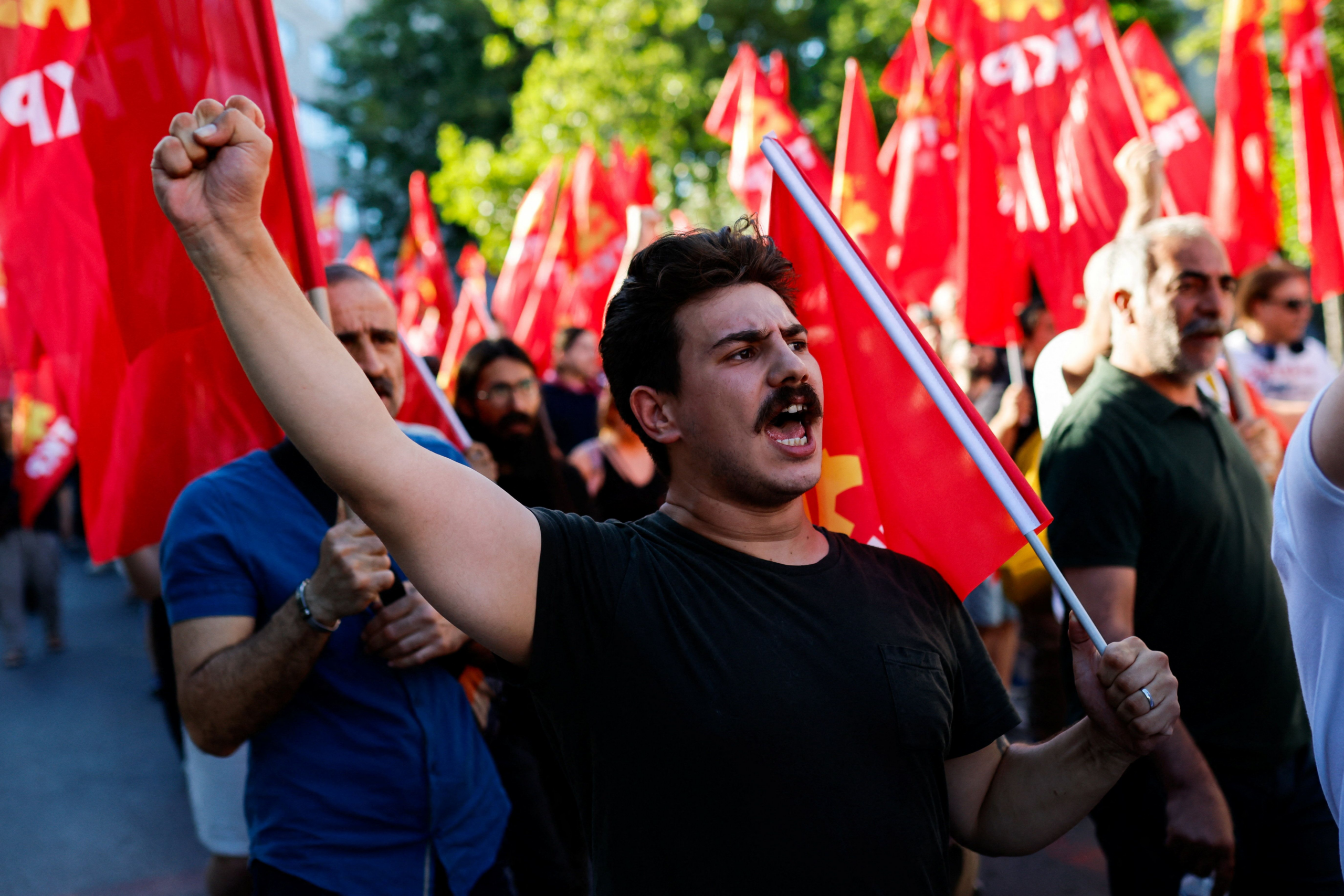
More than 100 members of Turkey’s Communist Party were pulled off the streets of Ankara on Sunday, riot police firing tear gas into a crowd chanting “Murderer NATO, get out of country” just three days before the alliance’s leaders arrive in the same city.
The detentions struck at the heart of Kizilay Square, where the party had organized a march explicitly timed to disrupt the atmosphere ahead of Tuesday’s summit. Among those held were TKP administrators, according to a statement the party released Sunday, describing a crackdown that swept up more than just rank-and-file demonstrators.
Turkey is set to host leaders from all 32 NATO member nations, along with representatives from allied partner states, for two days of talks Tuesday and Wednesday. Ankara has responded by sealing off large sections of the capital, banning demonstrations outright, closing roads and flooding the city with security personnel in the run-up to the gathering.
That lockdown didn’t stop protest organizers elsewhere.
Read also: Europe Rejects Trump’s Hormuz Naval Coalition, Warns On NATO
Hundreds marched in Istanbul from Taksim Square to Dolmabahce in a second TKP-organized demonstration, while two additional protests unfolded separately in the Kadikoy district under the banner of other leftist groups. Unlike Ankara, Istanbul’s protests passed without physical confrontation, despite a heavy police presence lining the march routes.
TKP Secretary General Kemal Okuyan framed the day’s actions as a promise kept, telling supporters in Istanbul that the party had refused to let Ankara go quiet in the face of NATO’s arrival. “We would not allow Ankara to remain silent,” he said. “We have fulfilled that promise.”
The government has offered no public response to either the protests or the arrests.
Sunday’s detentions arrive on top of a much larger security sweep that began weeks earlier. Turkish authorities detained 225 people in anti-terror raids across Ankara last month, formally arresting 103 of them, according to reporting on the operations at the time. That figure climbed further over the weekend: media outlets reported Sunday that 39 additional people had been detained nationwide, a group that included journalists from independent news organizations, academics and activists.
Read also: NATO Criticized Over Iran As Trump Revives Greenland Claim
Opposition politicians see a pattern forming, not a coincidence.
Tuncer Bakirhan, co-chair of the pro-Kurdish DEM Party, accused the government of exploiting the summit to justify sweeping arrests that have nothing to do with securing the event itself. Writing on X, he described the country as having been converted into what he called a detention center, adding that Turkey was living through what amounted to undeclared martial law.
Kemal Kilicdaroglu, the court-appointed chairman of the main opposition Republican People’s Party, joined that criticism, calling the detentions an unacceptable barrier to basic rights at a moment when the world’s attention is fixed on Ankara.
Turkish prosecutors have pushed back against any suggestion the raids are summit-related, maintaining in prior statements that the operations target genuine militant activity and have no connection to NATO’s arrival — a claim made without any reference to the summit’s timing at all.
That silence on timing has done little to quiet the accusations. The raids began weeks before Tuesday’s gathering and have continued accelerating as the date approaches, sweeping in everyone from party officials to reporters covering the crackdown itself.
Journalists trying to cover the summit have run into obstacles of their own. Dozens were denied accreditation to the event last month, a decision that drew criticism from press freedom advocates even as Turkish officials proceeded with security preparations elsewhere in the capital.
By Sunday evening, Ankara looked less like a city preparing to host diplomats and more like one bracing for a confrontation that had already arrived. Streets sat barricaded, tear gas hung over Kizilay Square, and more than a hundred party members spent the night in custody — three days before the leaders they were protesting even touched down.