

Case File: Fallopian Tubes
Tubal Disease, Infection and Silent Pelvic Damage
Perfect timing solves nothing when the road is closed. A tube can be scarred shut for years by an infection a woman never knew she had.
A couple can do everything the fertility advice demands — track ovulation to the hour, time intercourse perfectly, eat and sleep and abstain exactly as told — and still never have a chance, because the road the egg must travel is closed. The fallopian tubes are the meeting place: the egg is caught at one end, sperm swim up from the other, and fertilisation happens inside the tube before the embryo is carried down to the womb. If the tube is blocked, none of that can occur, and no amount of timing changes it. The cruelty is that the damage is usually silent, done long before, by an infection the woman was never told she had.
Picture the anatomy plainly. From each upper corner of the uterus a fallopian tube reaches out toward an ovary, ending in soft finger-like fimbriae that sweep the released egg inward. A healthy tube is an open, muscular corridor lined with tiny beating hairs that move the egg and, later, the embryo along. Fertility depends on that corridor being open on at least one side. When infection scars it — narrowing the channel, gluing the fimbriae shut, or sealing the tube entirely — the egg and sperm simply cannot meet, and the diagnosis is tubal factor infertility.
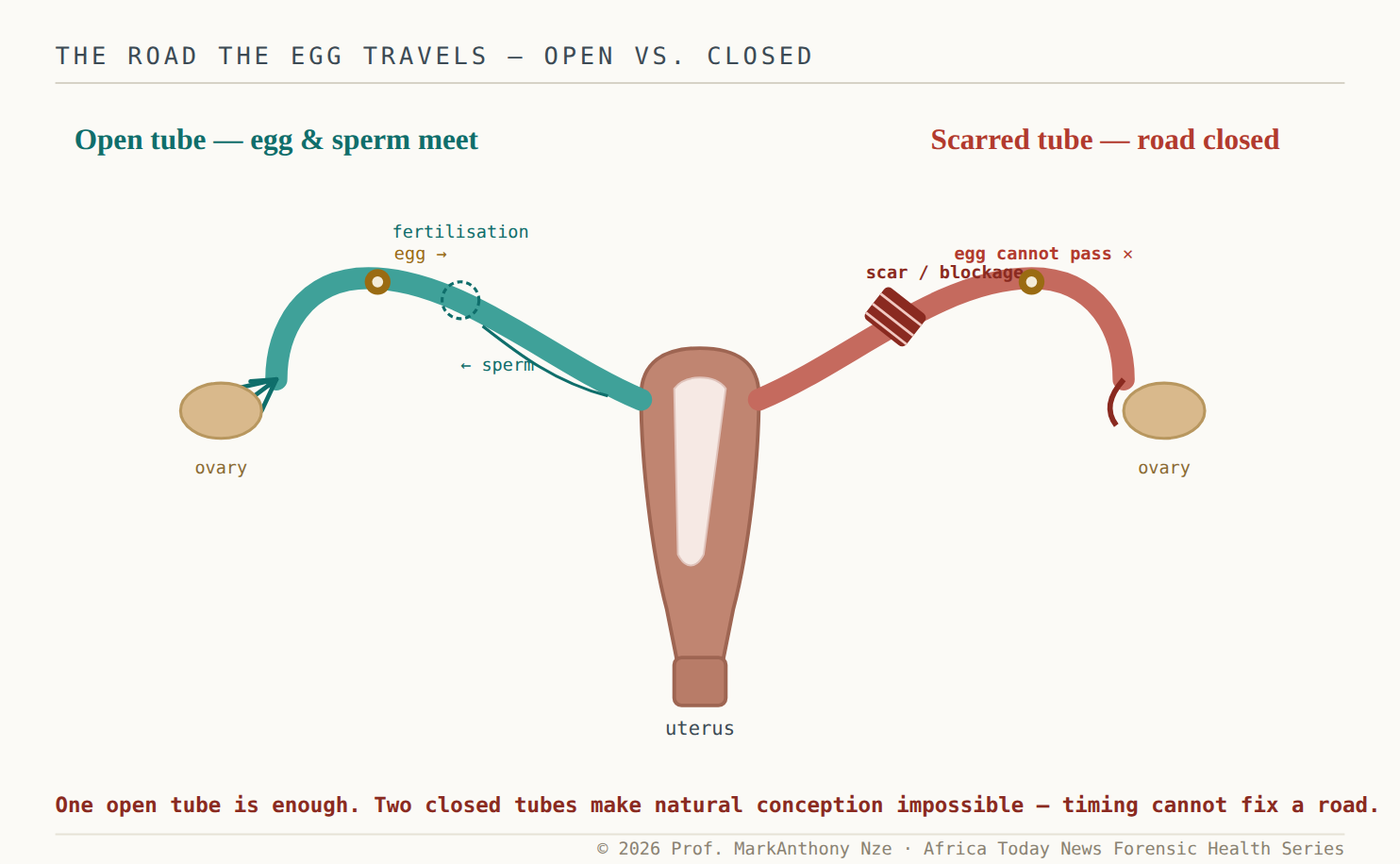
Fig. 24.1 A meeting place, not a detail. Fertilisation happens inside the tube. An open corridor on one side preserves the chance; two closed tubes end it, no matter how perfect the timing.
Read also: The Fertility Repair Series III — Part 23
The infection nobody felt
The commonest cause of that scarring is infection, and its defining feature is silence. Chlamydia and gonorrhoea ascend from the cervix into the tubes and set off pelvic inflammatory disease; the body heals inflammation the only way it can, by laying down scar. But most of these infections cause no symptoms a woman would notice, and the tubal damage is often discovered years later only when pregnancy will not come. This is why “I’ve never had an infection” is not reassurance — a great many women with tubal damage never had a diagnosis, because the disease that caused it ran quietly. The silence is the danger, not an all-clear.