
The United States carried out its 11th consecutive night of airstrikes against Iran early Wednesday, widening the bombing campaign to new targets as President Donald Trump said talks with Tehran remained unlikely and confirmed that 18 U.S. service members have been killed in the war so far.
American forces struck a military site near the northwestern Iranian city of Tabriz, according to Iranian media, marking the first time the area is believed to have been hit since hostilities intensified two weeks ago. The U.S. also struck the western towns of Abdanan and Chovar, near the border with Iraq, prompting Tehran to activate air defenses over the capital. Iran responded by firing on U.S. bases in Kuwait, Bahrain and Jordan.
Trump said the U.S. would keep intensifying its bombing campaign until Iran agrees to reopen the Strait of Hormuz and stop attacking tankers and other vessels transiting the waterway. Iran has rejected Trump’s characterization that it is seeking a new round of negotiations, though Tehran’s interior ministry said an “exchange of messages” with Washington remains possible even though no formal talks are underway, according to the Mehr news agency. “They want to desperately meet, and until they’re ready to meet in a meaningful way, we have no interest” in talks, Trump said Tuesday at the White House.
Iran’s interior minister, Eskandar Momeni, traveled to Pakistan on Tuesday to ask Islamabad, one of the conflict’s principal mediators along with Qatar, to continue its efforts, though there was no sign the visit had eased tensions. A senior Iranian official separately said Monday that Tehran had received a mediator proposal for a 10-day ceasefire aimed at salvaging an interim truce the U.S. and Iran signed in June, which had itself replaced an earlier ceasefire from April.
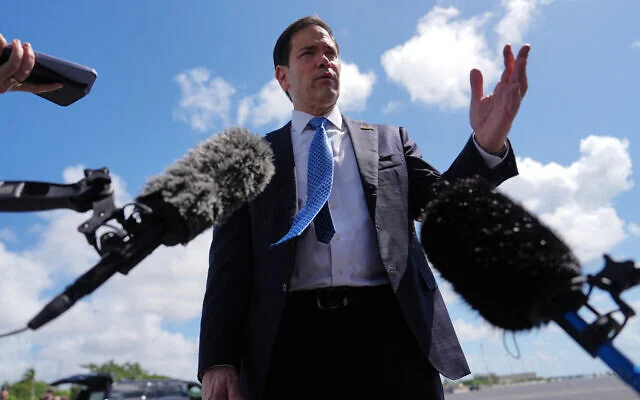
Secretary of State Marco Rubio, speaking to Southeast Asian foreign ministers in Manila, said Washington remains open to negotiations but questioned Tehran’s sincerity. “The problem we’re having right now is that they’re not serious about talks. If they’re serious, we’re serious,” Rubio said, adding that the U.S. would otherwise do what is necessary to protect its own interests and those of its allies.
Read also: Iran’s Path To Washington
The human toll has continued to climb on both sides. Trump said four of the 18 American deaths came in Iranian attacks on U.S. bases in Jordan and Iraq in recent days; the Pentagon said an Army sergeant from Queens, New York, Angel S. Rampersad, 28, was believed killed last Friday during an attack on Muwaffaq Salti Air Base in Jordan. Nearly 100 U.S. troops have been injured in the two weeks since the war resumed. A Tehran health ministry official said 50 civilians have been killed and 500 wounded in the recent U.S. strikes on Iran, a figure that could not be independently verified.
Defense Secretary Pete Hegseth told Congress during a budget hearing that the Pentagon’s latest estimate for the war’s cost stands at $37.5 billion, a figure he said aligns with some independent assessments of direct expenses. Analysts have said indirect costs, including higher fuel prices tied to disruptions in the Strait of Hormuz, push the true total considerably higher; Brent crude surpassed $90 a barrel Tuesday, nearing its highest level in a month. Trump separately renewed his threat to strike Iran’s Natanz nuclear facility again soon, a site the U.S. bombed in June 2025 and that Trump has said was totally obliterated at the time; Iran has promised to retaliate if it is struck again.
Read also: US And Israel Strike Iran In Operation Shield Of Judah
The war took on a new dimension this week after Iran-aligned Houthi militants in Yemen announced Monday they would impose a naval blockade on Saudi Arabia, threatening a second critical energy chokepoint beyond the Strait of Hormuz. The Houthis have not yet fired on any vessel, but three tankers carrying Saudi crude toward Asia reversed course in the Red Sea and turned instead toward the Suez Canal, according to the maritime intelligence firm Kpler. Trump warned the U.S. would strike the Houthis if they follow through, as it did when the group targeted shipping during the war in Gaza.
The threat has pushed Saudi Arabia and the United Arab Emirates toward a public display of unity after months of strained relations that had spilled into delayed bank transfers and prompted Wall Street firms to draft contingency plans. Saudi Media Minister Salman Al-Dosary and Abdulla bin Mohammed Alhamed, chairman of the UAE’s National Media Authority, posted coordinated messages on social media Tuesday night affirming the countries’ shared history, and the UAE said Wednesday it supported measures to safeguard Saudi security.
Separately, the Trump administration plans to announce a broad civilian nuclear cooperation agreement with Saudi Arabia on Wednesday that could allow the kingdom to enrich its own reactor fuel, according to U.S. officials who described the deal on condition of anonymity. Officials said the accord is meant partly to bind Washington and Riyadh more closely as the Iran war strains the relationship, and would benefit the U.S. nuclear industry, starting with reactor designer Westinghouse. Unlike an earlier version discussed under the Biden administration, the deal is not tied to Saudi recognition of Israel. Congress can review the agreement under the Atomic Energy Act, but opponents would need a veto-proof majority to block it, making passage likely despite objections from some lawmakers in both parties and from Israeli officials who fear the technology could eventually be diverted toward weapons development.
The broader war, which began Feb. 28 with U.S. and Israeli strikes on Iran, has killed thousands of people across the Gulf region since then, according to death tolls reported by officials on both sides.