
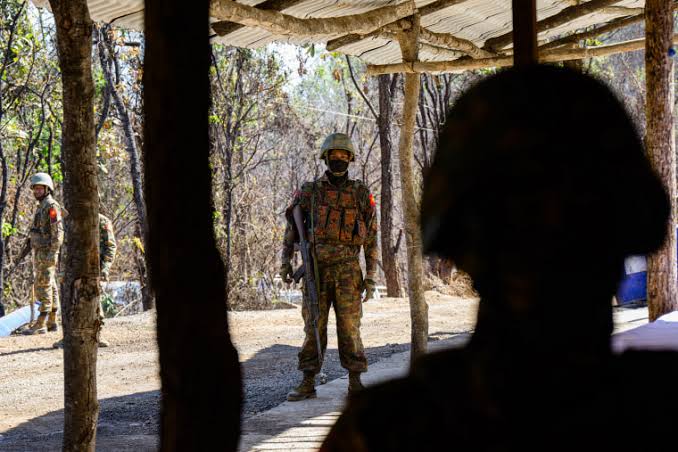
A conflict monitoring group said Monday that Myanmar’s military killed more than 450 civilians in at least a dozen mass killings during the first half of 2026, a toll it attributed to tactics adopted by a new military command installed in March as the junta’s leader moved into the presidency.
The Armed Conflict Location & Event Data Project said the escalation followed a reshuffle at the top of Myanmar’s armed forces. In late March, Min Aung Hlaing appointed longtime loyalist and former military spy chief Ye Win Oo, 60, as the armed forces’ new commander-in-chief, clearing the way for Min Aung Hlaing to be sworn in as president the following month after an election that had barred most opposition parties from competing. Min Aung Hlaing had led the military as commander-in-chief since 2011 and had ruled Myanmar continuously since seizing power in the February 2021 coup; he served as acting president from August 2025 before parliament, dominated by military appointees and the junta-backed Union Solidarity and Development Party, formally elected him to the post in April. The reshuffle also installed Htun Aung, a former air force commander, as defense minister the same month, rounding out a broader realignment of the military’s senior leadership around the presidential transition.
Under Ye Win Oo, ACLED said, the military has intensified its air campaign, regularly deploying specialized groups of two to five fighter jets to carry out sustained strikes against single targets, alongside a broader worsening of ground repression against civilians. In one such strike in June, an airstrike hit the town of Kyauktaw in western Rakhine State, leaving buildings in ruins, according to images from the scene. Roughly 40% of the civilian deaths ACLED recorded in the first half of the year occurred in Myanmar’s central dry zone, known as the Anyar region. The military has also pushed renewed offensives into border areas that include deposits of rare-earth minerals and key overland trade routes.
Read also: UN Fears Death Toll Above 500 In Myanmar Boat Disaster
One of the deadliest reported episodes occurred in May, when three residents told Reuters that hundreds of junta troops swept through parts of Myit Chay township, across the river from the ancient temple complex at Bagan, killing at least 40 people. Reuters could not independently verify the accounts. The incident does appear in ACLED’s event database, with a recorded toll of at least five fatalities, and was separately reported by local media. “About 700 soldiers came into the town, grabbed the belongings of the people here and then beat them and killed them,” said Ye Naung, 35, one of the residents who described the raid.
ACLED said the shift under the new command reflects a change in method rather than any softening of the military’s approach. “The military’s tactics in 2026 so far show merely shifting modalities of civilian repression rather than any reduction in its severity,” the group said, adding that it saw little prospect of relief for civilians as the junta works to consolidate control following Min Aung Hlaing’s transition from military commander to civilian president.
The violence traces back to February 2021, when the military ousted the elected government led by Aung San Suu Kyi, touching off a civil war that has killed an estimated 100,000 people and displaced millions more across the country, from the central dry zone to the borderlands with Thailand, India and China.
Read also: Myanmar Expels Timor-Leste Rep Over War Crimes Dispute
Even as the killings continue, Myanmar’s political transition has opened the door to a wave of diplomatic activity that had been largely closed to the junta since the coup. Min Aung Hlaing has traveled to India and China in his new capacity as president, and Myanmar has seen tentative re-engagement with the 11-member Association of Southeast Asian Nations, which barred the country’s military leadership from its summits after 2021. He is scheduled to make an official visit to Thailand on Aug. 6 and 7, a trip seen as part of a broader push for international legitimacy following his formal transition to civilian rule and his effort to present the presidency as a break from the military rule that preceded it.
A Myanmar government spokesperson did not respond to questions about the ACLED report, which draws on media reports, local partners, and monitoring by the United Nations and human rights organizations operating in and around the country.