
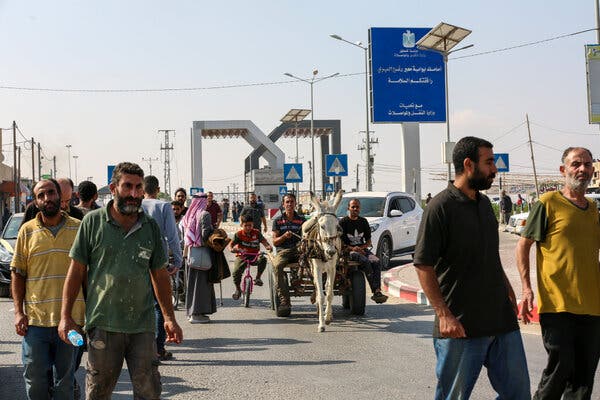
Israel said on Wednesday that it intends to reopen the Rafah crossing between Gaza and Egypt within days, a move officials described as part of efforts to support the ongoing ceasefire with Hamas. The announcement immediately drew a sharp response from Cairo, which denied it was working with Israel on any such arrangement.
The status of the Rafah crossing has become a central pressure point in the humanitarian crisis in Gaza, where thousands of seriously ill residents remain unable to leave for urgent medical treatment. Any change at the border carries political weight for Israel, Egypt and the Palestinian factions involved in the ceasefire deal.
The Israeli military body Cogat said departures from Gaza would be organised “in coordination with Egypt, following security approval by Israel and under the supervision of the European Union mission,” mirroring a system previously used during the January truce. An Israeli security official noted the move was intended to reinforce the current ceasefire, which has held for seven weeks.
Soon after Israel’s announcement, Egypt publicly rejected claims that it had agreed to reopen Rafah under Israeli oversight.
Read Also: Netanyahu Pardon Request Deepens Israel Political Tension
The State Information Service cited an unnamed senior official who said that if the crossing were to reopen, “it will be in both directions, to enter and exit the Gaza Strip, in accordance with the plan of US President Donald Trump.”
The remarks referred to Trump’s 20-point peace framework for Gaza, which calls for a mechanism at Rafah that mirrors the system used during January’s ceasefire.
Rafah has been largely closed since May 2024, when Israeli forces seized the Palestinian side of the crossing. Before that, it was the main exit point for Palestinians permitted to leave the enclave and a major entry route for relief supplies.
The World Health Organization says at least 16,500 critically ill or injured Palestinians are waiting to be evacuated for lifesaving care abroad. The group reports that only 235 patients — nearly all of them children — have been transported out of Gaza through Israeli-controlled crossings since the latest ceasefire took effect.
Meanwhile, Israel’s Haaretz newspaper reported that Palestinian Authority personnel are expected to assist in operating the crossing alongside the EU Border Assistance Mission. A European source told the paper that PA representatives quietly supported border functions during the previous ceasefire, though they did so without visible insignia to avoid political friction.
Prime Minister Benjamin Netanyahu has repeatedly rejected any future governance role for the PA in Gaza, a stance that complicates plans for civilian administration and border control.