
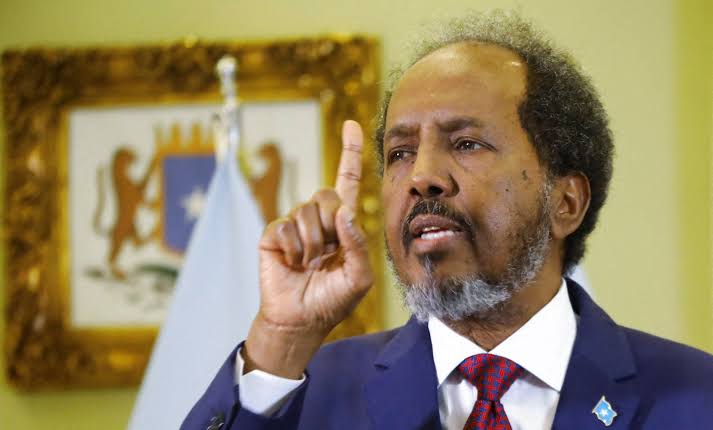
Somali President Hassan Sheikh Mohamud has strongly criticised what he described as Israeli interference in his country’s affairs, escalating tensions across the Horn of Africa after Israel’s controversial recognition of Somaliland. In recent remarks, Mohamud said Somalia would never permit the establishment of any Israeli military base in the breakaway territory, stressing that such a move would be treated as a direct threat to national sovereignty. His comments reflect growing unease in the region, where diplomatic rivalries, maritime security concerns and shifting alliances have created an increasingly fragile political environment.
The president warned that allowing a foreign military presence in Somaliland could destabilise neighbouring countries and potentially transform the territory into a strategic launch point for regional conflicts.
Somalia considers Somaliland an integral part of its territory despite the region’s decades long push for international recognition, and Mohamud’s stance signals that Mogadishu intends to respond firmly to any external attempts to alter that status. He argued that unilateral recognition undermines the principles of international law and risks weakening already strained global institutions.
Israel’s decision to recognise Somaliland as an independent state in late 2025 sparked immediate backlash from Somalia and several regional actors. The move marked a dramatic shift in diplomatic dynamics in the Horn of Africa, a region located near key shipping lanes linking the Red Sea and the Indian Ocean. Somaliland has operated with its own government, currency and security forces since declaring independence from Somalia in 1991, yet it has struggled to gain widespread international recognition.
Israel’s decision therefore carries significant geopolitical weight, potentially influencing future alliances and economic partnerships across East Africa.
Mohamud described the recognition as reckless and fundamentally wrong under international law, insisting that Somalia would defend its territorial integrity if necessary. He emphasised that any Israeli military presence would be met with resistance, signalling that tensions could move beyond diplomacy if the proposal materialises. His comments also echoed broader fears that foreign powers might exploit divisions within Somalia for strategic advantage, particularly in a region already affected by piracy, militant activity and cross border disputes.
The controversy has been fuelled by reports suggesting discussions about a potential Israeli military facility in Somaliland. While Israeli and Somaliland officials have rejected claims that such plans are finalised, some regional observers believe the idea reflects the growing competition for influence along one of the world’s busiest maritime corridors. Somalia’s government argues that the proposal risks militarising the region further and could provoke new confrontations between neighbouring states.
Somaliland’s leadership, however, has welcomed Israel’s diplomatic recognition, presenting it as a breakthrough after years of international isolation. Officials in Hargeisa have framed the development as an opportunity to attract investment and deepen security cooperation with new partners. Supporters of recognition argue that Somaliland has maintained relative stability compared with southern Somalia and has demonstrated a capacity for self governance, factors they believe justify its push for sovereignty.
Read Also: Quebec Immigration Protests Spark Backlash Over PEQ Cut
Despite these arguments, many African and Arab nations continue to back Somalia’s claim over the territory, emphasising the importance of preserving established borders to avoid triggering wider secessionist movements. International organisations have repeatedly urged dialogue between Somalia and Somaliland rather than unilateral actions that could inflame tensions. Analysts note that the dispute reflects a broader struggle between traditional concepts of territorial integrity and evolving geopolitical interests in the Horn of Africa.
Beyond the immediate diplomatic fallout, Mohamud linked the issue to what he described as a weakening of the global rules based order. He argued that powerful states increasingly pursue strategic interests without sufficient regard for international norms, warning that such behaviour could encourage instability far beyond Somalia’s borders.
His remarks echoed concerns raised by several regional leaders who fear that new military alignments around the Red Sea could intensify rivalries between global powers.
Read Also: China Overturns Death Sentence of Canadian Robert Schellenberg
The president also connected developments in Somaliland to wider tensions in the Middle East, suggesting that regional conflicts cannot be viewed in isolation. According to Mohamud, the same political dynamics shaping conflicts elsewhere are now influencing East Africa, raising questions about the future of diplomacy in a rapidly changing international landscape. He warned that institutions created after World War II face growing challenges as geopolitical competition intensifies.
Israel has defended its recognition decision by highlighting Somaliland’s decades of self rule and its potential as a partner in technology and economic cooperation.
However, critics argue that the move risks further isolating Israel diplomatically and complicating relations with African and Arab nations that support Somalia’s territorial unity. The situation remains fluid, with several countries monitoring developments closely but avoiding immediate shifts in their own recognition policies.
As tensions continue to build, Somalia’s government insists that dialogue and respect for sovereignty remain the only viable path forward. Mohamud’s firm rejection of any Israeli base in Somaliland underscores the high stakes surrounding the issue, which combines questions of security, diplomacy and regional identity. With competing narratives shaping the debate, the future of Somaliland’s status and its role in international politics is likely to remain one of the most closely watched developments in the Horn of Africa.