
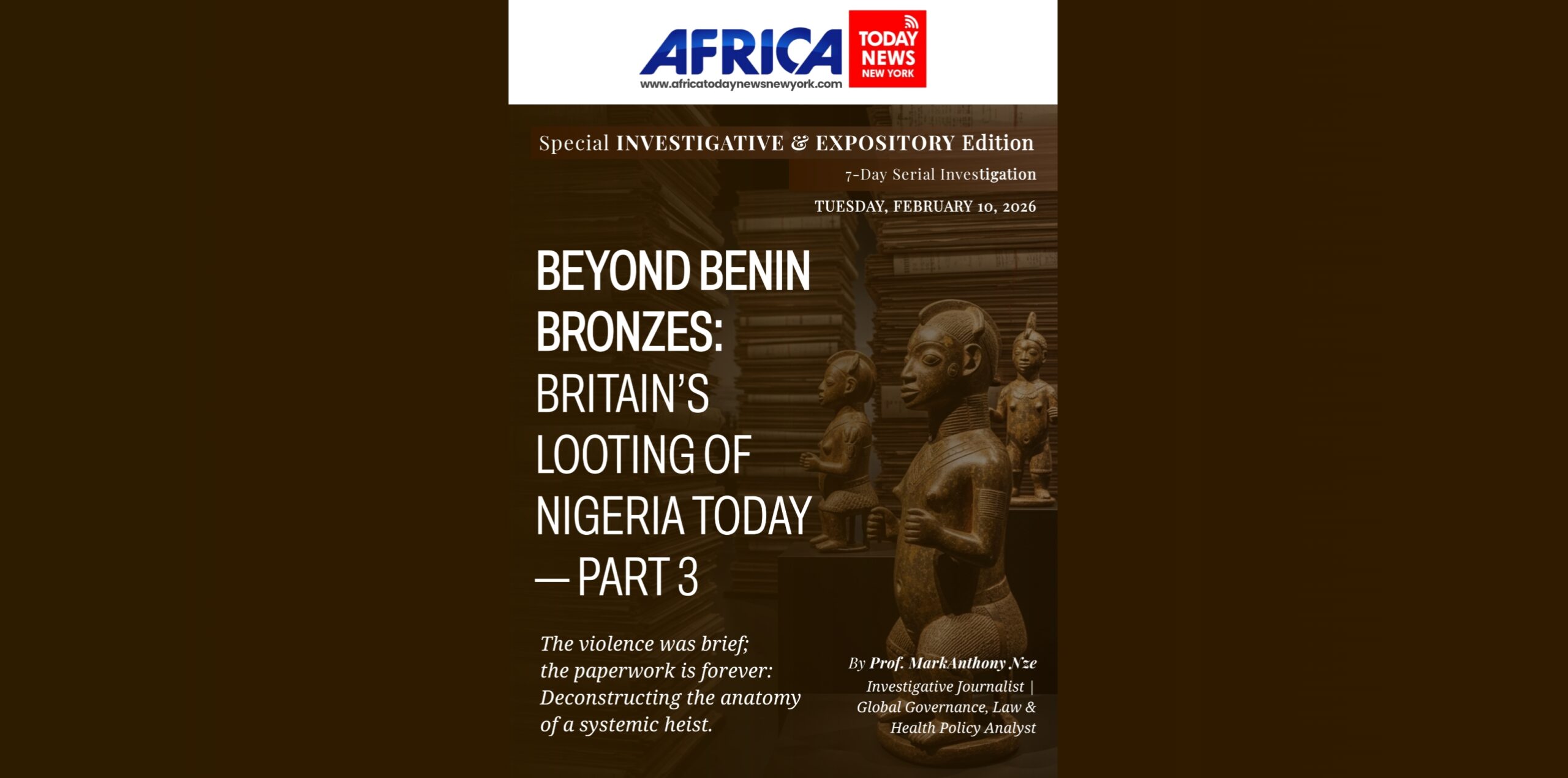
The violence was brief; the paperwork is forever: Deconstructing the anatomy of a systemic heist.
Forced Market Dependency
To diagnose the systemic paralysis of the Nigerian state, one must first exhume and incinerate the myth of “natural” economic development. Conventional textbooks peddle a convenient fiction: that Nigeria’s descent into single-commodity export dependency was a benign byproduct of “comparative advantage”—a natural drift in the global tides. This is intellectually fraudulent. A forensic audit of the colonial archive exposes an ugly, deliberate reality: Nigeria’s economic agency was not misplaced in the currents of history; it was executed. We are not witnessing the results of an organic evolution, but the wreckage of a calculated liquidation. Britain did not wait for the market to speak; it cut the throat of indigenous competition to ensure the only sound heard was the rattle of extraction. This was not specialization; it was the engineering of a captive state, a structural decapitation of economic choice designed to pay dividends to London in perpetuity.
Part 3 of this series deconstructs the mechanism of Forced Market Dependency. If Part 1 exposed the raw violence of the 1897 invasion and Part 2 mapped the “paperwork of the aftermath,” Part 3 identifies the decapitation of the indigenous machine. Britain did not merely want Nigerian resources; it required the absolute destruction of Nigerian competition. The objective was to convert a self-sustaining regional power into a captive supplier base—a funnel designed to feed the British metropole while starving the internal Nigerian market of its industrial potential. The violence is brief; the paperwork is forever.
Read also: Beyond Benin Bronzes: Britain’s Looting Of Nigeria Today—Part 2
1. The Liquidation of the Decision-Maker: The Palm Oil Heist
The first lever of power used to engineer dependency was the removal of the indigenous decision-maker. In the late 19th century, West African trade networks—specifically those in the Niger Delta—were sophisticated, competitive, and controlled by local merchant princes who possessed a courtroom-trained understanding of sovereignty and trade. Foremost among these was Jaja of Opobo.
Jaja did not represent a “clash of cultures”; he represented a threat to the profit margins of the Royal Niger Company (RNC). By 1885, Jaja had successfully bypassed British middlemen to ship oil directly to Liverpool, demanding the same market-clearing prices enjoyed by European firms. For the RNC, a chartered company acting as a proto-state, this exercise of economic sovereignty was intolerable.
The mechanism used to neutralize Jaja was the “Protectorate Treaty”—a legal instrument that promised “protection” but delivered annexation. When Jaja insisted on his sovereign right to trade, Britain used kidnapping and exile to remove the obstacle. This was the “Palm Oil Heist,” an institutional liquidation of Nigeria’s indigenous trade networks. By removing Jaja and contemporaries like Nana Olomu, Britain achieved a critical forensic objective: the capture of Price-Setting Authority. As noted in the broader analysis of extractive institutions, the removal of local competition allowed British firms to dictate the “Farmgate Price” of Nigerian goods while keeping the “Export Price” for themselves (Adediran, 2020). This established the precedent that persists in 2026: Nigeria produces value, but the global North determines its worth. This is the foundational logic of how the British government has been stealing from Nigeria for over a century (Africa Today News, New York, 2020).
2. Infrastructure as a Funnel: The Logistics of Extraction
In colonial hagiography, the railway is cited as Britain’s “gift” of modernization. A structural analysis of the rail map tells a different story. A railway built for a sovereign nation connects its internal cities to facilitate internal trade and industrial clusters. The Nigerian colonial railway, however, was built as a vertical funnel.
Between 1898 and 1914, the rail lines were laid with a singular, forensic purpose: to connect the resource-rich hinterlands directly to the coast, bypassing internal markets entirely. This infrastructure actively discouraged internal Nigerian trade. It was cheaper and faster to send groundnuts from Kano to Liverpool than to send them to the thriving markets of the South.
This engineered “outward flow” decapitated the internal food systems that had sustained the region for centuries. The railway was not an engine of development; it was a conveyor belt for extraction (Falola, 2022). By 1914, the amalgamation of Nigeria was less a political project for the benefit of Nigerians and more a fiscal strategy to ensure that the Northern revenue could subsidize the “railway debt” of the South, keeping the extraction machine solvent for the British Treasury. This was the opening move in the Invasion for Profit (Africa Today News, New York, 2026a). The infrastructure didn’t build a nation; it built a funnel.
Read further: Beyond Benin Bronzes: Britain’s Looting Of Nigeria Today—Part 1
3. The Decapitation of Industry: Destroying the Nigerian Loom
Before the colonial era, Nigeria was the manufacturing hub for West Africa. The textile industries of Kano and the ironworks of the East were not “primitive” hobbies; they were high-margin industries that competed directly with British exports. For the British textile mills in Manchester to thrive, the Nigerian loom had to die.
The method of destruction was fiscal strangulation. The colonial administration imposed Prohibitive Tariffs on the raw materials needed for local manufacturing while removing duties on finished British goods. Simultaneously, internal “Tolls” and movement restrictions were placed on indigenous traders to make their goods uncompetitive in their own backyard.
This was the deliberate De-industrialization of West Africa (Eze, 2023). British manufacturers required a “Captive Market” that was barred from producing its own essentials. By the 1930s, the Nigerian weaver who once clothed the region was forced to buy cheap Manchester cotton. The transition from producer to consumer was not a market choice; it was a market sentence. When British envoys today speak of trade relations worth £7bn, they are standing on the ruins of the industries Britain strangled a century ago (Africa Today News, New York, 2024).
This destruction of indigenous manufacturing is why modern “development” feels like an uphill climb. Hegemony is not just about holding territory; it is about the destruction of the competition’s ability to produce essentials (Mensah, 2021). Britain ensured Nigeria would enter the 20th century as a customer, not a creator.
4. The Mono-Product Trap: Engineering the Oil Dependency
The most enduring atrocity of British economic scaffolding is the Mono-product Dependency. Colonial administrations preferred “Single-Commodity” zones because they were easier to tax, monitor, and control. One region was assigned cocoa; another, rubber; another, groundnuts. This specialization made the Nigerian economy hyper-vulnerable to the “Price Shocks” of the London markets (Okoye, 2021).
This laid the institutional groundwork for the modern “Oil Trap.” When crude oil was discovered in the Niger Delta, the existing colonial framework of outward extraction was simply pivoted toward petroleum. The architecture ensured that the institutions, the contracts, and the transport routes were already in place to bypass the Nigerian people entirely (Nwoke, 2019).
Sovereignty was granted in 1960, but the Decision Rights—the authority to determine how value is produced and retained—remained locked in the colonial basement. Nigeria was handed the keys to the house, but Britain and its corporate proxies kept the deeds to the land and the control of the front door. This is the Architecture of the Aftermath (Africa Today News, New York, 2026b).
5. The Modern Mechanism: Forced Dependency in 2026
The “Looting Spree” has matured into an “Institutional Routine.” The forced dependency of the 1920s is mirrored in the trade architecture of the 2020s. The forensic investigator identifies three primary levers currently in operation:
● The “Primary Producer” Ceiling: Nigeria is still incentivized to export raw crude while importing refined petrol—a structural absurdity that drains billions in foreign exchange annually. This is the “processed complexity” import model that sustains primary commodity dependency (Ibrahim, 2023).
● Service Capture: While Nigeria “trades” physical goods, British firms control the high-margin “services” (insurance, shipping, legal, and financial) that facilitate that trade. This ensures that even when Nigeria “wins” a trade deal, the gain is repatriated to London (Umar & Mohammed, 2020).
● The Debt Scaffolding: Modern “Development Loans” serve the same purpose as the 19th-century railway bonds. They lock Nigerian revenue into interest-repayment cycles that benefit Western financial centers, ensuring the country remains a “captive debtor” while its human capital is harvested as a secondary export. This explains the real reason Nigerian visa applications are soaring as Britain extracts the very talent Nigeria needs to industrialize (Africa Today News, New York, 2022).
6. Conclusion: The Return of Economic Sovereignty
A country that cannot feed itself, clothe itself, or process its own resources is a country that has been denied its economic choice. The “looting” of Nigeria did not end with the seizure of the Bronzes; it reached its pinnacle with the destruction of the Nigerian machine.
To dismantle this, we must recognize that “Dependency” is not a lack of effort; it is a presence of structure. The levers of power—the contracts that favor the exporter over the producer, the infrastructure that ignores the internal market, and the laws that protect the foreign monopoly—are the same levers Britain installed in 1897.
The forensic truth is simple: Force creates the market; dependency sustains the profit. Until Nigeria reclaims the Decision Rights over its own industrial destiny, it remains a captive of a colonial business model that has simply changed its vocabulary. We are not just looking for the return of our art; we are looking for the return of our economic sovereignty. This series began with an Introduction to the looting of Nigeria, and it will end only when the anatomy of that looting is fully exposedThe conclusion of this will occur only after the entirety of the corrupt practice, its structure, and mechanisms are brought to light. (Africa Today News, New York, 2026c).
Professor MarkAnthony Ujunwa Nze is an internationally acclaimed investigative journalist, public intellectual, and global governance analyst whose work shapes contemporary thinking at the intersection of health and social care management, media, law, and policy. Renowned for his incisive commentary and structural insight, he brings rigorous scholarship to questions of justice, power, and institutional integrity.
Based in New York, he serves as a full tenured professor and Academic Director at the New York Center for Advanced Research (NYCAR), where he leads high-impact research in governance innovation, strategic leadership, and geopolitical risk. He also oversees NYCAR’s free Health & Social Care professional certification programs, accessible worldwide at:
https://www.newyorkresearch.org/professional-certification/
Professor Nze remains a defining voice in advancing ethical leadership and democratic accountability across global systems.
Selected Sources (APA 7th Edition)
Adediran, O. (2020). Extractive institutions and the Nigerian economy: A long-term perspective. Oxford University Press.
Africa Today News, New York. (2020, August 24). How the British government has been stealing from Nigeria.
Africa Today News, New York. (2022, November 21). Real reason Nigerian visa applications are soaring – UK envoy.
Africa Today News, New York. (2024, May 6). Nigeria, UK trade relations currently worth £7bn – Envoy.
Africa Today News, New York. (2026, February 7). Beyond Benin Bronzes: Britain’s looting of Nigeria today—Intro.
Africa Today News, New York. (2026, February 8). Beyond Benin Bronzes: Britain’s looting of Nigeria today—Part 1: Invasion for profit.
Africa Today News, New York. (2026, February 9). Beyond Benin Bronzes: Britain’s looting of Nigeria today—Part 2: The architecture of the aftermath.
Eze, U. S. (2023). De-industrialization in West Africa: A historical-institutionalist perspective on colonial trade policy. Journal of African Economic History, 51(1), 45-68.
Falola, T. (2022). Colonialism and violence in Nigeria. Indiana University Press.
Ibrahim, G. (2023). Neocolonial trade regimes and the persistence of primary commodity export dependency in Nigeria. Review of African Political Economy, 50(175), 210-225.
Mensah, J. (2021). Trade and hegemony: The British empire and the destruction of indigenous manufacturing in the 19th century. Routledge.
Nwoke, C. (2019). Mono-product dependency and the Nigerian state: The colonial roots of the oil trap. African Journal of Political Science, 12(2), 89-112.
Okoye, C. (2021). The political economy of colonialism in Nigeria: Resource extraction and underdevelopment. Palgrave Macmillan.
Umar, B., & Mohammed, Z. (2020). The effects of illicit financial flows on oil and gas revenue generation in Nigeria. Journal of Money Laundering Control, 24(1), 177–186.