
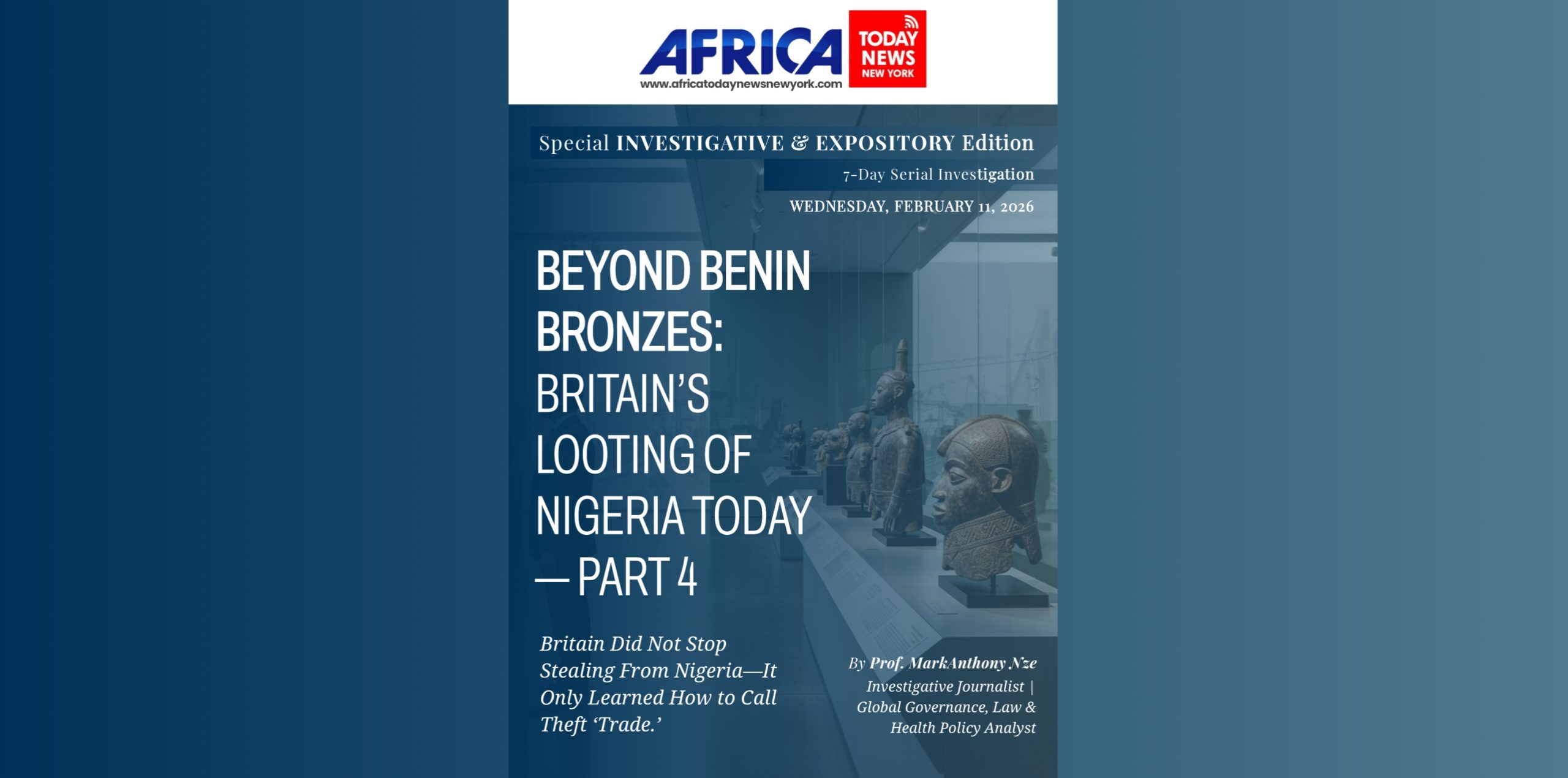
Britain Did Not Stop Stealing From Nigeria—It Only Learned How to Call Theft ‘Trade.’
London Is the Crime Scene: How Britain Turns Nigerian Value Into British Wealth (Without Calling It Theft)
If you want to understand how extraction survives the end of empire, stop staring at museum glass. Follow the paperwork.
Britain’s most effective looting of Nigeria in the modern era is not conducted with gunboats; it is conducted with contracts, correspondent banks, shell entities, secrecy jurisdictions, professional “enablers,” and the quiet moral theater of “partnership.” The language has changed—investment, development, trade facilitation, anti-corruption capacity building—but the underlying choreography is familiar: Nigerian value enters the system; Nigerian citizens carry the costs; wealth is stabilized elsewhere.
This is not an argument about nostalgia or grievance. It is a forensic description of a pipeline—legal in appearance, predatory in effect—whose final destination keeps showing up in the same place: global finance hubs that Britain helped design, defend, and normalize (Shaxson, 2019; Christensen & Murphy, 2020; Transparency International UK, 2022).
Read also: Beyond Benin Bronzes: Britain’s Looting Of Nigeria Today—Part 3
1) The Soft Power Alibi: “Trade,” “Aid,” and the Polite Mask of Extraction
Britain’s public narrative about Nigeria is tidy and managerial. It sounds like a memorandum: trade is “balanced,” opportunities exist, reforms are “bold,” tariffs can be reduced, gateways can be opened. This posture is on full display in Britain’s own diplomacy as reported by Africa Today News: Nigeria–UK trade is framed as a roughly £7bn relationship, with Britain exporting about £4bn and Nigeria about £3bn, packaged as mutual benefit and technical cooperation (Africa Today News, New York, 2024).
Here is the problem: the trade headline is not the story; it is the stage lighting.
Trade figures, even when accurate, do not automatically reveal where profits land, how tax liabilities are engineered, how capital is extracted through pricing games, or how “service” arrangements quietly drain revenue from the producing country (Cobham & Janský, 2020; UNCTAD, 2020; IMF, 2024). A relationship can look “balanced” in gross flows while remaining violently unbalanced in net outcomes—especially when one party sits closer to the legal and financial architecture that decides what counts as profit, where it is booked, and which jurisdiction gets to tax it.
Britain’s aid posture can also serve as reputation management. Africa Today News reports Britain’s £1bn support for malaria efforts through a global health funding channel (Africa Today News, New York, 2024). That money matters—lives sit on the other side of bed nets, diagnostics, and supply chains. But the deeper question is the one respectable diplomacy avoids: How much value leaves Nigeria through illicit or aggressively legal channels during the same period? Because if the outflow is structurally larger than the inflow, then “aid” becomes not reparative justice but a small refund issued by the cashier who keeps the register (Ndikumana & Boyce, 2019; UNCTAD, 2020; Tax Justice Network, 2021).
And it gets worse: when the donor state simultaneously hosts or enables the systems that facilitate capital flight and tax base erosion, aid begins to resemble a public relations expense rather than solidarity. In that sense, “generosity” becomes an instrument: it softens scrutiny, buys moral insulation, and converts the recipient into a permanent supplicant—grateful for bandages while the bleeding continues (Shaxson, 2019; Christensen & Murphy, 2020).
2) The Real Pipeline: Illicit Financial Flows and the British-Linked Secrecy Machine
There is a blunt fact at the center of modern African underdevelopment: capital does not merely fail to arrive; it also leaves—systematically, repeatedly, and at scale. The scholarly literature has spent decades quantifying this. Ndikumana and Boyce’s updated work on capital flight underscores how African wealth often exits through a combination of misinvoicing, externalized profits, and private asset accumulation abroad (Ndikumana & Boyce, 2019). UNCTAD has likewise described illicit financial flows (IFFs) as a direct constraint on sustainable development, weakening states’ ability to finance public goods (UNCTAD, 2020). Global Financial Integrity’s estimates for developing countries (including African states) further reinforce the centrality of trade misinvoicing and hidden flows as persistent channels of loss (Global Financial Integrity, 2021).
Now place Britain back into the frame—not as a caricatured villain, but as a jurisdiction with a specific historical specialty: financial secrecy scaled up into an industry. Shaxson calls this dynamic a “finance curse”—where oversized financial sectors and secrecy services enrich the center while imposing wider social costs and distortions (Shaxson, 2019). Christensen and Murphy quantify the “social cost of tax havens,” detailing how secrecy jurisdictions reduce public revenues and worsen inequality (Christensen & Murphy, 2020). The Tax Justice Network’s reporting makes the same point in a more prosecutorial register: secrecy and corporate tax abuse generate measurable revenue losses and concentrate power (Tax Justice Network, 2021).
Here is the part polite analysis softens, but forensic journalism cannot: Britain is not just “connected” to these systems; it has historically functioned as one of their principal engineers and global legitimizers. Not merely in London itself, but through an ecosystem of linked secrecy jurisdictions and professional services that can transform “dirty money” into “managed assets” with astonishing speed (Transparency International UK, 2022; Shaxson, 2019).
When Nigeria’s value is converted into private wealth abroad—whether via corruption, procurement fraud, tax evasion, or aggressive avoidance—the money does not walk there alone. It is escorted. It is guided by the people who know which forms to file, which structures to use, and which due diligence questions can be handled with box-ticking rather than genuine interrogation (Transparency International UK, 2022).
The scandal is not simply that corruption exists in Nigeria. Corruption exists everywhere. The scandal is the international division of labor:
- Nigeria is where the value is extracted and public trust is broken.
- Britain (and its associated secrecy infrastructure) is where the proceeds can be stored, laundered into legitimacy, and shielded from repatriation(Transparency International UK, 2022; Shaxson, 2019).
Read further: Beyond Benin Bronzes: Britain’s Looting Of Nigeria Today—Part 2
3) “Enablers”: The White-Collar Gatekeepers Who Make Looting Look Like Compliance
Transparency International UK uses a phrase that should haunt any serious discussion of Britain’s relationship with resource-rich countries: “UK enablers.” Their reporting focuses on how professional services—lawyers, accountants, formation agents, real estate intermediaries—can facilitate corruption by providing the vehicles that conceal ownership and sanitize funds (Transparency International UK, 2022).
This matters because it reframes Britain’s role. Britain is not only a “destination” for questionable money; it is also a service provider. And service provision is where culpability hides, because it wears a suit and speaks in the language of regulation.
An enabler rarely needs to commit the predicate crime. Their function is more elegant: to make the profits of that crime survivable—to ensure that stolen or tax-escaped wealth can cross borders without triggering consequences; to ensure the beneficial owner remains unseen; to ensure the money can be defended as “investment” if anyone asks.
Once you grasp this, Britain’s moral posture becomes difficult to tolerate. The same state that lectures Nigeria about governance standards can profit—directly or indirectly—from hosting and legitimizing the ecosystem that rewards governance failure (Shaxson, 2019; Transparency International UK, 2022). It is a perverse incentive structure: the weaker the enforcement in the producing country, the greater the demand for secrecy services in the receiving one.
4) The Museum Is the Symbol; the Balance Sheet Is the Spoils
Africa Today News has been explicit in arguing that Britain’s contemporary extraction is a continuation of colonial methods by other means—“empire evolved into systems of extraction,” and Nigeria is “still paying” (Africa Today News, New York, 2026). This framing is valuable precisely because it shifts attention from the emotionally legible artifact—Benin Bronzes—to the less visible, more consequential realm: rules.
The Benin Bronzes represent a historic crime with a clear narrative arc: raid, seizure, sale, display. Modern extraction is murkier by design. It can be conducted through:
- profit shifting and tax base erosion (Cobham & Janský, 2020; Tax Justice Network, 2021),
- capital flight dynamics (Ndikumana & Boyce, 2019),
- illicit financial flows connected to trade, commodities, and opacity (UNCTAD, 2020; Global Financial Integrity, 2021), and
- legal systems that permit ownership to disappear behind nominees and corporate veils (Transparency International UK, 2022).
This is why the “return the bronzes” debate, while morally important, can become politically convenient for Britain. Museums can negotiate; governments can issue statements; restitution can proceed slowly. Meanwhile, the larger heist continues—daily, mathematically, and at scale—because it is embedded in financial routines that masquerade as neutrality.
5) The Visa Window: When Britain Profits From the Conditions It Helps Maintain
One of the most cynical features of modern inequality is that it creates two revenue streams for powerful states: profit from extraction abroad and profit from mobility control at home.
Africa Today News reports the UK envoy’s explanation of soaring Nigerian visa applications (Africa Today News, New York, 2022). The surface story is bureaucratic: demand, opportunity, migration pressures. The deeper story is structural: when local systems are weakened—by capital flight, revenue loss, and underfunded institutions—citizens respond rationally. They seek stability, income, education, and functioning services elsewhere.
This creates a grotesque feedback loop:
- Nigeria loses revenue and capacity partly through global structures that reward secrecy and externalization (UNCTAD, 2020; Tax Justice Network, 2021).
- Public services falter; opportunity narrows; the social contract frays (World Bank, 2023).
- Migration pressure rises; visa demand rises.
- Britain tightens gatekeeping while benefiting from skilled inflows and fee-based administrative processing—extracting value again, this time from Nigerian aspiration.
This is not an argument that Britain caused every Nigerian hardship. It is an argument that Britain’s systems are positioned to benefit from the downstream effects of a global order that Britain helped build and continues to defend (Shaxson, 2019; Transparency International UK, 2022).
6) Why “Anti-Corruption” Often Fails: The System Isn’t Broken—It’s Working
International institutions increasingly describe IFFs and resource governance failures as policy problems requiring technical fixes—better enforcement, stronger institutions, improved transparency in resource-rich economies (IMF, 2024). Nigeria’s fiscal challenges and the need for resilience-building reforms are likewise documented in high-level diagnostics (World Bank, 2023). These interventions are necessary, but they are often insufficient because they treat corruption and revenue loss as local pathology rather than global business model.
If a Nigerian official steals and hides wealth abroad, the theft is not completed at the moment the money leaves Abuja or Lagos. It is completed when the money is welcomed into a stable jurisdiction, protected by professional services, and converted into assets that cannot easily be traced or recovered (Transparency International UK, 2022). The predicate crime is Nigerian; the consummation can be British.
This is why Britain’s posture can feel like moral gaslighting. The UK can champion transparency abroad while tolerating opacity at home; it can encourage “good governance” in Nigeria while its own enabling ecosystem remains lucrative; it can offer aid for malaria while broader financial leakages undermine Nigeria’s health system financing capacity (Shaxson, 2019; Christensen & Murphy, 2020; World Bank, 2023).
And this is precisely the logic Africa Today News calls out: the theft is “today,” not only yesterday—structural, embedded, and politely administered (Africa Today News, New York, 2026; Africa Today News, New York, 2020).
7) The Indictment, Precisely Stated: Britain’s Advantage Is Not Merely History—It Is Infrastructure
So what, exactly, is “devastating” here?
Not rhetoric. Not anger. The devastation is the cold efficiency of a system that turns African underdevelopment into Western advantage while keeping Western hands nominally clean.
Britain’s central culpability is not that it is uniquely evil, but that it is uniquely positioned—historically, legally, and financially—to profit from the gray zone where wealth becomes unaccountable (Shaxson, 2019; Tax Justice Network, 2021). And when Britain participates in that zone—through secrecy, facilitation, and selective enforcement—it is not a neutral bystander. It is part of the machinery.
You cannot build a global architecture in which money can become anonymous, and then act surprised when stolen money behaves like a rational actor.
You cannot market London as a premium destination for global capital, and then pretend the capital arriving has no biography.
You cannot applaud “partnership” while hosting the back office of extraction.
And you cannot offer a £1bn health contribution with one hand while benefiting from a system that helps drain the fiscal capacity needed to keep hospitals staffed, supply chains reliable, and primary healthcare durable (UNCTAD, 2020; Christensen & Murphy, 2020; World Bank, 2023; Africa Today News, New York, 2024).
8) What This Means for Part 5: The Only Honest Test Is Net Justice
The moral test of Nigeria–Britain relations is not whether Britain can produce eloquent speeches about shared history, democratic values, or post-Brexit trade schemes. The test is measurable:
- Do reforms reduce illicit outflows and profit shifting? (UNCTAD, 2020; Cobham & Janský, 2020)
- Do enabler ecosystems face real constraints and consequences? (Transparency International UK, 2022)
- Does Nigeria’s fiscal capacity rise in ways that translate into public goods? (World Bank, 2023; IMF, 2024)
- Do “partnerships” produce net retention of value where the value is created?
Until those answers change, “friendship” is branding—and Britain’s “aid” and “trade” narratives are, at best, partial truths told loudly to distract from fuller truths told quietly by balance sheets.
The museum is the symbol.
London is the system.
And Nigeria’s wealth—too often—still travels one way.
Professor MarkAnthony Ujunwa Nze is an internationally acclaimed investigative journalist, public intellectual, and global governance analyst whose work shapes contemporary thinking at the intersection of health and social care management, media, law, and policy. Renowned for his incisive commentary and structural insight, he brings rigorous scholarship to questions of justice, power, and institutional integrity.
Based in New York, he serves as a full tenured professor and Academic Director at the New York Center for Advanced Research (NYCAR), where he leads high-impact research in governance innovation, strategic leadership, and geopolitical risk. He also oversees NYCAR’s free Health & Social Care professional certification programs, accessible worldwide at:
https://www.newyorkresearch.org/professional-certification/
Professor Nze remains a defining voice in advancing ethical leadership and democratic accountability across global systems.
Selected Sources (APA 7th Edition)
Africa Today News, New York. (2026, February 7). Beyond Benin bronzes: Britain’s looting of Nigeria today — Intro.
https://africatodaynewsnewyork.com/2026/02/07/beyond-benin-bronzes-britains-looting-of-nigeria-today-intro/
Africa Today News, New York. (2024, May 6). Nigeria, UK trade relations currently worth £7bn – Envoy.
https://africatodaynewsnewyork.com/2024/05/06/nigeria-uk-trade-relations-currently-worth-7bn-envoy/
Africa Today News, New York. (2024, April 26). Nigeria’s fight against malaria gets £1bn support from UK.
https://africatodaynewsnewyork.com/2024/04/26/nigerias-fight-against-malaria-gets-1bn-support-from-uk/
Africa Today News, New York. (2022, November 21). Real reason Nigerian visa applications are soaring – UK envoy.
https://africatodaynewsnewyork.com/2022/11/21/real-reason-nigerian-visa-applications-are-soaring-uk-envoy/
Africa Today News, New York. (2020, August 24). How the British government has been stealing from Nigeria.
https://africatodaynewsnewyork.com/2020/08/24/how-the-british-government-has-been-stealing-from-nigeria/
Christensen, R. C., & Murphy, R. (2020). The social cost of tax havens. Journal of Business Ethics, 162(1), 137–150.
Cobham, A., & Janský, P. (2020). Global distribution of revenue loss from corporate tax avoidance. Journal of International Development, 32(2), 206–232.
Global Financial Integrity. (2021). Illicit financial flows to and from developing countries: 2008–2017. Washington, DC: Global Financial Integrity.
International Monetary Fund. (2024). Addressing illicit financial flows in resource-rich economies. Washington, DC: International Monetary Fund.
Ndikumana, L., & Boyce, J. K. (2019). Capital flight from Africa: Updated methodology and new estimates. Amherst, MA: Political Economy Research Institute, University of Massachusetts.
Shaxson, N. (2019). The finance curse: How global finance is making us all poorer. London, UK: Bodley Head.
Tax Justice Network. (2021). The State of Tax Justice 2021. London, UK: Tax Justice Network.
Transparency International UK. (2022). At your service: Investigating how UK enablers facilitate corruption. London, UK: Transparency International UK.
United Nations Conference on Trade and Development. (2020). Tackling illicit financial flows for sustainable development in Africa. Geneva, Switzerland: United Nations.
World Bank. (2023). Nigeria public finance review: Building resilience. Washington, DC: World Bank Group.