
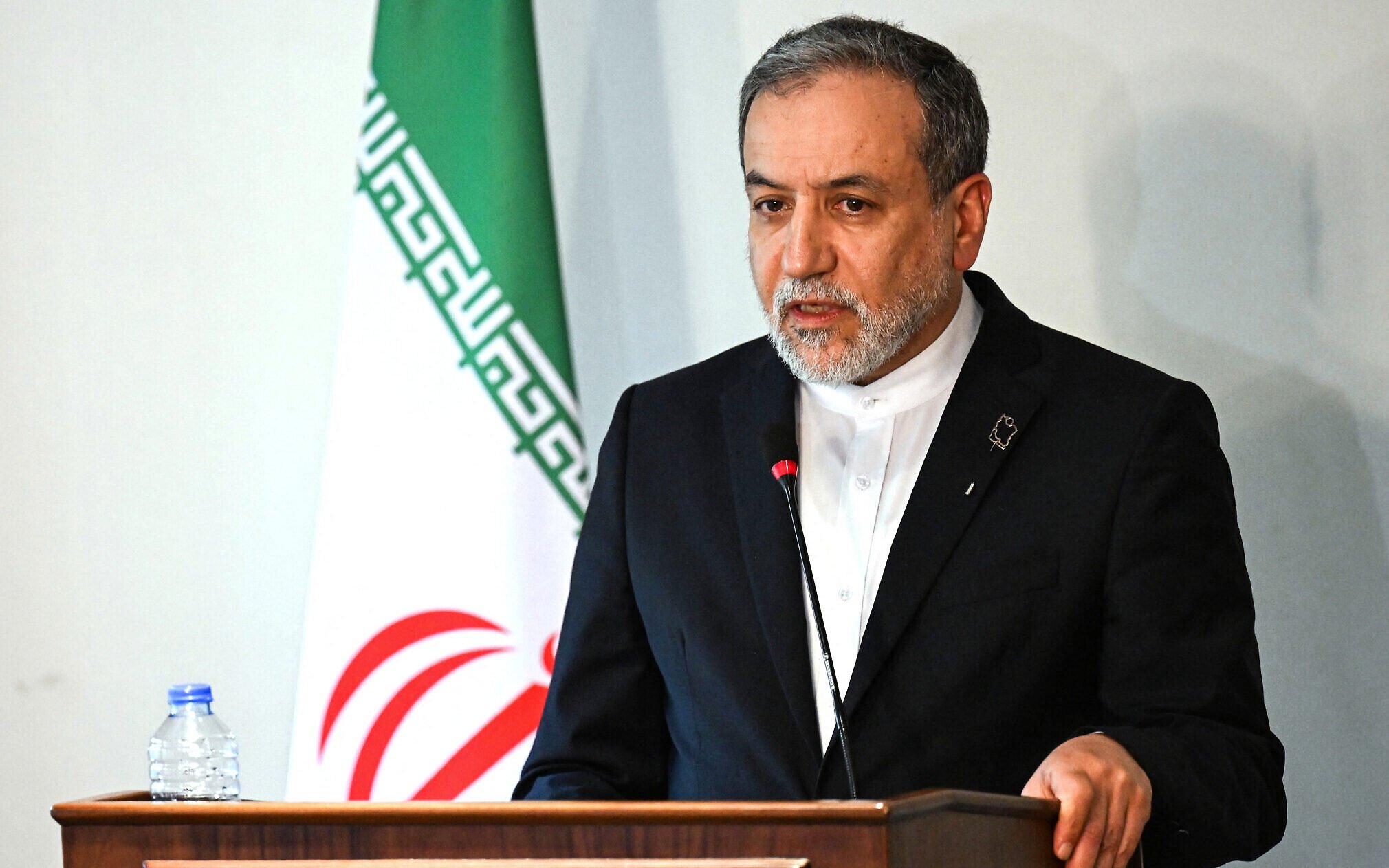
Iranian Foreign Minister Abbas Araghchi told American television on Friday that a nuclear agreement with the United States was “at our reach” and diplomatically achievable, describing the outcome of a second round of indirect talks in Geneva this week as a meaningful step forward, even as President Donald Trump said he was “considering” limited military strikes against Iran and the United States continued a substantial military buildup in the Gulf.
The tension between those two tracks, active diplomacy and active military preparation, has defined the negotiating environment since talks resumed in early February and shows no sign of resolving before the next round of negotiations, for which no date has yet been set.
The Geneva talks, held at the residence of the Omani ambassador to Switzerland in the lakeside neighbourhood of Cologny, concluded on Tuesday with both sides acknowledging that guiding principles for a framework agreement had been identified. “Ultimately, we were able to reach broad agreement on a set of guiding principles, based on which we will move forward and begin working on the text of a potential agreement,” Araghchi told Iranian state television. “This does not mean that we can reach an agreement quickly, but at least the path has begun.”
The American assessment was markedly more cautious. White House Press Secretary Karoline Leavitt said “a little progress” had been made but that the two sides were “still very far apart on some issues.” A U.S. official told Axios that Iran had offered to return within two weeks with detailed proposals to address “some of the open gaps in our positions.”
The gap between those two characterisations illustrates the structural difficulty of a negotiation being conducted under simultaneous military, economic, and diplomatic pressure, with each side communicating to multiple audiences at once. Araghchi’s Friday interview on MS NOW was directed as much at the American public and political establishment as at his counterparts across the negotiating table. He was explicit about Tehran’s terms: Iran would accept rigorous monitoring and limits on its enrichment programme but would not dismantle it entirely.
“A diplomatic solution is at our reach; we can easily achieve it,” he said. “I have been in this business in the past 20 years and negotiated with different parties. I know that a deal is achievable, but it should be fair and based on a win-win solution.”
Read Also: Iran Talks To Proceed With Trump Playing Behind-The-Scenes
His remark that the United States had “not asked for zero enrichment” appeared to contradict the Trump administration’s stated public position, under which senior officials had repeatedly demanded full dismantlement of Iran’s nuclear programme. Whether that signals a genuine shift in Washington’s negotiating position or a gap between public rhetoric and private flexibility is among the central unresolved questions of the entire process.
Iran’s deputy foreign minister, Majid Takht-Ravanchi, separately signalled that the zero-enrichment demand was “no longer an issue in negotiations,” suggesting both delegations may have quietly moved away from the maximalist public stances with which they entered the process. Iran has consistently maintained that the Treaty on the Non-Proliferation of Nuclear Weapons guarantees its right to civilian enrichment, a legal argument the United States has not accepted as a basis for negotiations but may be incorporating as a practical reality.
The military context is impossible to separate from the diplomatic one. The United States has deployed two aircraft carrier strike groups to the Middle East, the USS Abraham Lincoln and the Gerald R. Ford, the world’s largest warship, alongside dozens of fighter aircraft and supporting naval assets. For the first round of talks in Muscat, the United States brought Admiral Brad Cooper, head of US Central Command, to the negotiating venue in his dress uniform, a deliberate, visible reminder that military options remained live. Hours before the Geneva round began on Tuesday, Iran temporarily closed sections of the Strait of Hormuz under the pretext of naval exercises, an action widely read as its own counter-signal that Tehran retains the capacity to disrupt global oil flows if the situation deteriorates. Ayatollah Ali Khamenei, Iran’s supreme leader, warned separately that Iran’s missiles were “more dangerous” than the American carriers themselves.
Negotiations broke down in 2025 when Israel, joined by the United States, struck Iran’s three main nuclear facilities in June of that year, destroying significant portions of the infrastructure that had underpinned Iran’s enrichment programme for decades.
The status of that infrastructure, how much was destroyed, how much has been rebuilt, and where Iran’s stockpiles of highly enriched uranium currently reside, has not been independently confirmed. The International Atomic Energy Agency has been denied access to the bombed sites, leaving nuclear monitors in a state of partial blindness on the central factual question underlying every diplomatic and military calculation being made by every party to the negotiation.
Read Also: Iranian Diplomacy Returns To Geneva Amid Nuclear Talks
Israel has remained a complicating factor throughout. Witkoff met Israeli Prime Minister Benjamin Netanyahu in the days before the Geneva round, during which Netanyahu reportedly emphasised that Iran “can’t be trusted” and pressed for any agreement to include restrictions on Iran’s ballistic missile programme, a demand Tehran has explicitly rejected as outside the scope of nuclear negotiations. Trump has not publicly committed to excluding missiles from the eventual framework, leaving open a potential gap between what the United States is willing to accept and what its closest regional partner regards as acceptable.
Trump’s public statements this week reflected the dual-track character of his approach. He told reporters on Thursday that Tehran had ten days to reach a deal, then appeared to extend that to fifteen days.
Earlier this month he had said finalisation should occur within a month. On Friday, asked directly about limited strikes, he said: “I guess I can say I am considering that.” Araghchi’s response was measured but pointed: Iranians are “proud people” who respond only to “the language of respect,” he said, adding that the United States had tried “almost everything,” war, sanctions, snapback mechanisms, without success.
Both sides agreed at the conclusion of the Geneva round that they would work on the texts of a potential agreement and exchange draft proposals before agreeing on a date for a third round. Araghchi said that drafting phase would be “more difficult and harder” than the principle-setting discussions that preceded it. No timeline has been confirmed. The talks continue to be mediated exclusively by Oman. European powers, who were central to the 2015 Joint Comprehensive Plan of Action, have been excluded from the current process, a departure from multilateral precedent that several European governments have noted with concern.