
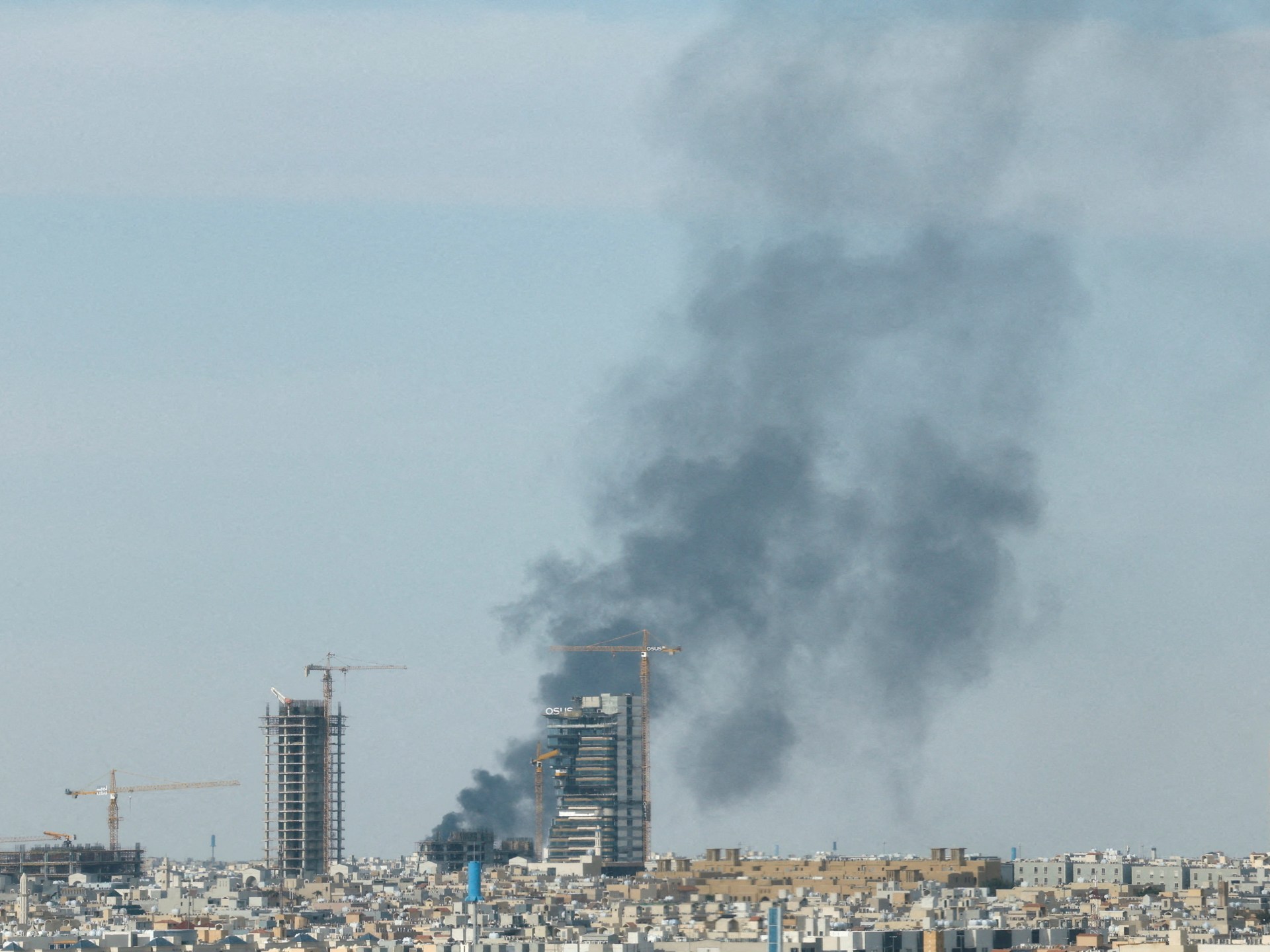
An Iranian drone strike targeting radar systems at Prince Sultan Air Base in Saudi Arabia’s Al-Kharj governorate missed its military objective on Sunday and struck a residential compound belonging to a maintenance and cleaning company instead, killing an Indian national and a Bangladeshi national and injuring twelve Bangladeshi residents, the deadliest single incident in Saudi Arabia since Iran began retaliating against Gulf states hosting American military assets.
Saudi Arabia’s Civil Defence confirmed the strike in a post on X, describing the projectile only as an “unspecified military projectile” without naming Iran as the source — a diplomatic framing consistent with Saudi Arabia’s careful effort throughout the nine days of the conflict to maintain back-channel communications with Tehran while publicly registering each attack with maximum legal precision rather than political attribution.
The IRGC had said earlier on Sunday that it had targeted radar systems in Al-Kharj governorate, which is home to Prince Sultan Air Base, a facility used by US Air Force units and one of the primary targets of sustained Iranian air attacks throughout the first week of the war. The compound struck by the wayward drone was approximately two kilometres from the base perimeter, according to security sources cited by Arab News.
The Civil Defence directorate emphasised that targeting civilian objects constituted “a flagrant violation of international humanitarian law” and said standard emergency protocols had been immediately implemented following the strike.
Al Jazeera’s Laura Khan, reporting from Doha, described the incident as representative of a vulnerability that had received insufficient attention in international coverage of the conflict.
“This is getting very volatile and dangerous for people across the Gulf,” she said. “It is really important to emphasise that over 200 nationalities live and work across the Gulf nations. Many of these could be labourers.” Her assessment was supported by the casualty profile: thirteen of the fourteen confirmed casualties from the Al-Kharj strike were South Asian nationals working in the maintenance and cleaning sector, a workforce stratum with no political stake in the war and no institutional capacity to protect itself from strikes calibrated for military targets.
India’s Ministry of External Affairs confirmed it was seeking information on the identity of the Indian national killed and the welfare of Indian workers elsewhere in Al-Kharj and the broader Riyadh region. Bangladesh’s foreign ministry said it was in contact with its mission in Riyadh to verify the nationalities of the wounded and the identity of the Bangladeshi fatality.
The Al-Kharj strike was the most lethal in a day of intensified Iranian aerial activity across Saudi Arabia. The Ministry of Defence separately confirmed it had intercepted 15 drones in multiple operations on Sunday, including an attempted attack on the diplomatic quarter of Riyadh that was fully neutralised without casualties. A continuation of a pattern of Iranian attacks on the Saudi capital’s diplomatic zone that had already struck the US Embassy in Riyadh on March 3, causing a limited fire and minor structural damage.
The IRGC had subsequently declared its intention to escalate attacks on what it called “American political centres” across the region, a category that encompassed embassy compounds, consular buildings, and diplomatic residential quarters.
The cumulative picture of Iran’s aerial campaign against Saudi Arabia since February 28 illustrated the scale of the attempted assault.
Read Also: Europe Splits Over Iran War’s Legality
Saudi defences had intercepted dozens of ballistic missiles aimed at Prince Sultan Air Base across three consecutive days — March 4, 5, and 6 — before Sunday’s drone broke through. The Aramco Shaybah oilfield deep in the Rub’ al-Khali desert had been targeted by multiple drone waves. The Ras Tanura refinery in the Eastern Province, one of the world’s largest crude oil processing facilities, had been struck twice, with fires contained on both occasions. A drone had been intercepted east of Riyadh city. The Gulf Cooperation Council had issued a collective declaration describing the attacks as “treacherous Iranian aggression” and affirming the right of member states to defend their territories, though no GCC member had announced offensive military retaliation against Iran and Saudi Arabia’s back-channel warning to Tehran — that continued strikes on energy infrastructure could force the kingdom to respond in kind — had not yet been acted upon.
The broader Gulf air defence picture on Sunday was comparably intense.
The UAE said it had intercepted 16 ballistic missiles and 113 drones on Sunday, with four drones penetrating defences and striking territory — bringing the cumulative UAE total since February 28 to 238 ballistic missiles detected of which 221 were destroyed, 1,422 drones detected of which 1,342 were intercepted. Four people had been killed in the UAE — of Pakistani, Nepali, and Bangladeshi nationalities — and 112 wounded. Bahrain confirmed an Iranian drone had struck one of its desalination plants, causing material damage without disrupting water supply. Kuwait confirmed that fuel storage tanks at Kuwait International Airport had been hit by a drone strike and that two of its officers had been killed in separate Iranian aerial activity.
Read Also: Starmer And Trump Speak After Days Of Public Acrimony
The IRGC’s threat calculus was communicated with unusual directness on Sunday by its spokesperson, who said in a statement that Iran had sufficient drone and missile inventories to continue attacks across the Middle East for up to six months.
He warned that continued US-Israeli strikes on Iranian energy infrastructure would push oil prices beyond $200 per barrel. “If you can tolerate oil at more than $200 per barrel, continue this game,” the spokesperson said, a threat that can move global oil prices sharply on Monday morning futures trading, with Brent crude rising $4.12 per barrel to $91.23 in after-hours trading as traders recalibrated their six-month supply outlook against the IRGC’s stated operational endurance.
The IRGC statement came hours after Israel struck five oil facilities near Tehran overnight, killing several people and blanketing the capital in acrid black smoke — the strikes Iran’s foreign ministry had already called a war crime for releasing hazardous materials into the civilian population.
Saudi Foreign Minister Prince Faisal bin Farhan met in Riyadh on Sunday with China’s Special Envoy on the Middle East Issue Zhai Jun — the most senior Chinese diplomatic engagement with a Gulf state since the war began — as Beijing pursued its stated mediating role while simultaneously being confirmed by US intelligence officials as supplying Iran with satellite data on the locations of American warships and military assets.
The meeting’s agenda was not disclosed but was understood to include both the humanitarian situation in the Gulf and China’s broader effort to position itself as the only major power willing to engage both sides diplomatically.