
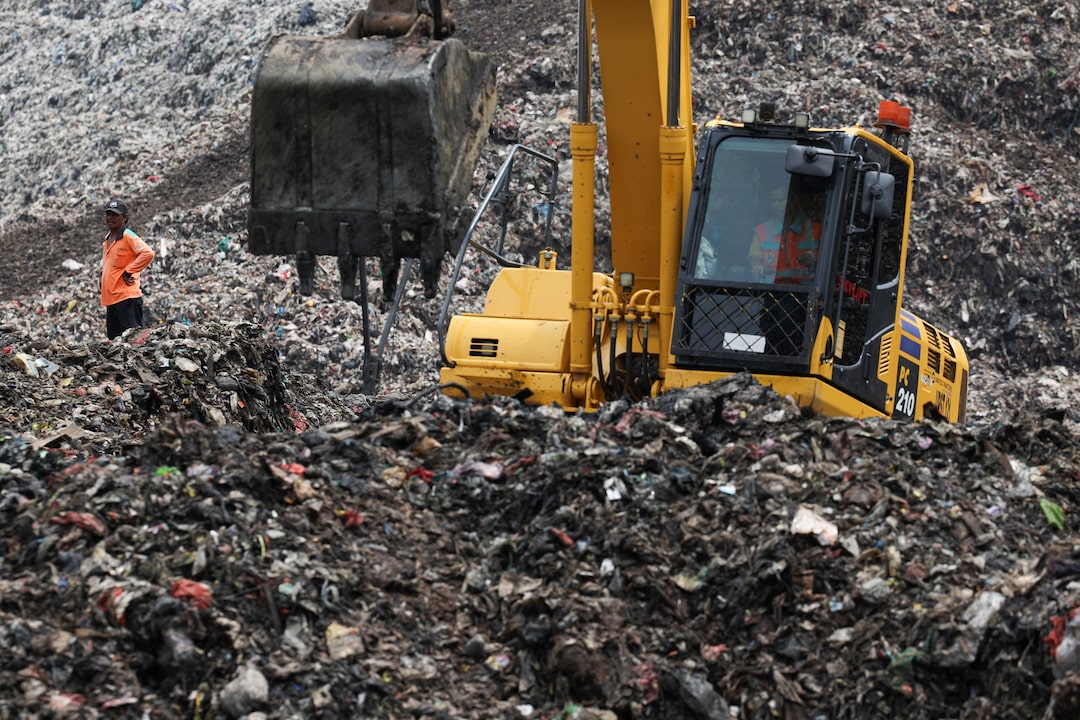
A garbage avalanche at Bantargebang, Indonesia, one of the world’s largest open landfills and the primary waste disposal site for Southeast Asia’s most populous metropolitan area — buried trucks, food stalls, and scavengers under tonnes of unstable refuse on Sunday afternoon, killing four people and leaving five others missing as a 200-strong rescue force including police, military personnel, and 17 excavators worked on Monday to locate survivors under a mountain of waste.
The landslide struck at 2:30 p.m. local time on Sunday at Bantargebang, a landfill just 25 kilometres outside the capital, according to the national search and rescue agency.
Desiana Kartika Bahari, head of the local rescue agency, told Reuters the collapse was most likely triggered by hours of heavy rainfall that had been falling since Saturday evening, destabilising the compacted waste columns that can rise to the height of six-storey buildings in the facility’s most heavily used zones.
“It was raining all day even from Saturday evening and the mountain of garbage was unstable,” Bahari said.
The landslide occurred in Zone 4C of the Jakarta Integrated Waste Treatment Site, in Cikiwul Village, Bantargebang District, Bekasi, West Java. The four confirmed dead were identified as S, aged 60, a coffee vendor; EW, aged 26, a scavenger; DS, aged 22, a truck driver from Semper Barat, Cilincing, North Jakarta; and IS, aged 40, also a truck driver.
The Tempo publication had initially reported three confirmed dead based on the names given by rescue agency head Desiana on Sunday — food stall owners Enda Widayanti and Sumine and truck driver Dedi Sutrisno — before a fourth victim was confirmed by Monday morning as excavation reached previously inaccessible parts of Zone 4C. A security guard on patrol near a coffee shop first discovered the landslide, heard shouts about the collapse, and observed a large pile of garbage fall across the road, covering the shop and nearby trucks. He immediately alerted emergency services through the landfill’s internal security communication channel.
Read Also: Indonesia Prepares Troop For Possible Gaza Deployment
Police estimated that around ten people were affected in total, with five being truck drivers and five being local scavengers. Bahari confirmed that five people remained missing as of Monday morning — specifically truck drivers who had been unloading garbage at the time of the collapse, and scavengers working the tip face, many of whom work informal shifts with no official record of their presence at the site on any given day.
The absence of formal registration systems for scavengers means the true number of people buried in the waste cannot be determined with certainty, a fact that complicates both the rescue operation and any eventual accounting of the disaster’s total human cost. Four people were confirmed to have survived the collapse.
The national search and rescue agency said rescuers were opening access using heavy equipment including backhoes and deploying tracking dogs to search for any indication of victims.
More than 200 rescuers, including police and military personnel and 17 excavators, were deployed since Monday morning to search for the missing. The scale of the mobilisation reflected both the urgency of the search and the extreme difficulty of operating within an active landfill: excavators must work carefully to avoid compressing waste further onto potential survivors, tracking dogs struggle with the overwhelming olfactory environment of a site receiving thousands of tonnes of organic waste daily, and the terrain shifts constantly as waste from different decomposition stages interacts with rainwater infiltration.
Bekasi Mayor Tri Adhianto Tjahyono visited the site and pledged full cooperation with Jakarta authorities in the rescue and recovery operation.
Hanif, a local official who visited the site Sunday night, told broadcaster Kompas TV that Jakarta’s city administration bore primary responsibility for the disaster. “Bantargebang belongs to the Jakarta administration, so they have to take responsibility. This incident must truly serve as a bitter lesson for us so that Jakarta can promptly make improvements,” he said.
Read Also: Indonesia To Repatriate 3,600 Citizens From Cambodia
The Jakarta environmental agency did not immediately respond to requests for comment. Jakarta Governor Pramono Anung had previously inspected the Bantargebang site alongside the Bekasi Mayor in a routine governance review visit — an inspection that did not produce any publicly announced structural safety measures before Sunday’s collapse.
Jakarta and its satellite cities, collectively known as Jabodetabek, are home to about 42 million people and generate an estimated 14,000 tonnes of waste daily. Bantargebang absorbs between 6,500 and 7,000 tonnes of that daily volume from Jakarta alone, a figure that has grown steadily as the metropolitan population expanded through decades of rural-to-urban migration.
The site, which opened in 1989, was designed for a fraction of its current intake and has been operating well beyond its design parameters for most of the past decade. The waste columns that collapsed on Sunday had been accumulating for years without the engineered slope stabilisation, drainage, and gas venting infrastructure that modern engineered landfills require. Sunday was not the first collapse at Bantargebang — previous incidents in 2012 and 2017 also buried workers, though with fewer fatalities — and each previous event produced official promises of structural improvement that were never fully implemented.
President Prabowo Subianto said last month that most of Indonesia’s landfills, which are being gradually phased out, would exceed their capacity by 2028.
The government planned to invest $3.5 billion in a project to build 34 waste-to-energy sites within two years that would incinerate garbage to produce electricity.
The waste-to-energy programme, if fully executed, would represent Indonesia’s most significant transformation of its solid waste management infrastructure since independence, but its two-year timeline was already being questioned by environmental engineers who noted that 34 large-scale incineration facilities could not realistically be designed, permitted, constructed, and commissioned within 24 months.