
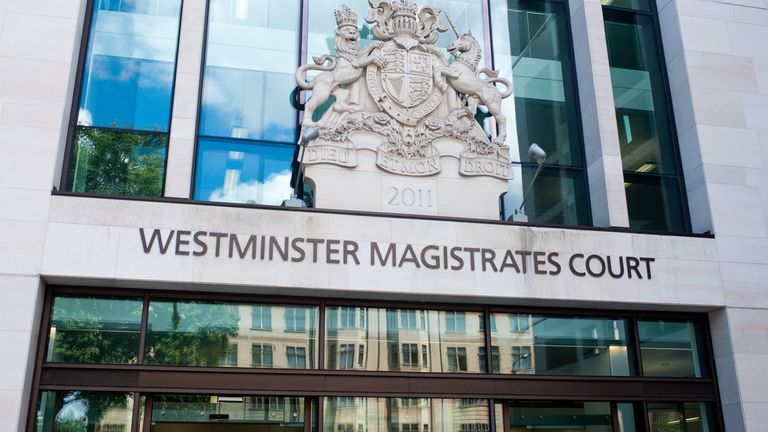
A former officer of Syria’s feared Air Force Intelligence directorate appeared before London’s Westminster Magistrates’ Court on Tuesday charged with three counts of murder as a crime against humanity and three counts of torture, the first time Britain’s Crown Prosecution Service has ever brought charges of murder as a crime against humanity, opening a legal front against perpetrators of the Assad regime’s 2011 crackdown that European courts had pioneered but British courts had not previously entered.
The 58-year-old man, who now lives in the United Kingdom, was charged in relation to his time working in the Syrian Air Force Intelligence department in Damascus. It is alleged that in his role, he led a group tasked with quelling demonstrations in the suburbs of Damascus.
Two of the killings occurred on April 22, 2011, and one in June 2011, according to the charges. He also faces one charge of conduct ancillary to murder as a crime against humanity, and a further three counts of torture relating to incidents at the Information Branch building in Jobar in 2011 and 2012. His lawyers sought a reporting restriction on the publication of his identity at Tuesday’s hearing; Chief Magistrate Paul Goldspring rejected the application but ordered that his address not be made public.
The defendant did not speak during the proceedings, with his lawyer telling the court he was too unwell to confirm his name. He appeared via videolink from his home wearing a breathing apparatus mask due to degenerative motor neurone disease. He will next appear at the Old Bailey on Friday.
The Counter Terrorism Policing War Crimes Team received a referral in November 2020 containing allegations relating to the individual while he was serving as a member of the Syrian armed forces during the early 2010s. On December 1, 2021, officers from the Metropolitan Police’s War Crimes Team visited an address in Buckinghamshire, arrested the man on suspicion of being involved in crimes against humanity, and carried out a search of the property. He was released on bail and remained free during the subsequent investigation, which involved enquiries across many countries and required close cooperation with a number of international partners. He has sought indefinite leave to remain in Britain.
The charges were brought under the International Criminal Court Act 2001 and the Criminal Justice Act 1988. The International Criminal Court Act was enacted to give effect to the Rome Statute and to provide for offences under the domestic law of England and Wales corresponding to offences within the jurisdiction of the International Criminal Court. UK law permits prosecution of serious international crimes, including crimes against humanity and torture, regardless of where they were committed, a legal doctrine known as universal jurisdiction.
The CPS confirmed this was the first time it had invoked that framework to bring charges of murder as a crime against humanity. In 2005, Afghan warlord Faryadi Zardad was convicted by a British court of torture committed in Afghanistan, a precedent the current case extends significantly by adding murder as a crime against humanity to the charge sheet.
Read Also: Syria’s Kurds Warn Iran’s Kurds: Don’t Trust Washington
Most Syrian war crimes cases have proceeded in continental Europe under universal jurisdiction. Anwar Raslan, who led an office in Syrian intelligence Branch 251, received a life sentence in Germany in a landmark 2022 trial.
Last year, Syrian doctor Alaa Mousa, who faced allegations of torturing detainees at military hospitals, was also jailed for life in Germany. Britain’s belated entry into that legal framework reflects a broader shift in how Western governments have responded to demands from Syrian survivors and human rights organizations that perpetrators of the Assad regime’s documented atrocities, including the systematic torture and killing of tens of thousands of detainees evidenced by the Caesar photographs, be held accountable in the courts of the countries where they sought refuge.
The Syrian Air Force Intelligence directorate, known internally as the AFI, was one of the Assad regime’s four main intelligence branches and was considered among the most brutal. It ran its own network of detention centers, operated independently of the civilian justice system, and was used extensively to suppress the pro-democracy demonstrations that erupted across Syria beginning in March 2011.
The Jobar district of eastern Damascus, where the defendant is alleged to have exercised command authority, was one of the earliest and most sustained sites of protest during the uprising’s opening months before it transformed into an armed conflict. Protesters in Jobar were predominantly organized around Friday afternoon prayers, and prosecutors allege the defendant gave orders to open fire on demonstrators during those gatherings.
Read Also: Syria, Saudi Arabia Ink Multibillion-Dollar Investment Pacts
CPS Counter Terrorism Division head Bethan David said her office had concluded there was sufficient evidence to bring the seven charges. Metropolitan Police Commander Helen Flanagan, who leads Counter Terrorism Policing London, described the investigation as “incredibly complex and challenging” and said the UK would not be a safe haven for alleged war criminals.
“The charges are extremely serious and show that we fully support the UK’s ‘no safe haven’ policy in relation to alleged war criminals. Where we are presented with allegations of war crimes and crimes against humanity that fall within our jurisdiction, then, as we have shown here, we will not hesitate to investigate those rigorously and robustly,” Flanagan said. Both the CPS and Metropolitan Police reminded media that proceedings were active and that the defendant retained the right to a fair trial.