
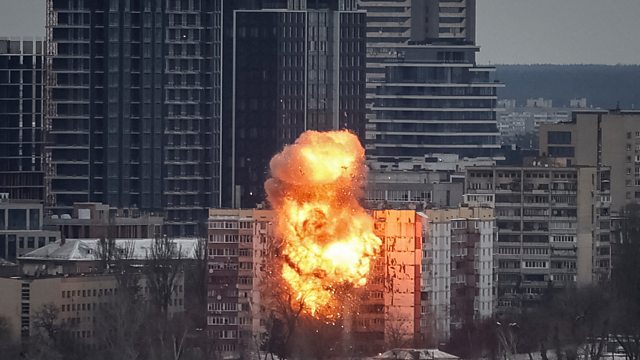
Russian forces launched a large-scale combined missile and drone attack on the Kyiv region in the early hours of Saturday, killing at least four people, wounding fifteen, and leaving tens of thousands of residents without electricity and heating, as Ukrainian President Volodymyr Zelensky boarded a flight to meet US President Donald Trump in Florida on Sunday, a meeting that represents the first direct US-Ukraine contact on ending the war since peace negotiations were suspended by the Middle East conflict.
The attack began shortly after 3 a.m. local time, with explosions heard across the capital as air defence systems engaged incoming ballistic and cruise missiles over the city. Mykola Kalashnyk, head of the Kyiv Oblast Military Administration, confirmed that Russian forces conducted a large-scale attack using drones and missiles, killing two people in the Brovary district and damaging student accommodation, production facilities, and warehouse premises.
The final toll across the four targeted districts of the region rose to four dead and fifteen wounded, with three of the injured in critical condition, two of whom were undergoing surgery, Kalashnyk said in a later statement.
Damage was recorded in the Brovary, Obukhiv, Boryspil, and Vasylkiv districts, encompassing residential buildings, educational institutions, commercial enterprises, and critical infrastructure facilities.
Ukraine’s Air Force reported that Russia deployed Tu-95MS and Tu-160 strategic bombers overnight, launching cruise missiles from the aircraft in combination with Kalibr cruise missiles fired from naval vessels that had entered firing positions in the Black Sea.
Kyiv City Military Administration head Tymur Tkachenko urged residents to remain in shelters until the all-clear was given as ballistic missiles entered the capital’s airspace. In the Zaporizhzhia region, four civilians including two children were injured in separate Russian strikes on residential property, according to the regional governor.
The Russian Defence Ministry said in a statement that it had carried out a “massive strike” using “long-range precision-guided weapons from land, air and sea, including Kinzhal hypersonic aeroballistic missiles” and drones, and said it was targeting energy infrastructure and military-industrial enterprises.
It described the strike as a response to Ukrainian attacks on “civilian objects” inside Russia, a characterisation Ukraine rejected. Poland scrambled fighter jets and temporarily closed airports in Lublin and Rzeszow near the border with Ukraine for several hours as a precaution, though Warsaw confirmed there was no violation of Polish airspace.
The timing of the attack, on the eve of Zelensky’s departure for talks with Trump, gave it an explicitly political dimension that Zelensky characterised bluntly.
“Today Russia demonstrated how it responds to peace talks between Ukraine and the United States on ending Russia’s war against Ukraine. They carried out massive attacks on Ukraine precisely as we move toward peace negotiations,” Zelensky said in an audio note to reporters while travelling. “That is Russia’s response.”
Read Also: Ukraine Strikes Russian Missile Plant With Storm Shadows
Zelensky confirmed he was en route to Florida for a Sunday meeting with Trump, at which he said the two leaders would discuss security guarantees, territorial issues in the Donetsk and Zaporizhzhia regions, and the framework for any eventual ceasefire. The meeting will be the most substantive direct engagement between Kyiv and Washington on the war since the Trump administration’s mediation effort was derailed by the US-Israeli strikes on Iran that began on February 28.
The postponement of scheduled peace talks in the UAE last week, attributed by US officials to the demands of the Middle East conflict, has created a backlog of unresolved issues that Zelensky has publicly described as urgently requiring a US commitment to maintain focus on Ukraine regardless of events in the Gulf.
The energy consequences of Saturday’s attack were significant. In some districts of the Kyiv region there was no electricity or heating in the hours following the strike, with Prime Minister Yulia Svyrydenko saying heat supply would be gradually restored by the end of Saturday. Areas on the left bank of the Dnieper River, where the strikes were concentrated, faced more prolonged outages due to the severity of infrastructure damage. Over ten residential buildings were damaged across the region, with interior ministry teams conducting evacuations from at least one structure where residents were trapped under rubble.
The attack arrived against a backdrop of continuing geopolitical manoeuvring around Ukraine’s position. The United States issued a 30-day waiver on Russian oil sanctions on Thursday — a measure framed as a response to energy supply disruption caused by Iran’s Strait of Hormuz blockade — that Zelensky said on Friday would effectively give Moscow approximately $10 billion in additional war revenue.
Read Also: Zelensky Warns US Russia Oil Waiver Funds War Against Ukraine
“This certainly does not help peace,” Zelensky said at a Paris news conference alongside French President Emmanuel Macron. Germany, the United Kingdom, and five other G7 members publicly expressed disagreement with Washington’s decision, with German Chancellor Friedrich Merz saying six of seven G7 members had told Trump directly that easing Russian oil sanctions “would not send the right signal,” only to learn the waiver had been granted regardless.
Russia’s strategic calculus since the Iran war began has involved neither supporting Tehran militarily nor condemning Washington and Tel Aviv with anything approaching the rhetoric it directed at Western involvement in Ukraine. The Kremlin has instead characterised the US-Israeli campaign against Iran as an example of Western lawlessness while simultaneously positioning Russia as a potential peace interlocutor, a posture that critics say allows Moscow to reap the economic benefits of high oil prices without assuming any of the political or military costs of standing by an ally under attack. Russia’s oil revenue has increased measurably since Brent crude crossed $100 a barrel in the second week of the conflict.
Front-line conditions in Ukraine remained largely static in the period covered by the current reporting cycle, with both the Russian Defence Ministry and Ukraine’s General Staff claiming incremental progress in separate eastern sectors. No confirmed territorial change of significance was recorded. Ukraine’s Foreign Minister Andrii Sybiha called Saturday’s attack “clear evidence that increased sanctions pressure on Moscow is necessary to accelerate the peace process.”
Zelensky’s Sunday meeting with Trump at Mar-a-Lago is expected to cover security guarantees for Ukraine, territorial parameters of any settlement proposal, and the question of continued Western weapons supply amid the competing demands of the Iran conflict and the Gulf states’ drawdown of their own air defence stocks.
No formal ceasefire proposal is known to have been tabled ahead of the meeting.