
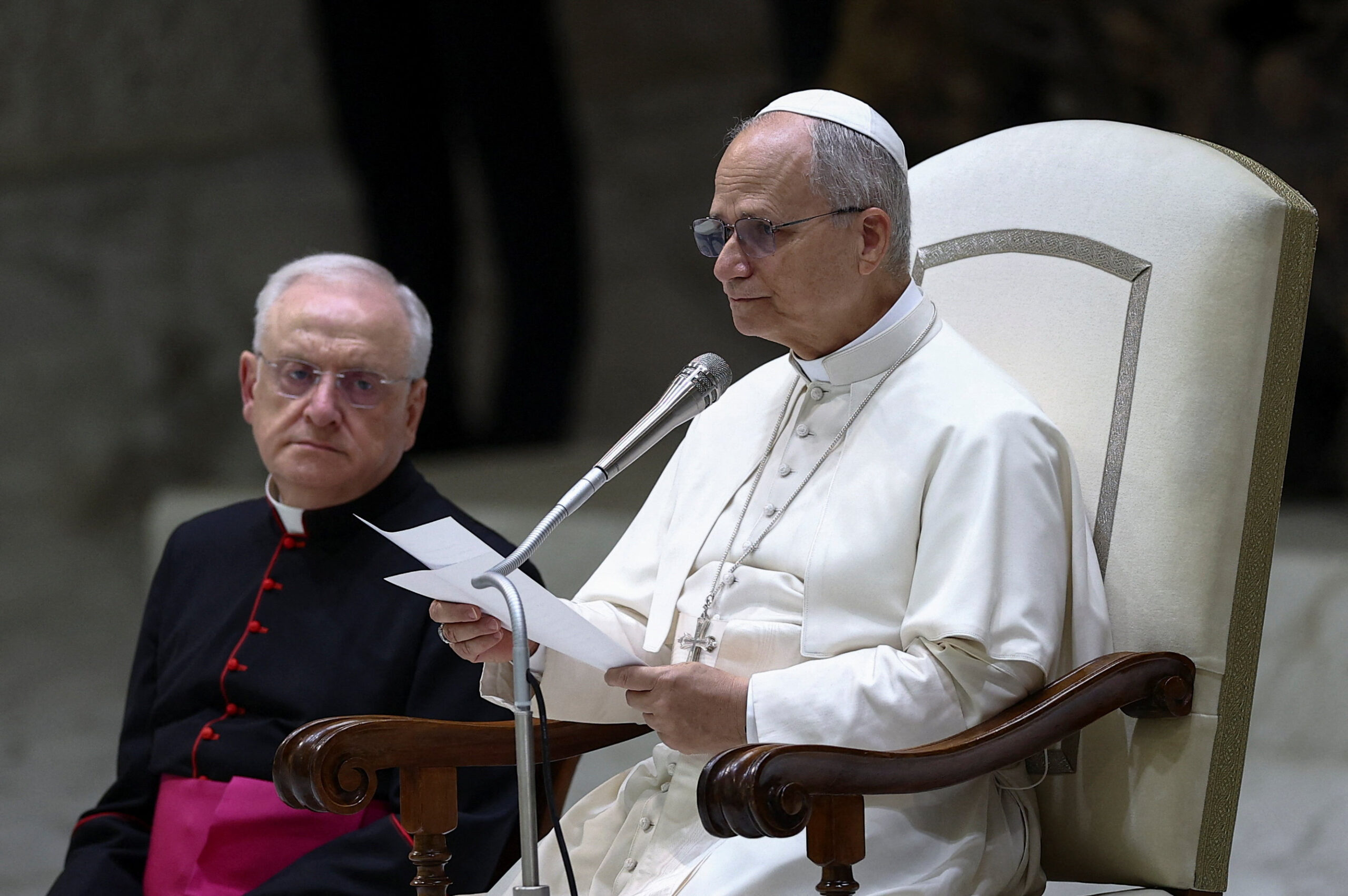
Pope Leo XIV delivered his most direct challenge yet to the architects of the US-Israeli war on Iran on Sunday, using his weekly Angelus address in St Peter’s Square to call explicitly on those responsible for the conflict to order an immediate ceasefire, language that departed from the carefully impersonal framing of his previous appeals and placed moral accountability squarely on the leaders who launched the war sixteen days ago.
“On behalf of the Christians of the Middle East and all women and men of good will, I appeal to those responsible for this conflict,” Leo said from the window of his studio above the square. “Cease fire so that avenues for dialogue may be reopened. Violence can never lead to the justice, stability, and peace that the people are waiting for.”
Leo named no country, government, or individual a restraint consistent with his conduct throughout the conflict. But the phrase “those responsible for this conflict” constituted an escalation in the precision of his language. Previous Angelus addresses had called on “all parties” or appealed to unnamed “leaders.” Sunday’s formulation directed the appeal not at all belligerents symmetrically but at those who bear authorial responsibility for the war’s initiation, a distinction that, in the context of a conflict begun with joint US-Israeli strikes on February 28, could not be read as evenly distributed.
Leo is the first American pope in the Church’s history, born Robert Francis Prevost in Chicago in 1955 and elected to the papacy in November 2024 following the death of Pope Francis. His nationality has given the question of his public statements on the war an unusual domestic resonance inside the United States: the president who ordered the strikes is American; several of his most senior cabinet members, including Vice President JD Vance and Secretary of State Marco Rubio, are practising Catholics. The Pope has declined, throughout the sixteen days of the war, to invoke those relationships explicitly. But the moral and institutional framework he has consistently applied — referencing the Church’s just war tradition through his statements and allowing Cardinal McElroy’s formal judgment that the strikes are “not morally legitimate” to stand unchallenged — has provided context that Vatican observers said made Sunday’s appeal something more than a conventional papal expression of concern.
Read Also: Pope Leo And Vatican Condemn Iran War As Illegal, Urge Dialogue
“For two weeks, the peoples of the Middle East have been suffering the atrocious violence of war,” Leo said. “Thousands of innocent people have been killed, and many more have been forced to leave their homes. I renew my closeness to all those who have lost their loved ones in the attacks.”
The death toll Leo referenced has now reached the low thousands across the conflict zone — more than 1,444 confirmed in Iran, more than 800 in Lebanon, and a growing count in the Gulf states, Israel, and Iraq, with thirteen US service members also killed. The UN has confirmed that more than 3.2 million Iranians have been internally displaced, with Lebanon’s displaced population exceeding 815,000. Those numbers do not encompass the casualties in Gaza and the occupied West Bank, where Israeli operations have continued in parallel, or the workers killed in the Kharg Island, Isfahan, and Shiraz strikes in the days immediately before Sunday’s address.
Leo’s concern for Lebanon was expressed with particular emphasis in the section of his remarks that addressed the country’s bilateral conflict with Israel and Hezbollah.
“The situation in Lebanon is also a cause of great concern,” he said. “I hope for paths of dialogue that can support the country’s authorities in implementing lasting solutions to the serious crisis currently underway, for the common good of all the Lebanese people,” he added, a formulation that acknowledged the Lebanese government’s distinct political position from Hezbollah, and expressed support for Beirut’s sovereign authorities rather than for the conflict’s armed parties.
Read Also: Pope Leo Warns Iran Conflict Could Engulf Lebanon
The reference to Lebanon’s “authorities” rather than to Lebanon as a single entity also reflected the diplomatic reality that Sunday’s reported progress toward direct Israel-Lebanon negotiations in Paris or Cyprus, with Jared Kushner facilitating and Israeli negotiator Ron Dermer leading the Israeli delegation, creates a specific diplomatic architecture that the Pope’s language could, without endorsing any particular party’s position, be seen as encouraging. The Lebanese state’s formal prohibition on Hezbollah’s military activities and its willingness to engage directly with Israel on security arrangements is precisely the kind of state-led process Leo described as capable of producing “lasting solutions.”
The Angelus address is delivered each Sunday from Leo’s studio window above St Peter’s Square, attended by thousands of pilgrims and tourists and broadcast internationally. It is one of the Pope’s most regular and most publicly visible platforms, and its use for direct political appeals is not without precedent, Pope Francis used the same format to appeal for peace in Ukraine on multiple occasions, but its escalating specificity across three consecutive weeks on the Iran war has marked a notable trajectory. Leo’s March 1 address called the world to recognise the possibility of “a tragedy of enormous proportions.” His March 8 address prayed for “the thunderous sound of bombs to cease.” Sunday’s call for those “responsible for this conflict” to order a ceasefire moved the language from prophetic warning to explicit moral demand.
The White House, the office of Vice President Vance, Secretary Rubio, and the Israeli government’s press office had not responded to the Angelus address by the time of publication.