
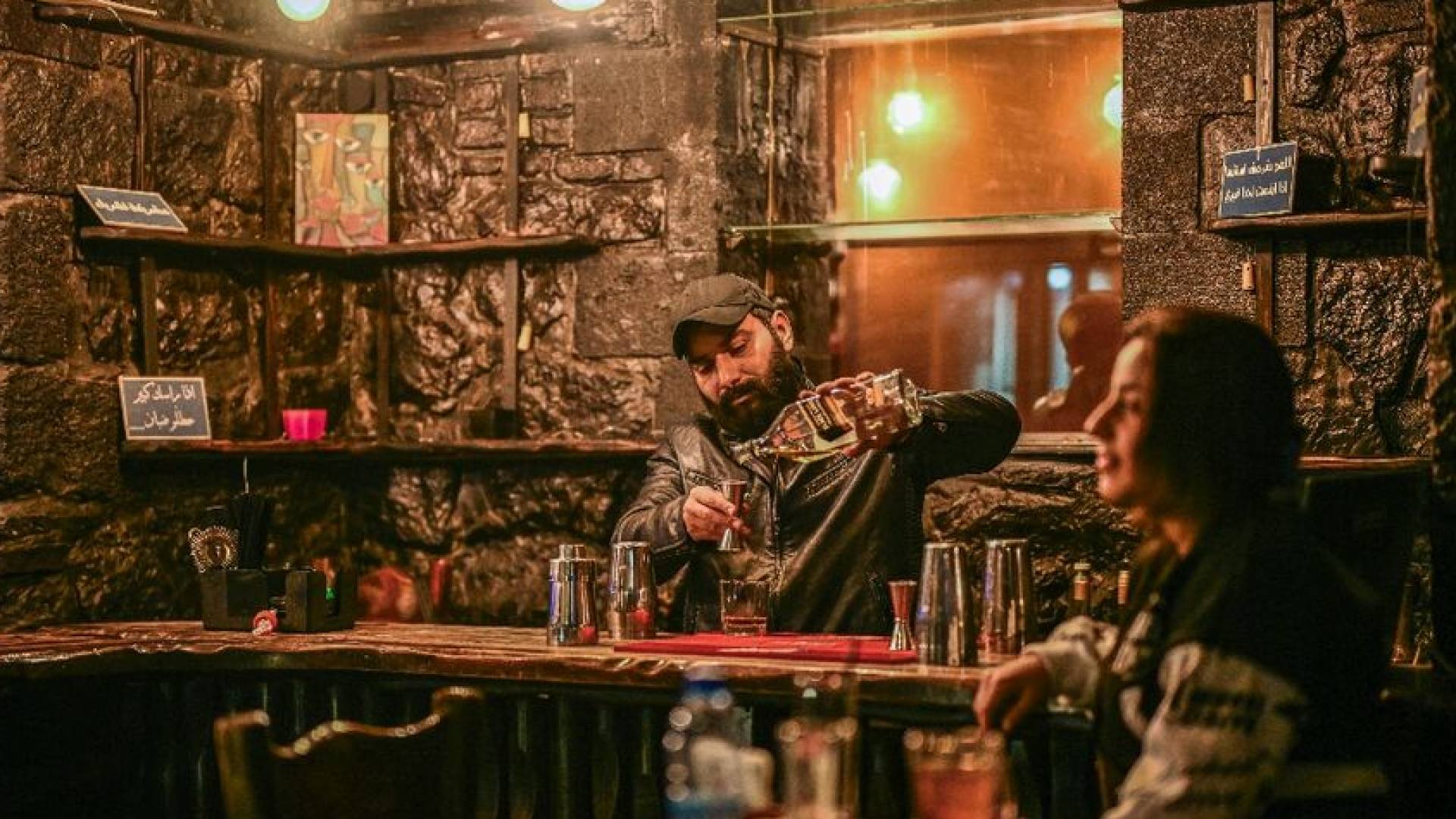
Damascus governorate issued a decree banning the sale of alcohol in restaurants and nightclubs across the Syrian capital, confining legal sales to sealed bottles for takeaway in three predominantly Christian neighborhoods — a more formally codified version of a restriction that the same authorities attempted last March but reversed within 24 hours after protests and a meeting between the governor and bar owners, raising questions about whether this week’s measure will hold.
The decree, issued by the Damascus governorate, stated that “the sale of alcoholic beverages is prohibited in restaurants and nightclubs throughout Damascus,” citing “numerous complaints and at the request of the local community, and with the aim of eliminating practices that violate public morals.” Sales of sealed bottles for takeaway are restricted to the historic Christian neighborhoods of Bab Touma, Qassaa, and Bab Sharqi, and only in establishments designated for the purpose under a commercial building permit. Businesses that continue to sell alcohol must be located at least 75 meters from mosques, churches, schools, and cemeteries, and at least 20 meters from police stations and government offices. Bar and nightclub license holders have been given three months to comply or convert their operating licenses to cafe or restaurant status.
The decree was issued by Maher Idlibi, the governor of Damascus, who served as a leading judicial figure in the Hay’at Tahrir al-Sham-backed Salvation Government in Idlib before the group captured Damascus in December 2024, and who is an in-law of President Ahmed al-Sharaa. The governorate’s decision is a local administrative decree rather than a national law — a distinction that matters to the legal challenge already forming around it.
Mohammad al-Abdullah, director of the Washington-based Syria Justice and Accountability Center, told reporters the decree lacked legal foundation. He said existing Syrian statutes do not prohibit the consumption or sale of alcoholic beverages, and that the decree contradicts Article 12 of the Constitutional Declaration approved by Sharaa last year, which incorporated all human rights treaties Syria had previously signed — several of which protect the right to consume alcohol.
“This is unconstitutional and should be challenged,” al-Abdullah said, arguing that the governorate did not have the authority to impose sectarian distinctions in the application of commercial regulations.
The exemption specifically for Christian neighborhoods drew particularly sharp criticism. Some commentators and rights advocates criticized the exemptions made for Christian neighborhoods as entrenching a sectarian approach to the city’s communities, with secular Muslims as the implicit target of a religious restriction from which their Christian compatriots are specifically exempted. The affected neighborhoods — Bab Touma, Qassaa, and Bab Sharqi in the Old City — are already the primary areas where alcohol is sold in Damascus, and many of the establishments there serve customers of all faiths who drink alongside each other without distinction. The decree effectively formalizes a geographic apartheid in the application of personal liberty based on the predominant religion of a neighborhood rather than the religion of individual customers.
Read Also: UK Charges Syrian Spy With Crimes Against Humanity
The background context is essential. Last March, days before the Eid al-Fitr holiday that marks the end of Ramadan, Damascus authorities launched a campaign that shut approximately ten restaurants and bars in the Old City, threatening over 200 establishments with closure. Bar owners in Bab Sharqi said police and municipality patrols widened their campaign beyond establishments without licenses and that the closures were “an attack on the district’s character” that would harm hundreds of families’ livelihoods.
Within 24 hours, after the Damascus governor met directly with restaurant owners who protested the closures, a second decree was issued ordering the “immediate reopening” of the affected premises. The reversal followed protests and a decision at the meeting between the governor and restaurant owners, with the affected establishments reopening on the same evening.
The current decree — with its three-month compliance window and its more formal legal structure citing specific distances from places of worship and schools — appears designed to avoid the administrative stumble that enabled last year’s reversal. It is not an emergency enforcement action but a formal regulatory instrument, giving it a different character from the 2025 episode. Whether that structural difference translates into sustained implementation or whether it will again be walked back under commercial and civil pressure — particularly with Eid al-Fitr approaching — is the most immediate question the decree raises.
Read Also: Syria’s Kurds Warn Iran’s Kurds: Don’t Trust Washington
The Monday alcohol decree is part of a pattern of conservative social regulation that has accelerated since the start of Ramadan. The arrest of a woman in the Salamiyah area of Hama — a governorate in Syria’s center — for breaking her Ramadan fast early was reported separately this week, with the public prosecutor accusing her of “violating public morals.” Authorities have banned government employees from being photographed with cigarettes in public. In January, female public sector employees were banned from wearing makeup at work. Last year, mandatory full-body swimsuits were required at public beaches.
Sharaa and senior HTS figures are Islamist in orientation, striving for a society whose main source of legislation is Islamic law and jurisprudence. At the same time, Sharaa has been careful in his public statements to offer reassurances to Syria’s religious minorities and secular population. In his address to the United Nations General Assembly last September, he pledged that Syria was “building the institutions of a state governed by the rule of law, guaranteeing rights and freedoms.”
The gap between those assurances and the practical regulatory trajectory of his government’s first 15 months is becoming increasingly visible in the lived experience of Damascenes who drink alcohol, dress informally, or break fast as individuals rather than as members of a religious community.
Syria has a long history of social pluralism by regional standards. Under the Assad dynasty, personal behavior in Damascus, Aleppo, and Latakia — where large Christian, Alawite, and secular Sunni populations concentrated — was relatively unregulated. Alcohol was widely available, mixed-gender socializing in bars and restaurants was normal, and religious minority practices were protected as a matter of both genuine tolerance and Ba’athist political interest. The new government has repeatedly stressed that it will not govern the same way as Assad, but for some Syrians the specific freedoms they valued most were precisely those that HTS’s ideological framework treats as violations of public morals.
The three-month compliance deadline runs to mid-June. No statement has been issued by the Syrian central government confirming or endorsing the Damascus governorate decree.